


Establishing comprehensive and pluralistic paradigm for classical studies
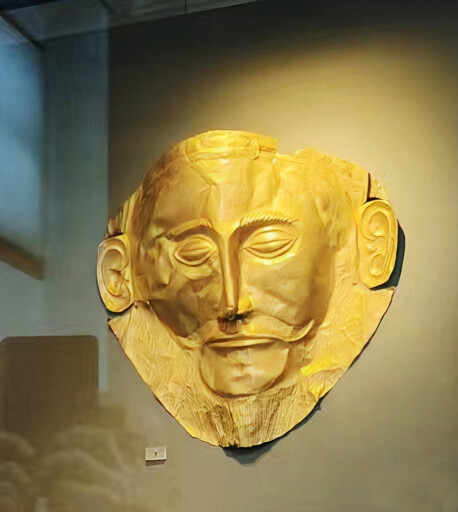
The Mask of Agamemnon, collected at the National Archaeological Museum in Athens, Greece Photo: Yang Xue/CSST

Ioannis M. Konstantakos Photo: PROVIDED TO CSST
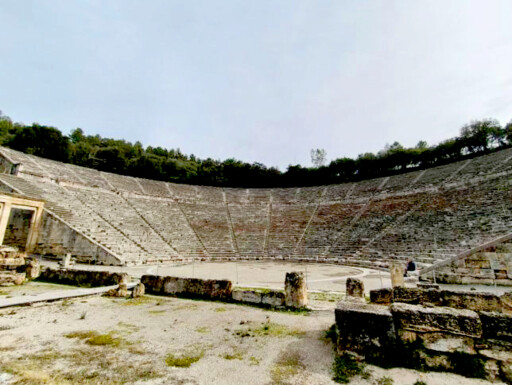
The Ancient Theatre of Epidaurus in the Argolis prefecture of the Peloponnese, Greece Photo: Yang Xue/CSST
Ioannis M. Konstantakos, a professor of ancient Greek literature at the National and Kapodistrian University of Athens, has long approached ancient Greek history and literature through the lens of civilizational exchange. Following the historical trajectory opened by Alexander the Great’s eastward expedition, he turns to legends, myths, and historical records to trace the presence of Greek civilization in the cultures of Asia Minor, Central Asia, and even India, examining how it intersected and interacted with local traditions. Although direct contact between China and Greece was formally established only in the late classical period, or perhaps even during the Byzantine era, Konstantakos notes that comparative scholarship on these two great civilizations has long been highly active in fields such as philosophy and science.
Classical studies should move beyond single perspective
CSST: Western academia has long defined classical studies primarily through ancient Greece and Rome. As interest in global perspectives continues to grow, should the field broaden to include other ancient civilizations, such as China? How might such a shift reshape the scope and methodology of classical studies?
Konstantakos: There is little value in speaking of classical studies in a strictly traditional sense. What we should be studying is the ancient world more broadly—its diverse cultures, their interactions, exchanges, and mutual influences. For a long time, classical studies remained isolated, focused almost exclusively on [ancient] Greece and Rome, often to the exclusion of other ancient civilizations, particularly those of the East.
This began to change in the late 19th and the 20th centuries, especially with the expansion of archaeological discoveries. As our knowledge grew, we gained a deeper understanding of the great civilizations of the ancient Near East and their extensive exchanges with the Greek world. Initially, the influence flowed from the East to Greece, notably through Egypt, the Hittites, and Mesopotamia. Later, with Alexander’s conquests, Greek culture, in turn, left its mark on the East. Over time, scholars increasingly recognized the vast networks of communication and cultural exchange linking Greece, Egypt, and Asia, leading to a fundamental shift in classical studies.
Philology and literary scholarship should follow this shift. It is widely accepted that culture should not be studied in isolation. The only way forward is to examine all ancient cultures together, emphasizing their interconnections. The Greeks were in contact with the broader world from the Mycenaean period through the classical era and later. They interacted with Egypt, Mesopotamia, Syria, Anatolia, Iran and the Persian Empire, and from the Hellenistic period onward, they engaged also with Jewish and Hebrew traditions, as well as Indian thought. Conversely, Greek influence can even be seen in Indian literary traditions, such as in the development of fable collections and Sanskrit epic literature.
However, direct contact between the Greek and Chinese worlds was virtually nonexistent for most of antiquity. It is only in late antiquity or the early Byzantine and medieval periods that we find documented interactions between Greece and China. Nevertheless, this does not mean that comparative studies of the Greek and Chinese cultures cannot yield valuable insights.
This comparative approach is already well-established in the field of philosophy. While there is no direct link between classical Greek and Chinese philosophy, scholars study the two traditions in parallel, examining them as distinct but comparable intellectual phenomena. Both Greek and Chinese thinkers grappled with fundamental questions—ethics, politics, leadership, existence, and the nature of the soul. While their answers differed, comparing these responses can deepen our understanding of how philosophical thought developed in each culture.
Enduring vitality of classical literature
CSST: Your research extensively covers ancient Greek and Roman tragedy and comedy. What accounts for their enduring vitality, and how do their themes continue to resonate with modern audiences?
Konstantakos: Ancient tragedies and comedies, though both foundational to Western theater, are vastly different in their approach and focus. [Ancient] Greek tragedies, at their core, address the most profound human concerns: the inevitability of suffering, the search for meaning in the face of pain, and the complex relationship between fate and free will. These plays tackle existential questions that continue to resonate with audiences today.
In contrast, comedy has a different role in the cultural landscape. It provides an outlet for humor, but also offers incisive social commentary. [Ancient] Greek comedy can be divided into Old Comedy and New Comedy, each with its distinct characteristics. Old Comedy, as exemplified by Aristophanes, is a blend of fantasy, farce, and political satire.
New Comedy, on the other hand, emerged in the late 4th century BCE and shifted its focus from political satire to more domestic, everyday concerns.
What makes both tragedy and comedy so enduring is their ability to transcend their historical context while still engaging with deeply human concerns. [Ancient] Greek and Roman drama are not just reflections of their time but offer insights into the universality of the human experience, making them timeless and relevant to every age.
CSST: Your research also examines the reception of classical texts in both Eastern and Western traditions. Have you encountered any especially striking examples of Greek literature being reinterpreted outside its original context?
Konstantakos: Absolutely. As we have discussed, classical texts are often received and interpreted very differently across cultures and time periods, influenced by local ideologies, identities, and traditions. The way these texts have been reinterpreted sheds light on both the timeless appeal of classical literature and its adaptability to the ever-changing concerns of different societies. Two particularly striking examples come to mind.
One example is Aristophanes, the great Athenian playwright known for his sharp political satire and critiques of the social and political elite. Yet, when we move beyond the context of ancient Athens, Aristophanes has been reinterpreted in strikingly different ways.
The second example is Aristotle’s Poetics, one of the most influential works in the history of Western literary criticism. Originally, Aristotle wrote the Poetics as a practical study of Greek tragedy and dramaturgical practice in his time, analyzing the components of tragic drama and the methods by which his contemporary playwrights crafted their dramatic works. However, during the Renaissance and the age of European Classicism, the Poetics underwent a profound shift in interpretation. What began as a descriptive analysis of the tragedians’ art was transformed into a prescriptive rulebook for how tragedy should be written.
What is particularly fascinating about these re-interpretations is that they speak to the enduring power of classical texts to engage with the human experience. This process of reinterpretation is one of the reasons why classical literature continues to hold such a strong place in our intellectual and cultural life.
Corroboration of myths and folklore in archaeology
CSST: Many folktales blend fiction with history. In your book Legends and Folktales about the Land of Gold, you explore the archaeology of the recurring mythic motif. To what extent can archaeology validate legendary narratives, and when should such stories be understood primarily as cultural expressions?
Konstantakos: Archaeology can illuminate the historical background of myths, but material evidence often diverges from the accounts of mythical imagination or of poetic sources. For instance, excavations have identified various successive strata at the site of ancient Troy, one destroyed by fire, another by a military sack—yet neither perfectly aligns with the Homeric description and the traditional chronology of the Trojan War. In many cases, rather than confirming legends, archaeology raises more questions than it answers.
CSST: Herodotus, often called the “Father of History,” incorporates storytelling and folklore into his accounts. Should his narratives be read primarily as historical records, literary works, or something in between?
Konstantakos: Herodotus’ work functions as both a historical record and a literary composition. The kind of history he wrote differs significantly from modern historiography. Due to the peculiar conditions of his time and culture, he relied heavily on oral accounts, which, as we know, tend to become more fictionalized the longer they are passed down.
A striking example is his record of Egyptian history. When Herodotus traveled to Egypt, he consulted local priests, who recounted to him stories that originated not from historical chronicles but from Egyptian novels and folklore. While these narratives may not be factually accurate, they hold immense value in understanding cultural identity, national character, and societal customs. They also offer insight into universal aspects of human nature across civilizations.
Editor:Yu Hui
Copyright©2023 CSSN All Rights Reserved