


Huangmei Opera culture shines with contemporary brilliance
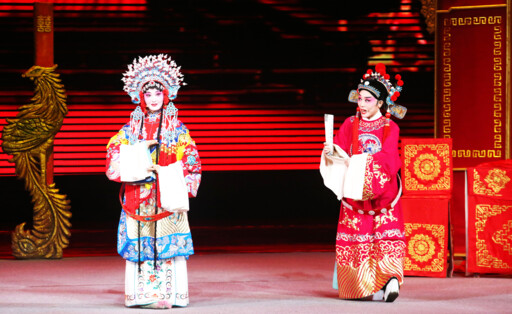
A scene from the signature Huangmei Opera work “The Female Prince Consort,” staged in Xi’an, Shaanxi Province, on Nov. 15, 2025 Photo: IC PHOTO
Huangmei Opera culture is a local operatic tradition centered on the art of Huangmei Opera itself. Its origins, formation, flourishing, and subsequent development together trace a coherent historical trajectory. Compared with many classical opera forms, Huangmei Opera demonstrates distinct contemporaneity and clear artistic strengths, making it the most emblematic cultural form of Anhui Province. It has been nurtured by rich regional culture as well as by the artistic traditions of Hui Tune, Qingyang Tune, and Yuexi High Tune. The Yangtze River’s waterways and polder-based culture have continually fueled its innovation and evolution, while Anqing—once Anhui’s provincial capital and a major political and economic hub—drew Huangmei Opera into deeper engagement with urban civilization. Meanwhile, the growing consumption capacity of the Yangtze River Economic Belt has guaranteed a stable audience base for Huangmei Opera performances.
From the essence of Huangmei Opera itself to its artistic practices, and further to the extended scope of its cultural connotations, this cultural form draws on opera, music, dance, literature, history, sociology, and other fields of study. This integration has enriched the structural layers of Huangmei Opera’s key elements, including its creators, works, narrative subjects, and audiences. As a result, the expressive forms of Huangmei Opera culture transcend the art form itself, acquiring both greater breadth and deeper cultural resonance.
Innovatively developing ‘Liuchi Alley’
In recent years, Huangmei Opera works compiled and staged around “Liuchi Alley,” a story revolving around the namesake valley in Tongcheng, Anqing, have embodied the spirit of creative transformation and innovative development. The well-known story of “Liuchi Alley,” a representative example of neighborhood comity in Tongcheng and in Chinese culture more broadly, embodies a gentlemanly ethos, rigorous family traditions, and a spirit of harmony, whose appeal transcends time and place. Adapting this story to the Huangmei Opera stage is not only an artistic necessity but also a concrete practice of the creative transformation and innovative development of fine traditional Chinese culture. Compiling and creating Huangmei Opera works centered on “Liuchi Alley” thus follows a clear practical logic, articulates a well-defined value orientation, and carries far-reaching contemporary significance.
A substantial body of historical materials relates to “Liuchi Alley” and the “wall-yielding poem,” involving figures and regions across a wide geographic range. Only when the story is situated in its specific context of Tongcheng can the traditional virtue of “emphasizing comity and valuing harmony” be meaningfully applied to the mediation of neighborhood disputes.
The contemporary relevance and exemplary significance of “Liuchi Alley” thus serve as the logical starting point for the continued compilation and performance of “Liuchi Alley”–themed Huangmei Opera works. “Liuchi Alley” itself has become an important subject for new Huangmei Opera productions. Stage plays such as “Ballad of the Pagoda Tree,” “Tongcheng Liuchi Alley,” “Liuchi Alley,” “The Virtuous Minister of the Qing Dynasty,” and “Liuchi Alley·Broadness,” as well as the Huangmei Opera film “Liuchi Alley,” have appeared in succession, recounting the story from multiple perspectives, shaping vivid characters, illustrating approaches to conflict resolution, and highlighting the Chinese nation’s tradition of modesty.
Each Huangmei Opera work centered on the theme of “Liuchi Alley” is grounded in a rich historical context while also reflecting the spirit of its own time. By reinterpreting the ritual order and systems of governance of ancient society, these works address conflicts arising from the tension between reason and law in contemporary life, thereby giving concrete form to the application of ancient wisdom in modern contexts. As a result, they display a higher level of artistic conception, a broader narrative vision, deeper emotional resonance, and clearer internal logic.
Boosting local culture and tourism
In the new era, Huangmei Opera culture is demonstrating enormous potential in driving the development of local tourism economy. This momentum is fueled by the combined effects of technological innovation, the integration of culture and tourism, the Yangtze River National Cultural Park initiative, new urbanization, and comprehensive rural revitalization. As a nationally recognized form of intangible cultural heritage and a major operatic genre that remains vibrant, Huangmei Opera rests on a profound cultural foundation and enjoys a broad popular base.
In recent years, cultural activities centered on Huangmei Opera have become increasingly rich and diverse. The annual China (Anqing) Huangmei Opera Art Festival has emerged as a highly recognizable cultural brand, while Anqing’s “Four Seasons of Opera” Huangmei Opera exhibition, has continued to grow in both scale and influence. Touring performances by opera troupes beyond their home regions remain in high demand; leading performers have gained large followings through livestreaming; and the Anhui China Huangmei Opera Museum has proven highly effective in attracting visitors.
At the same time, cultural enterprises related to Huangmei Opera are steadily breaking new ground. Government procurement, box-office income, guild operations, and festival showcases have together opened multiple pathways for the expansion of the performing arts sector. A creative industry chain is gradually taking shape, encompassing themed cafés and restaurants as well as cultural and creative products that incorporate Huangmei Opera elements. Moreover, immersive site-specific Huangmei Opera performances in tourist destinations, AIGC-enabled short opera productions, and interactive “digital avatars” of Huangmei Opera are injecting fresh momentum into the integration of Huangmei Opera culture and tourism, effectively propelling the sector toward new heights.
Going forward
To further advance the integrated development of Huangmei Opera culture and tourism, priority should be given to refining the art form’s internal symbolic system and shaping distinctive cultural icons. “The Fairy Couple” and “The Female Prince Consort” may be regarded as signature works of the genre. As the most classic Huangmei Opera piece, “The Fairy Couple” recounts a legendary love story in which the Seventh Fairy Maiden secretly descends to the mortal world, marries the impoverished farmer Dong Yong, and weaves brocade overnight to repay his debts. “The Female Prince Consort” tells the story of Feng Suzhen, a clever and resolute young woman who disguises herself as a man to sit for the Imperial Examinations in order to save her beloved, ultimately overcoming adversity and achieving a happy union.
Dong Yong, the Seventh Fairy Maiden, and Feng Suzhen have become iconic character images in Huangmei Opera, while Wang Shaofang and Yan Fengying stand as representative performers of the genre. Further refining these symbols across repertoire, music, roles, and performers can enhance the opera’s public recognition and strengthen the distinctiveness of Huangmei Opera–based cultural tourism.
The second task is to strengthen festival branding and increase the density of distinctive cultural tourism offerings. Major traditional festivals and commemorative days—such as the Spring Festival, Lantern Festival, Dragon Boat Festival, Mid-Autumn Festival, Double Ninth Festival, and National Day—should be firmly established as “festivals with opera,” with regular Huangmei Opera performances integrated into their programming. At the same time, a sustained “going global” strategy should be pursued to expand the international reach of leading Huangmei Opera festival brands and move toward the goal of “opera everywhere.”
Finally, technology-driven empowerment and diversified innovation are essential to nurturing new forms of Huangmei Opera–based cultural tourism. Initiatives such as the digital restoration of historic opera stages, the development of audiovisual archives, the production of Huangmei Opera animations, and the application of Huangmei Opera–themed visual art remain at an early stage and urgently require greater industrial investment. At present, the most pressing priority is to cultivate specialized talent for Huangmei Opera cultural tourism in order to improve the quality of distinctive services.
Han Zaifen is vice chairperson of the China Theatre Association and dean of academic affairs of the School of Huangmei Opera at Anqing Normal University. Ye Dangqian is a research fellow from the institute for Huangmei Opera culture at Anqing Normal University.
Copyright©2023 CSSN All Rights Reserved