


Beauty of Spring Festival resonates with world
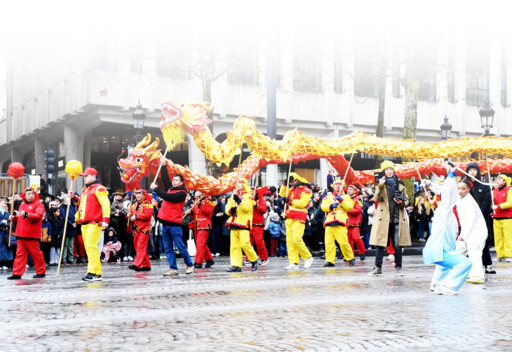
Dragon dance and martial arts performance during a Spring Festival parade at the Champs Elysees in Paris on Feb. 1, 2026 Photo: IC PHOTO
As the most important festival for the Chinese people, the Spring Festival, or the Chinese New Year, has embodied a rich and deeply rooted aesthetic tradition since ancient times. It fosters cultural sharing through aesthetic identity and has gradually evolved into a cultural symbol cherished by the entire Chinese nation. Having been inscribed on the UNESCO Representative List of the Intangible Cultural Heritage of Humanity, the Spring Festival is now celebrated around the world in the spirit of “appreciating the beauty of each civilization and the diversity of civilizations,” emerging as a prominent and distinctive global phenomenon of festive aesthetics.
As living aesthetic phenomenon
The Spring Festival is both a living social practice and a living aesthetic phenomenon. An aesthetic perspective sheds light on Chinese people’s enduring attachment to family-centered New Year celebrations, their devotion to the pursuit of nianwei (the “flavor” or atmosphere of the New Year), and their active participation in a rich array of aesthetic and cultural practices. The Spring Festival serves not merely as a temporal and spatial stage for the flourishing of diverse forms of folk art, but also as an aesthetic object in its own right.
Taken together, these practices and perceptions give the Spring Festival the character of a stable aesthetic system. Centered on New Year’s Eve and New Year’s Day, it establishes a ritualized and enduring festive structure. As early as the Eastern Han Dynasty (25–220), Simin Yueling (Monthly Instructions for the Four Classes of People) recorded some of China’s earliest New Year rituals, many of which—such as ancestor worship, reunion dinners, and New Year greetings—have continued for nearly two millennia.
In this sense, the Spring Festival constitutes both one of the most stable ritual frameworks and one of the most ancient and persistent aesthetic frameworks. It accommodates folk recreation, opera, poetry, performance, handicrafts, and oral literature, collectively displaying the aesthetic creativity of the entire population. Aesthetic preferences and aspirations are projected onto the Spring Festival, producing comprehensive aesthetic experiences that transcend everyday life.
Over time, the Spring Festival has given rise to a holistic aesthetic framework centered on “bidding farewell to the old and welcoming the new,” structured by the temporal rhythm of the festival and the spatial setting of the family, oriented toward reunion and auspiciousness, and integrating multisensory experiences of sight, taste, hearing, and touch. Through this framework, the Spring Festival articulates Chinese aesthetic ideals concerning the relationships among individuals, between people and society, and between humanity and nature.
The Spring Festival also embraces a wide range of aesthetic activities. Its aesthetic nature is most vividly expressed through diverse practices with deep cultural connotations and distinct social functions. As the saying goes, “Once Laba [the eighth day of the 12th lunar month] passes, the New Year begins.” From the 12th lunar month onward, a sequence of colorful aesthetic activities unfolds, including offering sacrifices to the Kitchen God, pasting door guardians, hanging lanterns, performing dragon and lion dances, yangge dances, shehuo folk performances, and lantern festivals.
Across China, nearly every region has developed Spring Festival customs with distinctive local characteristics. In Jixi, Anhui Province, for example, rituals such as community shrine worship, and swing and float pageants play a pivotal role in shaping rural cultural identity through artistic expression.
What gives the Spring Festival its distinctive appeal is the aesthetic atmosphere known as nianwei. The festival’s beauty resides less in any single custom than in this shared ambience, which permeates the experience of the New Year as a whole. At its core, nianwei denotes an integrated sense of atmosphere rooted in a specific time and space—a psychological and emotional experience grounded in bodily perception.
From the perspective of atmosphere aesthetics, the significance of the Spring Festival therefore lies not only in particular practices, but in the underlying ambience that sustains them. This atmosphere—spiritual, aesthetic, and conceptual in nature—has taken shape as a shared cultural tradition. Preserving the Spring Festival as a living heritage thus requires attention not merely to individual customs, but to the aesthetic spirit embodied in nianwei. This is especially relevant in the digital era, when many New Year practices are undergoing rapid transformation.
As cultural symbol of Chinese nation
The Spring Festival is not only a shared aesthetic tradition among the Chinese people, but also an aesthetic symbol cherished by the entire Chinese nation. Its status as a shared cultural symbol is closely tied to the aesthetic identity it fosters.
Cultural sharing of the Spring Festival is, in essence, a form of cultural identification. Generally, cultural identity formation rests on three pillars: shared historical and cultural heritage, collective memory, and long-formed aesthetic sensibilities. Within this process, cultural identity and aesthetic identity are closely intertwined: Long-accumulated cultural values inform and determine aesthetic preferences, while aesthetic identity—through concrete and perceptible symbolic images—strengthens cultural identification, evokes emotional responses, and forges strong and distinct cognitive and affective bonds.
Compared with identities grounded in lineage or gender, aesthetic identity carries a degree of inclusiveness and freedom, qualities that make it especially conducive to cross-ethnic and cross-regional cultural sharing and enable it to play an active role in the formation and reinforcement of cultural identity.
Rather than being a single, fixed symbol, the Spring Festival is better understood as a constellation of symbolic forms—spring couplets, dumplings, reunion dinners, lanterns, and dragon and lion dances—whose reception relies on aesthetic arousal, aesthetic acceptance, and aesthetic empathy.
Two conditions are essential for meaningful identification with and sharing of Spring Festival symbols. First, there must be a basic understanding of the cultural meanings embedded in these symbols. Aesthetic forms are accumulations of cultural significance, and the perception of formal beauty often reflects an implicit identification with underlying cultural meanings. Without an understanding of the cultural depth behind symbols such as dumplings or spring couplets, communication remains superficial, and deeper cultural identification is difficult to achieve.
Second, aesthetic activities must be adapted to local conditions in order to achieve local integration. In the context of the Spring Festival’s status as an inscribed item of intangible cultural heritage, activating its cultural spirit requires strengthening localized practices of symbolic sharing. This allows people in different regions to perceive its aesthetic imagery, experience its aesthetic atmosphere, and participate in celebrations through immersive aesthetic encounters. The Qinhuai Lantern Festival in Nanjing, Jiangsu Province, for instance, constructs a festive aesthetic landscape centered on colorful lantern art; Harbin Ice-Snow World in Heilongjiang interprets auspicious Spring Festival symbols through ice and snow sculpture; and the “Intangible Cultural Heritage New Year” events in Dali Old Town, Yunnan, offer hands-on aesthetic experiences such as tie-dyeing. All of these practices embody Spring Festival culture and promote cultural sharing through aesthetic identity.
Aesthetic identification with the Spring Festival helps expand its reach, build a compelling festival-oriented cultural system, foster shared aesthetic feeling among different ethnic groups, and advance the broader circulation of Spring Festival culture. In the new media era, the widespread use of short videos and live streaming has further amplified Spring Festival aesthetics, making hybrid online–offline New Year celebrations increasingly common and reinforcing the sharing of Spring Festival cultural symbols through aesthetic experience.
As shared cultural heritage of humanity
Inscription on the Representative List of the Intangible Cultural Heritage of Humanity has provided a crucial opportunity for the Spring Festival to be shared globally, elevating it from a festival of the Chinese nation to a living heritage appreciated by all humanity. Since its inscription, nearly 200 countries and regions have hosted Spring Festival–related aesthetic activities, including temple fairs, dragon and lion dances, float parades, hanfu experiences, and the illumination of red Chinese decorations, significantly enhancing the festival’s international visibility and cultural influence.
Promoting the dissemination of Spring Festival culture through its prominent aesthetic dimensions makes it easier for people in different cultural contexts to develop an aesthetic affinity with the festival. The Spring Festival has generated a wealth of aesthetic symbols in terms of clothing, food, domestic life, travel, and folk recreation, as well as numerous vivid and engaging activities that respond to the desire, in different cultural contexts, to understand and experience traditional Chinese folk culture. Its global recognition is rooted in this profound aesthetic substance.
Building on this aesthetic identification, aesthetic practices such as lantern festivals, festive cuisine, music, dance, and parades engage sight, sound, taste, and touch, forming an expressive aesthetic language capable of transcending cultural boundaries and enabling broader appreciation of the Spring Festival’s formal beauty. At the same time, aesthetic ideals such as “bidding farewell to the old and welcoming the new,” “family reunion and social harmony,” and “praying for blessings and auspiciousness” provide a shared value framework that supports broader cultural recognition. The core aesthetic of Spring Festival culture centers on harmony, reunion, renewal, and auspiciousness—ideals resonating with widely shared human sensibilities, value pursuits, and cultural norms—providing a basis for cross-cultural dialogue and exchange and evoking strong emotional resonance.
The aesthetic significance of the Spring Festival ultimately lies in its capacity to transcend geographical, political, and ethnic boundaries. As a heritage form endowed with a compelling aesthetic structure and rich in shared spiritual and cultural values, it activates aesthetic perception both within China and beyond. Guided by the ethos of “appreciating the beauty of each civilization and the diversity of civilizations,” the Spring Festival continues to foster global cultural sharing as a living heritage.
Ji Zhongyang is a professor from the School of Humanities at Southeast University. Zhang Na is an associate professor from the College of Humanities and Social Development at Nanjing Agricultural University.
Editor:yu-hui
Copyright©2023 CSSN All Rights Reserved