


Chinese postal culture evolves in rhythm with nation’s trajectory
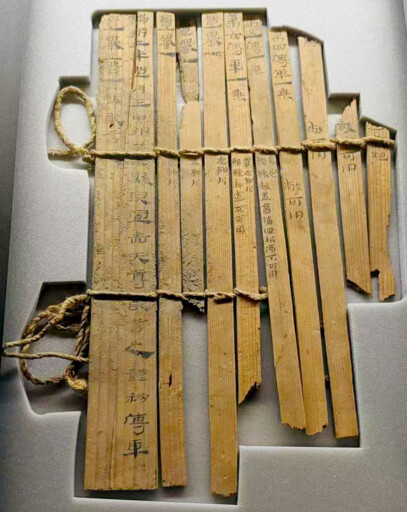
Slips unearthed from the archaeological site of Xuanquanzhi, a Han-Dynasty post office in today’s Dunhuang, Gansu Province, on display at the National Art Museum of China in June 2025 Photo: Rong Zhi/CSST
As a vital medium of communication and connection in human civilization, postal services have long evolved in tandem with national governance, social transformation, and cultural integration. The history of China’s postal system stretches back thousands of years—from the rudimentary courier network of antiquity, through the institutional transformation of the modern era, to its standardized development in contemporary times. Each stage bears the imprint of its age and accumulates rich cultural significance. Along the winding postal routes, the circulation of information and goods has long been intertwined with a persistent mission of sustaining national unity and fostering exchange among diverse communities.
Key link in national governance
The origins of China’s postal system can be traced to the courier network of the pre-Qin era (prior to 221 BCE), whose emergence was closely tied to the practical needs of state governance, serving as a crucial link between central authority and local administration.
During the Xia (c. 21st century–16th century BCE) and Shang (c. 16th century–1046 BCE) dynasties, as early state structures began to take shape, primitive communication nodes such as chuan (passing on) and ju (expediting) appeared, transmitting information through relay methods and forming the earliest prototypes of courier systems.
By the Western Zhou Dynasty (1046–771 BCE), the system had developed further, with improvements in road networks, relay stations and lodgings, and dedicated officials, laying the groundwork for more formalized postal institutions in later periods. At this stage, the courier network primarily served the royal court and feudal lords, conveying administrative orders, military intelligence, and supplies. Operations relied mainly on foot messengers, supplemented by horse-drawn carriages, and remained largely confined to core regions under centralized rule.
In the Qin (221–206 BCE) and Han (206 BCE–220 CE) dynasties, increasing power centralization drove the system toward maturity. Following the unification of the six states, Emperor Qin Shi Huang’s standardization policies—standardizing the written script and unifying the gauges of carts and chariots—facilitated the construction of a nationwide courier network, laying the foundation for later institutional uniformity. By the Han Dynasty, a denser and more institutionalized system had taken shape, characterized by the arrangement of “a relay station every 10 li (a unit of distance, approximately 500 meters) and a postal station every 30 li.” These stations were equipped with dedicated couriers, carriages, and horses, substantially improving efficiency while fulfilling multiple functions, including official document delivery, official reception, public security management, and logistics. The Xuanquanzhi archaeological site in Dunhuang, Gansu Province, offers compelling evidence of this system: Bamboo and wooden slips unearthed there record in detail the day-to-day operations of postal stations, attesting to their key role in frontier governance and cross-regional exchange.
During the Sui (581–618) and Tang (618–907) eras, the courier system expanded rapidly. The construction of the Grand Canal during the Sui Dynasty greatly improved north–south connectivity, fostering the development of integrated land-and-water courier networks and significantly increasing the number of relay stations. The Tang court further refined the system by introducing “courier passes” to regulate access to station resources.
The Song Dynasty (960–1279), marked by flourishing commodity trade and growing demand for communication, established the “urgent delivery relay” system. Its highest-tier service, the “golden-tablet urgent relay,” could reportedly cover 400 to 500 li per day, achieving remarkable efficiency in transmitting official documents and military intelligence.
During the Yuan (1271–1368), Ming (1368–1644), and Qing (1644–1911) dynasties, the courier system both inherited earlier frameworks and developed new, contemporary features. The Yuan Dynasty’s vast territory gave rise to the extensive jamuci network—linking European and other Asian regions—facilitating both governance and international exchange. The Ming court reformed the system by tightening resource controls to alleviate fiscal burdens while strengthening administrative oversight to improve efficiency. The early Qing largely followed Ming practices, but in its later years, mounting social tensions, fiscal strain, and the introduction of Western postal systems led to the gradual decline of the traditional courier network, which was ultimately abolished in the early Republic of China period (1912–49).
As the precursor to China’s modern postal services, the ancient courier system consistently adapted to the evolving needs of national governance. It ensured the stable functioning of premodern society while facilitating cultural dissemination and interethnic exchange, laying a durable foundation for the development of postal culture.
Integration of traditional, modern practices
From the mid-19th century onward, modern postal services began to emerge and take shape. This transition reflected both the collision and the gradual integration of traditional courier practices with modern postal institutions—a process that mirrored the broader, often arduous transformation of Chinese society from tradition to modernity.
Following the Opium Wars, Western powers established “guest post offices” in China under unequal treaties, monopolizing international postal services while introducing modern institutional practices. In 1866, the Qing customs administration initiated a trial postal service, marking a key step toward the institutionalization of China’s modern postal system. The issuance of the “Large Dragon Stamps” in 1878 became an important milestone.
Drawing on Western models, the customs postal system introduced uniform postage, registration, and insured mail, and adopted stamps as proof of payment, thereby acquiring the core features of a modern postal system. In 1896, the Qing court formally established an official post office, elevating three decades of experimental practice into a legally recognized system.
Yet the nascent postal service faced considerable challenges, operating under pressure from foreign-run “guest post offices,” as well as from the continued presence of the traditional courier system and private communication networks such as minxin ju (private letter offices).
After the Revolution of 1911, the Chinese postal system made progress in unified administration and service expansion. Through diplomatic efforts following World War I and during the Washington Conference, China succeeded—except in areas where Japan retained control—in abolishing foreign postal operations on its territory, thereby recovering most of its postal sovereignty. The network subsequently expanded, and services diversified from traditional mail to include parcels, remittances, and newspaper distribution, significantly enhancing its social functions.
Following the outbreak of the War of Resistance Against Japanese Aggression, the nationwide postal system suffered severe disruption. In Communist Party of China-led base areas, however, an independent wartime postal network was established to maintain communication. Postal workers operated under extremely difficult conditions, undertaking multiple tasks such as delivering official documents for the Party, government, and military, distributing newspapers and public letters, transporting supplies, and even escorting cadres. This experience fostered a “wartime postal spirit” defined by “unwavering loyalty and devotion to mission.” During the Liberation War, postal services in liberated areas were further developed and integrated, providing vital communication support.
Over the course of this transformation, China’s postal system absorbed Western institutional and technological advancements while building on indigenous communication organizations. Adapting to the exigencies of war and other national circumstances, it gradually evolved into a socially oriented service system. In doing so, it assumed the era’s historical mission of safeguarding communication sovereignty and serving national liberation, giving rise to a spirit of responsibility while laying the foundations of a people-centered postal ethos. These developments constituted a crucial chapter in postal culture bridging the past with the future.
Standardized transformation, cultural innovation
After the founding of the PRC, China’s postal service ushered in a new phase of unified planning and development. The state implemented further integration and comprehensive operational reforms, establishing a unified management system, improving the postal network, broadening service offerings, and promoting the deep integration of postal services with national economic and social development. At the same time, it emphasized the preservation of historical heritage and the contemporary reinterpretation of postal culture, promoting coordinated progress in both institutional development and cultural transmission.
The nationwide postal network was rapidly integrated, with unified standards and pricing systems put in place and administrative structures established from the central to local levels. The main priority was to ensure reliable communication for both the government and the public, with services steadily extending to rural and border regions. Alongside traditional mail, parcel delivery, and remittance services, new functions such as postal savings were introduced, further strengthening the system’s social role.
After reform and opening up, China’s postal service entered a period of accelerated development. Institutional reforms, driven by the establishment of the market economy system, introduced modern corporate management practices that improved both service quality and operational efficiency. In 1998, the separation of postal and telecommunications services marked a turning point, as China Post began operating independently within a market-oriented environment.
Entering the 21st century, rapid advances in information technology have driven the sector to actively embrace digital transformation, enabling deeper integration between traditional services and modern technologies. Throughout this process, sustained attention has been given to cultural heritage preservation and innovation, delving into the contemporary value of ancient courier culture and the wartime postal spirit fostered in modern times. Efforts have included the establishment of postal museums and heritage preservation sites for historic courier routes, the restoration, preservation, and organization of archival materials and artifacts, and the promotion of postal culture through festivals and academic forums. Combining traditional cultural elements with modern design, the sector has also developed distinctive stamps and cultural products, advancing the innovative development of postal heritage.
Across millennia, postal culture has continually renewed itself while maintaining its essential character. From ancient beacon towers and mounted couriers to modern postal workers, and now to digital intelligent networks, the evolution of China’s postal system has remained closely aligned with the nation’s trajectory. Long transcending the mere transmission of information, it has contributed to the shaping of Chinese civilization, the continuity of national vitality, and the development of the economy and society. Its core values—integrity, responsibility, service, and connection—have become deeply embedded in the cultural fabric of the nation.
Qian Long is from Nanjing University of Posts and Telecommunications.
Copyright©2023 CSSN All Rights Reserved