


Ceramics-glass exchange on Silk Road informs civilizational evolution
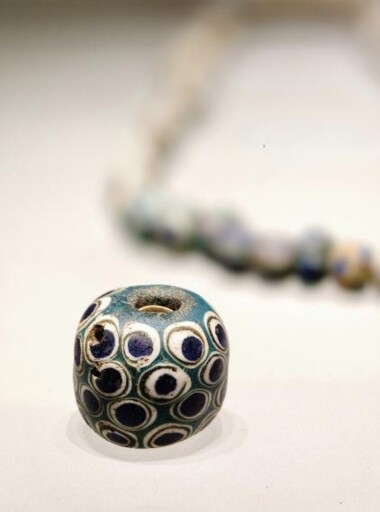
A “dragonfly eye” glass bead from the Warring States Period Photo: PROVIDED TO CSST
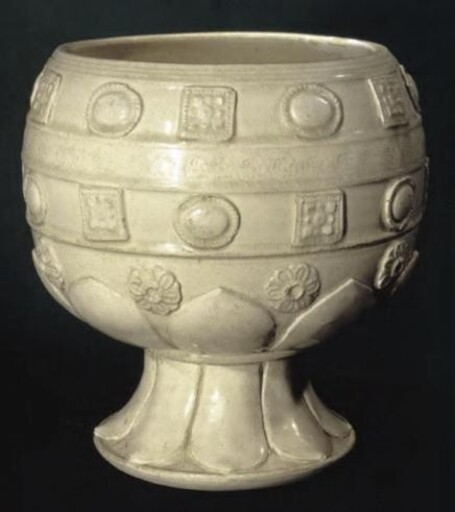
A white-glazed vessel with appliqués from the Tang-Dynasty Gongyi kiln, imitating the shape of Persian bronzeware Photo: PROVIDED TO CSST
Across more than two millennia of exchange along the Silk Road, ceramics and glass—representative carriers of Eastern and Western civilizations—have engaged in a far-reaching dialogue across time and space. Eastern ceramics, with their warm, refined texture shaped by the interplay of earth and water and fixed by fire, embody the philosophical wisdom of “harmony between humanity and nature.” Western glass, by contrast, with its transparency and light-transmitting qualities, formed through molding, articulates a civilizational spirit grounded in rational inquiry. From the more than 60,000 Tang-Dynasty (618–907) ceramic pieces recovered from the Belitung shipwreck to the glass artworks of Murano Island in Venice, preserved for over 700 years, the encounter between these two materials along the Silk Road signifies not merely the circulation of goods, but a deep integration of civilizational values—offering a historical lens for contemporary efforts to foster global dialogue.
Material expression of civilizational traits
Artifacts have never been merely functional; they also constitute the material expression of a civilization’s modes of understanding and its value systems. The differences between ceramics and glass ultimately reflect divergent conceptions of nature, human life, and beauty in Eastern and Western civilizations.
The history of Chinese ceramics is, in essence, a history of practicing the Eastern philosophy of “harmony between humanity and nature.” From the Neolithic period, when early communities expressed reverence for nature through depictions on painted pottery, to the proto-celadon of the Shang (1600–1046 BCE) and Zhou (1046–771 BCE) dynasties—later incorporated into ritual systems under the principle of “governing the state through rites”—and onward to the five major kilns of the Song Dynasty (960–1279) that brought refined culture to its height, the trajectory unfolds across successive eras.
Ming-Dynasty (1368–1644) scholar Song Yingxing observed in Tiangong Kaiwu (The Exploitation of the Works of Nature): “Water and fire achieve harmony, and the earth is transformed.” This formulation captures the essence of ceramic production: Raw materials are drawn from the earth and shaped through the balanced interaction of water and fire, culminating not in mechanical perfection but in a distinctive aesthetic shaped by the contingencies of the kiln. The underlying ethos—following nature, valuing moderation, and seeking harmony—pervades the entire process.
Longquan celadon glazes, as clear as water, convey a sense of depth and translucence. Features such as the “ice crackle” and “hare’s fur” patterns on Song ceramics are not treated as flaws, but as aesthetic effects endowed by natural craftsmanship. The fusion of utility and beauty in ceramics vividly illustrates the notion that “vessels embody the Dao,” whereby objects serve not only practical needs but also carry ritual meaning, aesthetic sensibility, and philosophical reflection.
Western glass developed along a markedly different trajectory. In 1291, the Venetian government relocated glass furnaces to Murano Island, both to reduce fire risks and to preserve specialized techniques. During the Renaissance, Murano artisans brought glassmaking to a high point: Millefiori (thousand-flower) glass produced intricate, flower-like mosaic patterns; reticello (grid-like) embedded fine lattice designs within the material; and filigrana (filigree) achieved delicate decorative effects through the interweaving of glass threads. Artisans mastered the use of minerals and oxides to produce vivid coloration—cobalt yields deep blues, while gold and silver particles create shimmering visual effects.
The production of glass reflects a pursuit of precision and control. Raw materials require purification, processes depend on exact temperature regulation and mechanical principles, and finished products are evaluated according to clarity, uniformity, and flawlessness—demonstrating an orientation toward mastering nature and probing the unknown.
Inter-civilizational dialogue
The movement of artifacts is not a one-way process of export or import, but a form of aesthetic resonance and cultural integration achieved through mutual appreciation and borrowing. The encounter between ceramics and glass along the Silk Road thus constitutes a compelling chapter in the history of inter-civilizational exchange.
By the Tang dynasty, a pattern often summarized as “southern celadon and northern white porcelain” signaled the rise of specialized production and large-scale trade in Chinese ceramics. The Belitung shipwreck, discovered in 1998 off the coast of Indonesia, yielded over 60,000 Tang ceramic pieces. Among them, the “Brown Speckled Porcelain Ewer in Green Glaze with Date Palm Patterns” from the Changsha kiln perfectly exemplifies the fusion of Arabic decorative motifs with Chinese craftsmanship, offering concrete evidence of mutual civilizational learning through customized export. These ceramics traveled along the Maritime Silk Road to Persia, the Arab world, and East Africa, disseminating Eastern aesthetic sensibilities and ritual practices to distant lands. By the Yuan Dynasty (1271–1368), Jingdezhen blue-and-white porcelain had become a widely circulated medium of global trade.
Archaeological findings indicate that the eastward transmission of glass likewise introduced new elements into Chinese civilization. “Dragonfly eye” glass beads from the Warring States Period (475–221 BCE) were exotic imports along the Steppe Silk Road; their “mosaic glass” techniques combined with the lapidary technologies of Central Plains jade to produce distinctive ornaments worn by nobles. At the Tang Dynasty Famen Temple underground palace, Islamic glassware and Yue-kiln “secret color” celadon were discovered together within a single chamber, illustrating the coexistence of different material cultures at the highest levels of society. These glass vessels, with their distinctive aesthetic properties, broadened the aesthetic experiences of people at the time.
On the technological level, Chinese archaeologist An Jiayao, in A Brief History of Glasswares in China, argues that existing archaeological evidence lends stronger support to diffusionist accounts of the origins of Chinese glass. Meanwhile, Peter Frankopan, a senior historian at the University of Oxford, argues in The Silk Roads: A New History of the World that large-scale importation of Chinese ceramics directly influenced local ceramic design and craftsmanship. Such interactions demonstrate that inter-civilizational exchange was not simple imitation, but creative transformation grounded in each civilization’s own cultural traditions.
These patterns of exchange are especially evident in the mutual borrowing of techniques and the blending of aesthetic principles. European artisans undertook a prolonged effort to replicate Chinese porcelain, even producing “glass porcelain” that used opaline glass to imitate ceramic glazes. Only after the Meissen factory in Germany successfully cracked the secret of true porcelain did Europe enter its own era of porcelain production. Ultimately, this long process of material exchange shaped a far-reaching inter-civilizational dialogue.
The rational spirit and scientific values embodied in Western glass, transmitted through optical instruments and experimental apparatus, contributed to shared human pursuits of knowledge and truth across different civilizations. The expansion of the Mongol army in the 13th century promoted connectivity across the Eurasian continent. Artifact exchange along the Silk Road thus went beyond the circulation of commodities, emerging as a dynamic cultural field that carried knowledge, ideas, and aesthetics. In the course of East–West interaction, it revealed a shared human aesthetic consciousness, shaped everyday habits and aesthetic tastes, and fostered a form of cultural dialogue that encompassed knowledge, ideas, beliefs, and aesthetic experience.
Lessons from civilizational dynamics
The history of reciprocal influence between ceramics and glass reveals the underlying mechanisms of civilizational evolution, offering valuable lessons for promoting inter-civilizational dialogue today.
The vitality of civilization lies in openness. Exchange along the Silk Road functioned as an early form of globalization: The export of Tang ceramics benefited from open policies, which in turn stimulated technological innovation. The rise of Jingdezhen and the revival of Venetian glassmaking both attest to the generative power of openness.
Innovation and integration constitute the core mechanisms for maintaining civilizational vitality. The principle that “delicious soup is cooked by combining different ingredients” is exemplified in the mutual learning along the Silk Road. European efforts to imitate Chinese porcelain ultimately led to the development of local industries with distinct characteristics, while Chinese artisans in Jingdezhen incorporated European enamel pigments to create the world-renowned “fencai” (famille rose) porcelain. This perfect fusion of Eastern and Western art, and the ability to absorb external influences while remaining grounded in one’s own traditions, are the keys to civilizational vitality and renewal.
Silk Road remains are also revising our conventional understanding of civilizational exchange, prompting a paradigm shift in the study of civilizational interaction from the “center–periphery” model of one-way diffusion toward a pattern of equal dialogue based on “two-way symbiosis.” Increasing archaeological evidence has steadily challenged earlier assumptions: The coexistence of local glassware and Chinese ceramic fragments at Maritime Silk Road sites, the discovery of coexisting ceramic and glass artifacts at sites across the Middle East, and the joint display of celadon and Persian glassware at the Ardabil Treasure Museum in Iran all testify to the bidirectional flow and equal status of material culture. Production models such as Yuan-Dynasty blue-and-white porcelain dishes—combining Middle Eastern raw materials, Chinese craftsmanship, and Mongol-era markets—further prove that civilizational exchange unfolds through processes in which “all civilizations can appreciate each other’s beauty while valuing their own.”
Ultimately, the exchange of materials and techniques resonates at the spiritual level. The philosophical concept of “flawed beauty” embodied in the “crackle glaze” of Chinese ceramics echoes across time and space, finding an unexpected parallel in the modern pursuit of transparency in glass art. The clarity of glass—symbolizing openness, honesty, and collaboration—is a quality already evident in glassware dating back to the Han Dynasty (206 BCE–220 CE). Today, contemporary artists draw inspiration from this history, developing glazed glass cultural and creative works featuring ice crackle textures. These works retain the transparency of modern glass while endowing it with the temporal textures of Eastern aesthetics, interpreting the civilizational dialogue paradigm of “harmony in diversity.”
Cai Dongwei is an associate professor at East China University of Technology.
Copyright©2023 CSSN All Rights Reserved