


Dining with Yazhang: Reconstructing life, diet of a Shang general
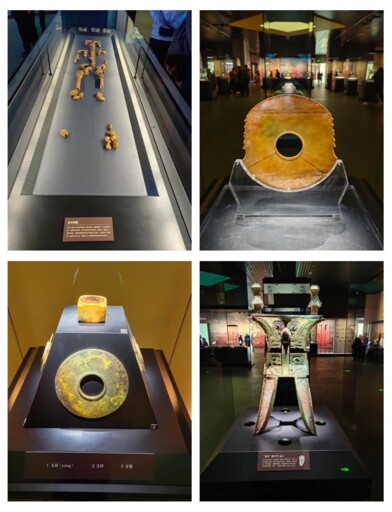
FILE PHOTOS: Archaeological remains from Tomb M54
Just east of Huayuanzhuang Village, next to the Xiaotun palace and ancestral temple complex at the Yin Ruins in Anyang, central China’s Henan Province, lies the tomb of a Shang-Dynasty (1600–1046 BCE) nobleman, sealed underground for more than 3,000 years. Designated M54, the tomb was uncovered during a rescue excavation in the winter of 2000–2001. It yielded more than 570 funerary objects—the largest assemblage found at the Yin Ruins since the discovery of Lady Fu Hao’s tomb. Most of its bronze ritual vessels bear inscriptions reading “Ya Zhang” or simply “Zhang.” “Ya” was the title of a Shang military official, while “Zhang” was the name of a clan. The tomb’s occupant has therefore been identified as a high-ranking commander named Yazhang. From the peppercorns scattered beneath his body and the bronze zun vessels filled with fine wine to the ding cauldrons used to stew meat and the dietary record preserved in his bones, every detail evokes an eternal feast spanning life and death.
A feast for the senses
The Shang people believed that upon death, individuals join the ranks of the ancestors and can safeguard the living, who revered them in turn. Food and wine were offered to ancestors and deities in prayers for protection and blessings. This belief gave rise to elaborate funerary rituals, with food serving as the principal medium connecting the living with the dead and mortals with the gods. Tomb M54 had never been looted, and its exceptional state of preservation offers a rare and remarkably complete picture of Shang aristocratic burial practices.
M54 is a rectangular earthen-pit tomb with a narrow opening and broader base, measuring over 7 meters deep and covering approximately 16.6 square meters. It held both an outer and an inner coffin, and the floor of the inner coffin was covered with cinnabar. Fifteen human sacrificial attendants and 15 dogs were also interred in the tomb. This elaborate arrangement attests to the occupant’s high status in life.
To reconstruct a Shang “banquet,” one must begin by examining the bronze ritual vessels buried with the dead. Each served a distinct purpose, and together they formed a complete dining service. Aristocratic tombs from the Shang and Zhou (1046–256 BCE) dynasties contained clearly defined sets of these vessels. Food vessels—including ding cauldrons, gui containers, li tripods, and yan steamers—held meat and grain. Wine vessels—including jue cups, gu goblets, gong vessels, zun vases, you pitchers, hu flasks, lei jars, and jia tripods—were used to hold and serve wine. Water vessels, including pan basins and he pitchers, were used for washing during banquets. The vessels recovered from Yazhang’s tomb are so varied and numerous that they include nearly every utensil a Shang-Dynasty feast would have required.
The most striking bronze from the tomb is a rare bovine-shaped zun vessel, unparalleled among finds from the Yin Ruins. This exquisite wine container is adorned with over 20 distinct decorative motifs, including dragons, birds, and tigers, combining practical function with extraordinary artistry. It was accompanied by various other wine vessels, including square zun, lei, square jia, and square yi. The prominence of wine vessels in the assemblage is emblematic of Shang bronze ritual culture.
The vessels set the table; music completed the scene. The tomb also yielded three bronze nao bells and a single stone qing chime. Picture Yazhang on such a night more than 3,000 years ago: seated in his place of honor, meat stewing in a ding cauldron before him, foxtail millet heaped in a gui vessel, his jue cup filled with light wine, and behind him, the crisp ring of bronze bells mingling with the resonant notes of the stone chime. It was perhaps as stately a dining scene as any high-ranking Shang commander could have hoped for.
Dietary secrets in the bones
Archaeology now reaches far beyond the study of artifacts. With modern scientific techniques, Yazhang’s life, eating habits, and even his final days can be restored piece by piece. The secrets are written in the bones: Researchers have conducted stable isotope analysis on nine human skeletons from Tomb M54, including Yazhang and several sacrificial attendants and victims.
Staple foods offer a natural starting point for reconstructing their diet. All nine individuals relied primarily on millet, which accounted for more than 90% of their diet—consistent with earlier studies of dietary patterns among residents of the Yin Ruins. Oracle bone inscriptions unearthed at the site frequently record the Shang king’s supervision of grain harvests across the territory, underscoring agriculture’s importance as the economic foundation of the state.
The details, however, reveal meaningful differences. Millet made up roughly 10% less of Yazhang’s diet than it did among the sacrificial attendants and victims. The difference was probably filled by rice, melons, fruit, and other foods, suggesting that higher status brought a more varied staple diet.
Excavators also found several small pottery lei vessels in Tomb M54. The soil inside each had hardened into solid masses, and when broken apart, numerous small fruit pits—identified as plum stones—were revealed. This discovery indicates that the vessels may have contained stewed fruit or similar preparations at the time of the burial, neatly reinforcing the isotope findings.
Differences in staple-food composition were relatively subtle; meat consumption, by contrast, exposed the social hierarchy clearly. The analysis indicates that Yazhang enjoyed the richest diet of anyone in the tomb. His diet was rich in meat, including not only the common domestic animals found at the Yin Ruins—pigs, cattle, and sheep—but possibly also protein-rich wild game or aquatic foods. His table, in short, was far more bountiful than those of ordinary people.
Among the sacrificial attendants and victims, access to meat varied markedly by rank, generally declining with social status—presumably from Yazhang’s concubines to his close associates and guards, and finally to the lowest-ranking servants. The sacrificial victims placed on the tomb’s second-tier ledges consumed dramatically less meat, with isotope values barely above those of herbivores. Plants made up nearly all of their diet, and meat was a rare luxury. These dietary differences closely corresponded to the quantity of grave goods and the victims’ positions within the tomb, turning diet into a biological measure of social rank.
Preservative across millennia
Even the grandest feast must come to an end. Yazhang’s skeleton bears seven traumatic battle wounds—six of which are concentrated on the left side of his body—all inflicted by sharp weapons such as knives or axes. The fatal wound was to his upper left thigh: A bronze spear thrust from behind severed his femoral artery, and he died soon afterward. The fallen general was then transported back to the royal capital and buried with high honors. His military achievements and marital ties to the royal house may explain why his tomb was placed so close to the palace precinct. His body was laid on a bed of peppercorns to preserve it—so many that some of the tiny grains became embedded in his bones. This remains the only known “peppercorn burial” ever discovered at the Yin Ruins.
Why were the peppercorns placed there? The explanation may lie in the violent and tragic circumstances of Yazhang’s death. They may originally have been used to staunch the bleeding and promote wound healing. When he was gravely wounded on the battlefield, his attendants or physicians probably reached for peppercorns—then used both as a spice and a medicinal herb—and applied them to the wound as emergency treatment. Peppercorn pericarps contain abundant volatile oils whose strong aroma naturally repels insects and may also inhibit the growth of bacteria that cause decay. Whether intended or not, the treatment also helped preserve his remains.
The identity of this high-ranking commander is equally intriguing. Examination of his jade objects, together with strontium and oxygen isotope evidence, suggest that he was not born in Anyang but probably came from the southeastern part of present-day Henan. Archaeologists also found a rammed-earth structure above Tomb M54, possibly an offering hall, which would signify the special honor the Shang king bestowed on him.
At banquets in the Shang capital, Yazhang enjoyed delicacies far beyond the reach of ordinary people, with an astonishing variety of ingredients. Millet remained his staple, but rice, fruit, and vegetables made up substantially larger shares of his diet than they did among the general population. Meat and fish were fixtures at his table, and his overall nutritional level surpassed that of everyone else buried in the tomb. Those around him—the sacrificial attendants and victims—received different diets according to their proximity to him, creating a hierarchy mapped through food.
Sealed beneath the loess for more than 3,000 years, Tomb M54 preserved the remnants of an extraordinary feast: Meat had simmered in the ding cauldrons, grain had filled the gui vessels, wine had been poured from the bovine-shaped zun, and bronze bells had rung alongside the resonant notes of a stone chime. Today, these vessels, surviving food remains, and chemical signatures in Yazhang’s bones are bringing more than the banquet back to life. They reveal a man who journeyed from afar, rose to serve the Shang king, enjoyed the privileges of high rank, and died on the battlefield—his story preserved in the food he ate and the feast buried beside him.
Wu Mengyang is an assistant research fellow from the Institute of Archaeology at the Chinese Academy of Social Sciences.
Copyright©2023 CSSN All Rights Reserved