


Under the same moon: Mid-Autumn Festival from antiquity to the present
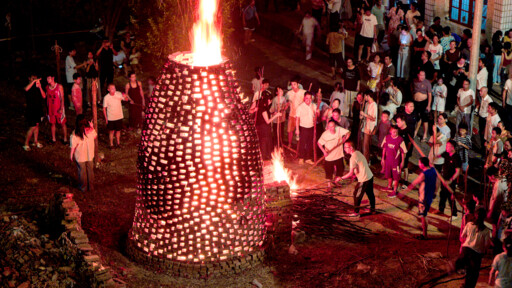
A traditional pagoda-burning activity was held at Baqiu Township, Ji’an, Jiangxi Province on Sept. 25 to celebrate the Mid-Autumn Festival. Photo: VCG
The Mid-Autumn Festival has endured over the centuries and remains an important part of Chinese life today. It carries ideas about the ancient concept of Heaven and humanity, while also embodying rich and vibrant modern values.
Origins
However, Mid-Autumn did not begin as a festival. Chinese folklorist Xiao Fang believes that its cultural origins may be traced back to ancient celestial worship. As early as the pre-Qin period (prior to 221 BCE), there was already a ritual system in which emperors worshiped the sun at the spring equinox and the moon at the autumn equinox. This moon-worship ceremony, which from the Zhou (1046–256 BCE) through the Qin Dynasty (221–206 BCE) belonged exclusively to the royal and imperial house and had little connection with ordinary people, endowed the later Mid-Autumn Festival with an early sense of sacredness. Yet at that time, the bright moon, set high above the realm of kingship and imperial power, was a remote deity rather than an object of popular emotional attachment.
When, then, did the Mid-Autumn Festival take shape? Scholars have long differed on the question. One view holds that it emerged in the Tang Dynasty (618–907), pointing to a large body of poetry and prose showing that by then, men of letters commonly gathered on Mid-Autumn nights to admire the moon, drink wine, and compose verse. This practice of “moon appreciation,” already widespread among the literati, together with the aesthetic sensibility and poetic spirit they brought to the occasion, gave Mid-Autumn night a distinctly festive character, setting it apart from ordinary days.
Other scholars argue that whether something qualifies as a festival should be judged by the extent of popular participation. After examining Tang-Dynasty reference works and miscellaneous writings, they argue that Mid-Autumn at the time was merely an elegant custom among the scholar-official stratum, far from the broadly observed festival it would become in the Song Dynasty (960–1279).
Although opinions differ on the origins of the Mid-Autumn Festival, one point is relatively clear: It was the people of the Tang who brought the bright autumn moon—once reserved exclusively for imperial rituals—down from the altar and into the poetic and wine-fueled revelry of the human world.
Celebration across society
It was the people of the Song Dynasty who truly brought the Mid-Autumn Festival into households across society. Song essayist Meng Yuanlao’s Dreams of Splendor in the Eastern Capital gives a detailed portrayal of the grandeur of Mid-Autumn celebrations in the Northern Song (960–1127) capital of Dongjing (present-day Kaifeng in central China’s Henan Province).
“Before the Mid-Autumn Festival, every shop sold new wine. They redecorated their storefronts with colored towers, flower-topped painted poles, and brocade banners bearing the image of the Drunken Immortal, and townspeople vied with one another to drink. By midday and early afternoon, the wine had been exhausted, and the wine-shop banners were taken down. Crabs had just come onto the market, while pomegranates, quinces, pears, jujubes, chestnuts, grapes, and artificially colored oranges were all newly available. On Mid-Autumn night, wealthy families decorated their terraces and pavilions, while ordinary folk crowded into wine houses to admire the moon, amid the clamor of string and bamboo instruments. Late into the night, residents near the imperial palace could hear the distant strains of the sheng and yu (traditional Chinese wind instruments), seemingly drifting from beyond the clouds. Children in the lanes and alleys played throughout the night, and the bustling night market continued until dawn.”
Wu Zimu’s Dreams of the Past records the festival customs of Hangzhou in the Southern Song (1127–1279) in even more poignant terms: “Even those who lived in humble alleys and were poor and destitute would pawn their clothes to buy wine, forcing themselves to make merry, unwilling to let the day pass in vain.”
That poor families would pawn their clothing for wine yet still insist on celebrating the festival suggests that, for those at the lower reaches of society, such persistence reflected more than the simple enjoyment of a holiday—it was also a tenacious affirmation of life’s meaning. By the Song Dynasty, the Mid-Autumn Festival had thus become a celebration shared across society. More importantly, it was during this period that the moon came to symbolize “reunion” for the first time.
Rich, varied customs
By the Ming (1368–1644) and Qing (1644–1911) dynasties, “reunion” had become the central spiritual theme of the Mid-Autumn Festival. The emotional warmth of family reunion, together with the popular custom of worshipping the moon and praying for blessings, became central to the seasonal aspirations of ordinary people. The Mid-Autumn Festival accordingly came to be known as the “Festival of Reunion” and gradually developed into one of China’s major traditional festivals.
If “reunion” is the soul of the Mid-Autumn Festival, then its rich and varied customs are the many forms through which that spirit has found expression across different times and places.
Offering sacrifices to and worshipping the moon are traditional Mid-Autumn rituals. On Mid-Autumn night, an altar is traditionally set up in the courtyard, with mooncakes, melons, and other fruits laid out as offerings to the moon. In Suzhou, Jiangsu Province, this is called “worshipping the Moon Palace”; in Zhenjiang, also Jiangsu, “thanking for peace”; in Sihui, Guangdong Province, “worshipping the moonlight”; and in Lingtai, Gansu Province, “offering to the moon.”
Family reunion, moon gazing, and eating mooncakes are among the most representative Mid-Autumn customs. Although the term “mooncake” already appeared in the Song Dynasty works Dreams of the Past and Memory of Wulin Hill, it was not until the Ming Dynasty that mooncakes became a food specifically associated with the festival. Description of the Scenery of the Imperial Capital, written in the late Ming, records that mooncakes at the time were “up to two chi (about 64 cm) in diameter” and were divided among the whole family as a symbol of reunion. Today, Mid-Autumn fare extends well beyond mooncakes, with distinctive seasonal foods found across different regions: reunion buns in Shaanxi Province, osmanthus duck in Nanjing, Jiangsu, and crabs in Zhejiang Province, among others.
Regional festival customs are likewise wonderfully diverse. In Beijing, the tradition of inviting “Lord Rabbit” has continued to this day. In 2014, the Lord Rabbit clay figurine was included on the national list of representative intangible cultural heritage items, becoming a cultural symbol unique to Beijing. In Jiangxi Province, Guangdong, and elsewhere, the Mid-Autumn custom of “burning pagodas” remains widespread: Brick-and-tile towers are built and fires lit inside them, symbolizing hopes for prosperity and flourishing life. In Zhejiang, the Qiantang tidal bore is viewed on Mid-Autumn night, while in Hong Kong, a fire dragon dance is performed for three consecutive days.
The Mid-Autumn customs of ethnic minority groups in China are equally distinctive. Among the Miao, the “Moon Dance” is marked by singing and dancing, while Mongolians gallop on horseback in “Chasing the Moon.” The Tibetan follow the water in “Seeking the Moon,” and the Dong hold singing contests in “Strolling Under the Moon.” Together, these rich and varied traditions form a colorful tapestry of Mid-Autumn culture across the Chinese nation.
Institutional arrangements
As the moonlight of a thousand years falls across the calendars of modern life, this traditional festival, rooted in an ancient agrarian culture, continues to offer meanings of its own. One expression of this can be found in a seemingly ordinary institutional arrangement. In 2008, the Mid-Autumn Festival was designated a national statutory holiday, a move carrying significance beyond the holiday itself.
A festival is, in the final analysis, a stretch of time endowed with special meaning. When the ancients laid down their work on Mid-Autumn, worshipped the moon, and reunited with family, they were imbuing this period of time with meaning in their own way. When the state designates this day as a statutory holiday, it affirms ordinary people’s “right to give meaning”—a response to public will and an expression of deep trust.
Today, the festival carries multiple meanings. It is a day for busy travelers to make their way home, for markets to bustle and commerce and tourism to flourish, and for intangible cultural heritage to be passed down through living practice. It is also a time for neighbors to come together, for young people to worship the moon in hanfu and express a new Chinese aesthetic, and for those far from home to look up at the moon and find an outlet for homesickness. It brings together people from different cultural backgrounds through a shared appreciation of the moon. The meanings attached to the festival may differ from those of earlier generations; what matters is that this right to give meaning is itself respected by institutions.
Thus, the ancient festival has taken on new life within the framework of modern institutions. This bright moon illuminates not only China’s ancient past, but also a contemporary China that draws strength from tradition and embraces its cultural confidence.
Hui Jia is from the School of Chinese Language and Literature at the University of Chinese Academy of Social Sciences.
Copyright©2023 CSSN All Rights Reserved