


Mei Baojiu dedicated entire life to preserving Peking Opera’s Mei School
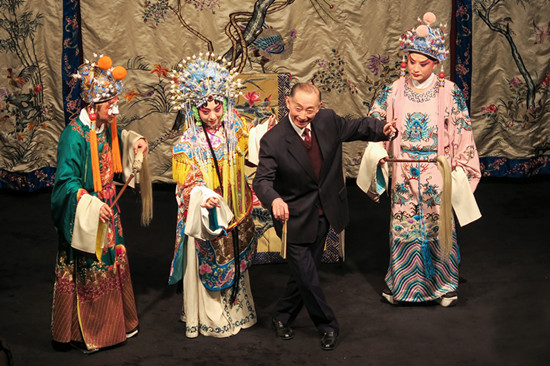
Mei Baojiu taught young Peking Opera artists how to pose at stage in Zhengyici Peking Opera Theatre on March 2016. Mei had rich stage experience and won a reputation both at home and abroad.
Famous Peking Opera artist Mei Baojiu (1934-2016), son of Opera master Mei Lanfang, passed away at age of 82 on April 25, 2016 in Beijing. Both men had been leaders of the Mei School of Peking Opera. Mei was China’s National Intangible Cultural Inheritor and head of the Mei Lanfang Peking Opera Troupe. The death of Mei Baojiu is a great loss to theater circles and the wider community.
Mei Baojiu was born in Shanghai, on March 29, 1934. He played Xue Yi in San Niang Teaches the Child as his first performance on his 10th birthday and started training with famous Peking Opera performers. In 1947, Mei Baojiu, together with his sister Mei Baoyue and famous painted-face role actor Qiu Shengrong, played Er Jin Gong as a church fundraising activity and began to attract attention.
Mei’s journey to the stage began when he started performing with his father. In 1950, Mei and his father performed The Rainbow Pass at a charity benefit for unemployed workers. This performance became a significant milestone in literary and artistic fields. In December of the same year, they shared the stage up to eight times to perform the Kunqu Opera Peony Pavillion, in order to train Baojiu’s Kunqu skills. They also performed Water Fight and The Broken Bridge that same year for Chairman Mao Zedong and other leaders at Huairen Hall in Zhongnanhai.
Mei formally joined the Mei Lanfang Peking Opera Troupe in 1951. After his father died in 1961, Baojiu became the leader of the Mei Lanfang Peking Opera Troupe and inherited his father’s legacy of the Mei School. In 1962, a set of plays were performed in commemoration of the first anniversary of Mei Lanfang’s death in Beijing. Mei Baojiu together with famous master of Peking Opera Tan Fuying performed The Great Enthronement, which was also Tan’s last performance. Later that year, the Mei Lanfang Peking Opera Troupe performed alongside the Beijing Youth Peking Opera Troupe in Shanghai. The performance included Zhao Rongchen, the successor of the Cheng School of Opera, thus bringing together the successors of two of China’s finest opera traditions. The Cheng School was founded by another Peking Opera master Cheng Yanqiu.
In 2009, Mei won the Outstanding Contribution Award at the 30th anniversary of The Beijing Peking Opera Theater. In 2014, the Mei Lanfang Art Research Center was established by the National Academy of Chinese Theatre Arts (NACTA) and Mei News, a journal about Peking Opera, began publication at irregular intervals.
“My father had a desire to publish a journal called Mei News to provide an exchange and learning platform for his more than 100 disciples across the country and the researchers, playgoers, teachers who love the Mei School of Peking Opera,” Mei once said.
A long-awaited book, Collection of Mei Lanfang, might be published in the second half of 2016. Mei Baojiu was excited about the new book, saying “it not only offers first-hand literature to the Mei Lanfang researchers, but also fulfills a long-held dream.” He served as the academic advisor for the book and wrote the preface.
Mei Baojiu was acclaimed and loved for his noble manners, charming personality, profound knowledge and the relentless pursuit of the cause. Maestro Mei Lanfang was one representative of traditional Chinese culture and also a model for Chinese drama, while Mei Baojiu is generally considered the most loyal inheritor of the Mei School of Peking Opera. No one else’s voice was more like Mei Lanfang than that of his son Mei Baojiu in terms of rhythm and spirit, because Baojiu’s vocal production techniques were extremely close to his father’s. Mei Baojiu put beauty into stage movements. Every motion and pose was carefully manipulated, with a sliding scale of vocalization such as expressions of happiness or anger, so his standardized Qingyi performance with classical styles make audiences appreciate the art.
The success of Mei Baojiu was partly due to his hard work and pursuit of a wide range of learning, but also benefited from his optimistic, open-minded and sincere character. Mei trained more than 40 disciples, including brilliant young artist Li Shengsu; Wei Haimin, the top Qingyi performer from Taiwan; Professor Zhang Jing from the NACTA, and Hu Wenge, the only Nandan apprentice. These people all played an active part in the inheritance and development of the art of Peking Opera.
Mei Baojiu was the recipient of numerous accolades. For example, he won the Montblanc de la Culture Arts Patronage Award and received his doctorate from J. F. Oberlin University in Japan. He went to 14 countries to give performances and lectures on Peking Opera, thus furthering its exposure throughout the world. The biggest contribution Mei Baojiu made to Peking Opera was ensuring its status as an item of Intangible Cultural Heritage, demonstrating that he indeed respected the Peking Opera as a quintessential part of Chinese culture. Mei faithfully defended Mei Lanfang’s ideas on Peking Opera reform—stepping but not transfiguring—and applied new meaning to it. His peaceful and natural manner of a rare virtue is closest to aesthetic excellence of traditional humanistic goals, which is also the essence of the Mei School.
Wu Ying is vice chairman of the Mei Lanfang Literature and Art Research Association.
Editor:Yu Hui
Copyright©2023 CSSN All Rights Reserved