


Ritual system as unique hallmark of China’s early state civilization

FILE PHOTO: A Shang Dynasty bronze drum, unearthed in Chongyang, Hubei Province in 1977, collected at the Hubei Provincial Museum
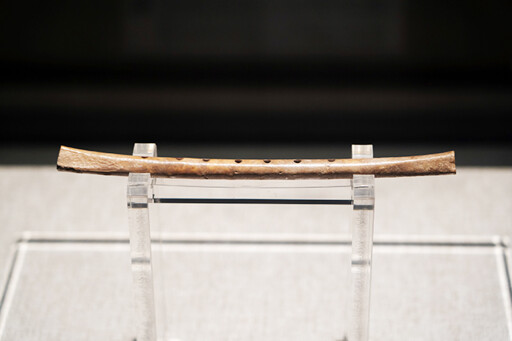
A Neolithic bone flute, dating back to around 8,000 years ago, unearthed in Wuyang, Henan Province in 1987, collected at the Henan Museum Photo: TUCHONG
The origins of Chinese civilization and early states have long been a central concern in scholarly research. Over time, scholars have proposed a range of interpretive frameworks, including the “three indicators of civilization,” the “state formation theory,” and more recent efforts to establish “new indicators for tracing the origins of Chinese civilization.”
Theories of markers of civilizational origin
In 1960, the American anthropologist Clyde Kluckhohn first proposed that if any society bore any two of the following features—a walled city, writing, or a complex ceremonial center—such a society could be considered a civilization. In 1985, Chinese archaeologist Xia Nai advanced the influential “three elements of civilization,” identifying cities, writing systems, and bronze-casting technology as the pivotal archaeological markers. Two years later, Zou Heng explored the origins of Chinese civilization through writing, bronze production and use, and the formation and evolution of cities. In the early 21st century, Zhu Fenghan summarized the four key markers of Shang (c. 16th–11th century BCE) state civilization: the establishment of a capital, the presence of a royal cemetery, the use of bronze for weapons and ritual vessels, and written scripts capable of recording language. Most recently, in 2023, Liu Qingzhu proposed focusing on a single defining feature—cities or capital cities—as the core marker of ancient civilization.
Regarding the “state formation theory,” Engels viewed the state as the embodiment of civilized society, while in China, Wang Zhenzhong was the first to articulate a domestic version of this theory. Su Bingqi argued that the concept of “the origin of civilization” is essentially a concise expression of the “origins of the family, private property, and the state.” Wang Wei and Zhao Hui similarly contended that the emergence of the state is the most fundamental indicator of civilization. In recent years, Wang Wei has put forward a new set of indicators for tracing the origins of Chinese civilization, covering five aspects—capital cities, palaces, large tombs, ritual vessels and systems, and war and violence—and later condensed them into three: the development of production and population growth leading to cities; social division of labor and stratification leading to the appearance of classes; and increasing consolidation of power leading to kingship and states.
Ritual-music system as unique marker
Each of these theories, however, faces limits in its broader applicability. The “three indicators” cannot account for the very different pathways through which civilizations worldwide took shape. The “state formation theory” contains internal paradoxes, and the “new indicators for exploring the origins of Chinese civilization” still leave explanatory gaps. The author agrees that the Xia (c. 21st–16th century BCE), Shang, and Zhou (c. 11th century–256 BCE) dynasties had already entered an early state stage. Even so, a crucial feature shared across these early civilizations deserves particular attention—the establishment of ritual and musical systems.
From the perspective of China’s historical development, the ritual-music system stands out as the defining marker of early state civilization in the three dynasties. It constitutes a core cultural gene of the Chinese nation; it provided the direct source of the Confucian core concept of “ritual” in later periods; and it has long been recognized by outside observers as central to China’s ancient political life. Moreover, the ritual civilization of the Shang and Zhou differs fundamentally from that of ancient Greece, particularly with respect to human-centered versus deity-centered orientations, the primacy of the community versus the individual, and the prioritization of humanistic rather than scientific values. An increasing number of scholars now see the ritual system as the unique hallmark of early Chinese state civilization in the three dynasties. Its immediate driving force lay in ritual and musical activities centered on ancestor worship—a feature that sets early Chinese civilization apart from other ancient civilizational models.
Shang Dynasty enters formative stage of ritual-music system
The Chinese ritual and musical system developed over a long arc, from prehistoric times to the Zhou period. Its evolution may be divided into three stages: the incipient stage, the formative stage, and the mature stage. The middle-to-late Neolithic period and the Xia Dynasty belong to the incipient stage, while the Zhou Dynasty represents the mature phase of the ritual system. Oracle-bone inscriptions provide firm evidence that the Shang Dynasty had already entered the formative stage. This is reflected mainly in two respects: widespread use of ritual and music among upper rulers—the Shang kings and the nobility—and the extensive integration of ritual and music into social life, including ritual learning, ritual-music-assisted divination, rain-praying ceremonies, and ritual accompaniment during feasts.
During sacrificial ceremonies, the Shang king frequently played a leading role in ritual and musical activities. Oracle-bone inscriptions record the king’s inquiries about whether to use instruments such as drums and flutes during grand sacrifices or military reviews. They also document the performance of stone and jade chimes. By the Shang period, musical instruments had already become diverse, with chimes crafted from a variety of materials.
The Shang king also personally led large-scale dances during sacrifices, especially martial dances. Aristocrats took an active part as well. Characters such as “子” (zi) and “子某” (zimou) in oracle-bone inscriptions are widely recognized as references to prominent nobles. Inscriptions show these individuals playing stone chimes, jade chimes, and zithers, and dancing during sacrificial rituals.
The increasing prevalence of ritual and music during the Shang Dynasty is evident in ritual-music learning. Instruction in music during this period encompassed both sacrificial songs and dance, and oracle-bone inscriptions indicate that Shang musical dance was often performed on a grand scale and with direct participation by the ruling class. Inscriptions also mention officials who served simultaneously as instructors and musicians, suggesting the presence of specialized teaching personnel.
This popularization also appeared in the use of ritual music to support divination. Oracle-bone inscriptions show that sacrificial rites were commonly accompanied by music and dance, and officials responsible for specific musical dance forms provided accompaniment during these activities. Ritual and music also played a role in rain-praying ceremonies, as shown by the substantial number of related oracle-bone inscriptions. Ritual accompaniment during feasts further demonstrates the system’s broad application. Taken together, these records indicate that the Shang Dynasty had entered the formative stage of China’s early ritual-music system.
Sacrifice and warfare as direct sources of Shang ritual system
Oracle-bone inscriptions indicate that the Shang ritual-music system was closely tied to sacrifice and warfare—direct forces that shaped its development. The rich ritual-music data recorded in these inscriptions offer vivid clues to the formation of early state civilization.
The origin of the character “Shang” in oracle-bone inscriptions reflects this emphasis. “Shang” referred to a type of musical dance and was closely associated with chimes. It also denoted the sound produced by stone chimes and eventually became the source of the “Shang” tone in the ancient pentatonic musical scale. Numerous musical-dance names in the inscriptions also relate to “Shang.” It was taught, performed, and used to educate aristocratic youths and to appear in public ceremonies—evidence that it was a musical-dance form created and preserved by the Shang people, deeply rooted in their cultural identity.
Oracle-bone inscriptions record a wide variety of musical and dance terms. Shang musical dance had the following features: significant diversity; service to sacrificial rites and warfare; utilitarian purposes; and inclusiveness.
How, then, was early Chinese state civilization established? In the case of early China, sacrifice and warfare were the direct forces that gave rise to the distinctive state civilization of the Shang. These two domains led to the convergence of ritual and music, creating a developmental trajectory clearly distinct from that of other ancient civilizations.
The emergence of the ritual-music system was closely intertwined with sacrificial practice. Oracle-bone inscriptions reveal that the Shang maintained a cyclical sacrificial order for former lords and kings, and that rulers employed multiple types of instruments in combination during sacrificial rites. By this stage, an integrated music-and-dance structure had already taken shape. Sacrificial ceremonies were accompanied by instrumental performance alongside choreographed dance, exhibiting characteristics of music-dance integration.
Warfare was equally integral to the growth of the Shang Dynasty ritual-music system. Inscriptions record that musical rhythms and dance forms were used during military activities to organize troops, instill discipline, heighten morale, and intimidate opponents—imbuing military action with ritualized qualities.
These accounts show that music and dance were not merely embellishments but served practical purposes within military life. By the Shang period, such practices had long surpassed the shamanistic music and dance traditions of earlier societies. Their functions shifted decisively toward sacrificial and military domains, and through sustained cycles of sacrifice and warfare, Shang music and dance gradually evolved from occasional ceremonial acts into fully structured ritual systems. As these practices became increasingly institutionalized, they rose to the level of formal state ceremony, ultimately giving rise to a comparatively mature and well-developed ritual-music system during the Shang Dynasty.
Li Xueshan is a professor from School of History and Culture at Henan Normal University. This article has been edited and excerpted from Social Sciences in China, Issue 11, 2024.
Copyright©2023 CSSN All Rights Reserved