


Unity in diversity cast in gold and silver from Xixia
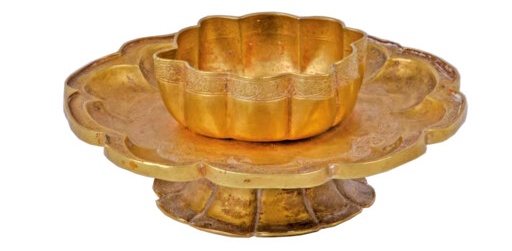
A Xixia gold lotus-shaped cup stand unearthed from an ancient city site in Bayannur, Inner Mongolia Autonomous Region Photo: PROVIDED TO CSST
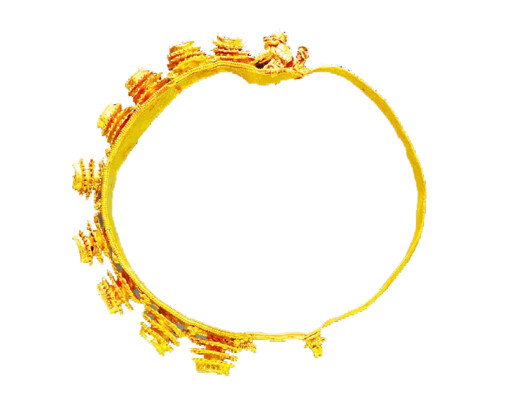
A golden headdress decorated with kalavinka, lotus petal, and pearl roundel patterns unearthed south of the Haibao Pagoda in Yinchuan, Ningxia Hui Autonomous Region Photo: PROVIDED TO CSST
The Liao (907–1125), Song (960–1279), Xixia (1038–1227), and Jin (1115–1234) periods collectively marked a pivotal stage in the formation of the pattern of pluralistic unity of the Chinese nation. Situated along a strategic route of the Silk Road, the Xixia was a melting pot where agricultural and nomadic cultures, Han and Zang traditions, and influences from the Western Regions converged. Through sustained interaction, the Xixia developed material and spiritual cultures marked by a distinctive pluralistic–integrative character, of which gold and silver wares are a prominent expression.
Since the 1950s, a total of 164 Xixia gold and silver artifacts have been unearthed from tombs, hoards, and other archaeological sites in Inner Mongolia Autonomous Region, Ningxia Hui Autonomous Region, Gansu Province, and surrounding areas. As material carriers of multiethnic cultural interaction during the Liao, Song, Xixia, and Jin periods, these artifacts embody profound cultural genes of Chinese civilization. They vividly illustrate its consistency, originality, unity, inclusivity, and peaceful nature, providing invaluable empirical evidence for understanding the evolution of Chinese civilization with unity in diversity.
Rooted in civilizational framework of Chinese culture
To date, 164 physical Xixia gold and silver artifacts have been identified, including 68 gold pieces and 96 silver pieces. Rich in variety, they constitute a complete typological system of Xixia gold and silver wares. Ornaments form the largest category, comprising 14 crown ornaments, 25 hair ornaments, 16 ear ornaments, 1 arm ornament, 2 head ornaments, 19 belt ornaments, 2 silver chrysanthemum ornaments inlaid with turquoise, and 20 gold and silver decorative fittings. Also identified are 2 horse harness fittings and 6 coffin ornaments; tableware such as 7 bowls, 5 alms bowls, 5 stemmed cup sets, and 2 silver chopsticks; religious objects including 2 silver relic caskets and 1 gold statue; daily utilitarian wares such as 1 gold nail cleaner, 4 silver basins, 2 silver yi (ancient water vessels), and 1 silver needle case; currency dominated by 25 silver ingots; and 2 silver tallies.
In addition to unearthed objects, a wide range of gold and silver artifacts are documented in pictorial sources—such as murals in Xixia grottoes and artworks from Khara-Khoto—as well as in historical texts. These sources record crown ornaments, hair ornaments, utensils, sacrificial offerings, and other categories. They include objects originating from the Liao and Song dynasties, such as gold and silver crowns, gold-plated silver belts, and gold-flowered silver caskets, as well as artifacts produced by the Xixia itself, including ornaments, tableware, religious items, daily utilitarian wares, currency, and weapons such as gold knives. Together, these iconographic and textual sources not only support the identification and authentication of unearthed Xixia gold and silver artifacts, but also further enrich their typological classification.
Viewed across their formation and development, Xixia gold and silver artifacts consistently developed within the broader civilizational framework of Chinese culture. In craftsmanship, technology, and other dimensions, they both inherited and innovated upon established traditions, ultimately forming a cultural pattern characterized by unity in diversity.
In terms of craftsmanship, Xixia gold and silver artifacts drew heavily on the traditional craft system of the Central Plains. Building on the refined gold and silver traditions of the Tang (618–907) and Song dynasties, Xixia craftsmen mastered at least 10 core techniques, including casting, repoussé, chasing and engraving, openwork carving, filigree, and gilding. The golden headdress decorated with kalavinka, lotus petal, and pearl roundel patterns—unearthed in 1997 from the south side of the Haibao Pagoda in Yinchuan, Ningxia—stands as a representative masterpiece. Integrating composite techniques such as repoussé, inlaying, casting, welding, and polishing, it fully demonstrates the high level of technical sophistication achieved.
The 12 gilded silver belt ornaments unearthed from a Xixia tomb in Minning Village, Ningxia, employ a technique in which the obverse side is gilded while the reverse remains plain silver. The extremely thin gilded layer adheres tightly to the surface—directly inheriting the Tang Dynasty gold-plating method and representing a full adoption of traditional Central Plains gilding technology.
In addition, the origins of core techniques such as repoussé forming, welding, and inlaying can all be traced to gold and silver artifacts from preceding Central Plains dynasties, powerfully demonstrating that the Xixia never severed the craft traditions of Chinese civilization.
The decorative motifs and formal design of Xixia gold and silver artifacts consistently followed traditional Chinese aesthetic paradigms. Their ornamentation predominantly features time-honored Chinese motifs with auspicious connotations, including peonies, lotus flowers, lychees, chrysanthemums, plum blossoms, phoenixes, double fish, and meander patterns, while also creatively integrating elements from other cultural traditions. Gilded silver belt ornaments from the Xixia tomb in Minning Village are embossed on the obverse with centrally symmetrical cloud scroll patterns using a double-mold repoussé technique. These patterns evolved from cloud-and-thunder motifs of the Shang (1600–1046 BCE) and Zhou (1046–256 BCE) dynasties, cloud designs of the Qin (221 BCE–206 BCE) and Han (206 BCE–220 CE) dynasties, and scroll grass patterns of the Sui (581–618) and Tang dynasties. Arranged along an axisymmetric S-shaped layout, the scroll grass-shaped cloud patterns on Xixia belt ornaments closely resemble Tang scroll grass designs, reflecting the deep inheritance and further development of Central Plains decorative motifs. In terms of form, Xixia twisted hairpins and curved-horn hairpins closely parallel their Song Dynasty counterparts, clearly underscoring continuity in aesthetic tradition.
Xixia gold and silver artifacts form a complete typological system with rich diversity. In their inheritance of craftsmanship, decorative patterns, and formal design, they carry forward the civilizational continuity of Chinese culture, vividly reflecting the historical reality that the Xixia and surrounding ethnic groups jointly created and transmitted Chinese culture through interaction and integration. These artifacts provide distinctive material evidence for interpreting patterns of exchange and integration among ethnic groups during the Liao, Song, Xixia, and Jin periods, and for understanding the evolution of Chinese civilization with unity in diversity.
Epitomizing originality, inclusivity, and peaceful nature of Chinese civilization
The vitality of Chinese civilization with unity in diversity lies in its inclusive spirit of embracing diverse elements and its innovative spirit of mutual learning and coexistence. Situated in the agropastoral zone and at the heart of the Silk Road, the Xixia emerged as a convergence point for Central Plains culture, nomadic traditions, religious influences, and Silk Road exchanges. Through the organic integration of these elements, Xixia gold and silver artifacts achieved innovation in function, form, and symbolic meaning, while also serving as important media for peaceful interaction among different regimes. They embody the originality, inclusivity, and peaceful nature of Chinese civilization, infusing its pluralistic and integrated development with sustained momentum.
Integrating its own cultural traditions, the Xixia pursued innovative fusions of Buddhist and Taoist motifs—such as musical figurines, lotus-born boys, makaras, kalavinkas, turtles, and red-crowned cranes—thereby forging new artistic forms that enriched the narrative of Chinese civilization with unity in diversity.
The integration of Silk Road culture further expanded the inclusive dimensions of Xixia gold and silver artifacts. Through trade along the Silk Road, the Xixia absorbed gem-inlay techniques and aesthetic preferences from the Western Regions: The turquoise used in gilded silver ornaments may have originated there, and the associated inlay methods closely resemble those employed in gold and silver craftsmanship in the Western Regions.
The golden headdress decorated with kalavinka, lotus petal, and pearl roundel patterns, unearthed south of the Haibao Pagoda in Yinchuan, integrates multiple composite techniques—including repoussé, inlaying, and casting—and takes the form of an arc-shaped decorative band, with delicate pearl roundels along both sides and peach-shaped gem-inlaid settings at the center, interspersed with lotus motifs. One end features a three-dimensional kalavinka figure—an exquisitely crafted form with a human head and bird body, adorned with ribbons and spreading its wings. This artistic composition incorporates elements of Buddhist culture and Silk Road art while embodying the profound heritage of Central Plains culture. Its exquisite craftsmanship and culturally inclusive symbolism give concrete form to the interactions, exchanges, and integration that characterize Chinese civilization.
Within the landscape of coexisting multi-ethnic regimes from the 10th to the 13th centuries, Xixia gold and silver artifacts also functioned as key media for peaceful exchange and diplomatic interaction. The Xixia maintained suzerain–vassal relations with the Song, Liao, and Jin regimes, in which gold and silver objects played a prominent role as diplomatic gifts. When Li Jipeng led his clansmen to an audience with Emperor Taizong of the Song Dynasty, his grandmother presented a golden plate and other valuables, and the emperor reciprocated with generous bestowals of silver, silk, and currency. During the reign of Li Deming, the Xixia offered tribute to the Song court in the form of horses, camels, and other livestock, while the Song responded with gold belts, ritual vessels, coins, and other objects.
In seeking an alliance with the Xixia against the Song, the Liao regime strengthened ties through marriage diplomacy. In this context, the Xixia dispatched envoys bearing Uyghur monks, golden Buddha statues, Buddhist scriptures, and other offerings, while the Liao court reciprocated with precious gifts such as gold belts and gold-plated saddle and bridle sets. After the Jin established suzerain–vassal relations with the Xixia, gold and silver artifacts likewise assumed a crucial role in tribute exchanges and reciprocal bestowals.
As material embodiments of cultural integration among ethnic groups during the Liao, Song, Xixia, and Jin periods, Xixia gold and silver artifacts, with their rich typologies, profound cultural genes, and distinct civilizational traits, illuminate the evolutionary logic of Chinese civilization with unity in diversity through exchanges and mutual learning among all ethnic groups. They reflect the inheritance of Central Plains cultural traditions, the incorporation of diverse cultural elements, innovations in craftsmanship and technical systems, and their role as media of peaceful interaction. These resplendent artifacts are important carriers of Xixia culture, and also stand as historical evidence of the joint creation and transmission of Chinese civilization by multiple ethnic groups, providing crucial support for elucidating its core values and prominent features.
Yu Guangjian is a professor from the institute of the community for the Chinese nation at Ningxia University.
Editor:Yu Hui
Copyright©2023 CSSN All Rights Reserved