


Archaeology offers crucial evidence for late Shang society
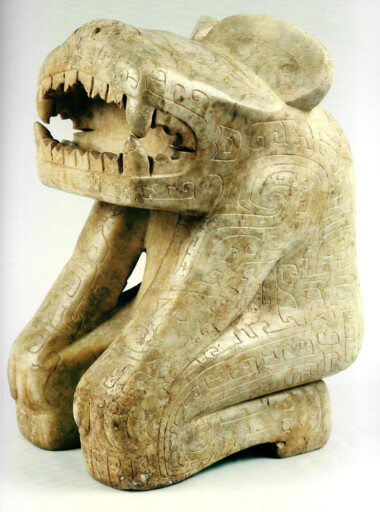
A tiger-headed, human-bodied marble sculpture unearthed from the royal cemetery area at Yinxu Photo: PROVIDED TO CSST
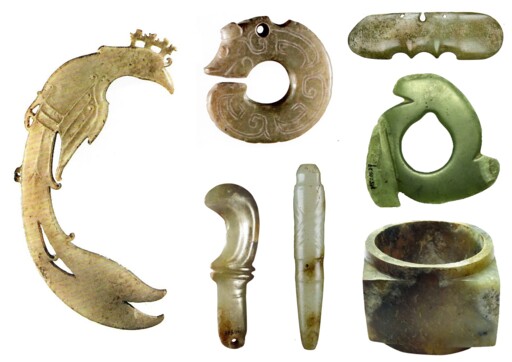
Jade objects with prehistoric stylistic features unearthed from the tomb of Fuhao at Yinxu Photo: PROVIDED TO CSST
According to the “Annals of Yin” in the Records of the Grand Historian, after the turmoil known as the “Nine Generations of Chaos” and King Pangeng’s relocation of the capital to Yin, the Shang Dynasty (1600–1046 BCE) entered a period of revival. After Wuding ascended the throne in particular, he “instituted a government reform, and practised virtue. The whole nation rejoiced, and the fortunes of Yin again flourished.”
From an archaeological perspective, major transformations also took place in the social and cultural landscape during and after Wuding’s reign. With Yin at its center, late Shang society displayed remarkable inclusiveness and creativity, absorbing and integrating diverse cultural resources while continuously transforming and innovating upon them. These developments brought about profound changes not only to social structures but also to social ethos, ushering the development of early states in China into a new stage.
Revival of early cultural traditions
Within high-status tombs and sacrificial pits at Yinxu, or the ruins of Yin, jade objects bearing stylistic features of the prehistoric or Xia Dynasty (c. 2070–1600 BCE) periods have been frequently discovered. Some appear to be early heirloom jades transmitted across generations; others are likely later works deliberately modeled on earlier forms. According to scholarly research, among the more than 700 jade objects unearthed from the tomb of Fuhao, a wife of Wuding, over 200 are either early heirloom jades or archaistic imitations. These early-style jades span an expansive spatial and temporal range—extending north to the Yan Mountains and beyond, south to the middle and lower Yangtze River region, west to Gansu and Qinghai, and east to the Haidai Region.
Across this broad horizon, such objects were collected, imitated, modified, and used by high-ranking elites of the late Shang period. Since early jade objects were predominantly shamanistic jades endowed with religious functions, this extensive collecting and imitation was likely not driven by curiosity or aesthetic appreciation. Its practical purpose was, rather, to integrate the religious traditions and spiritual resources embodied in jades from different regions and cultures, thereby constructing a more inclusive belief system.
Certain high-level burials at Yinxu have also yielded marble sculptures depicting dragons, tigers, bovines, owls, human figures, and tiger-headed, human-bodied figures. These objects vary in size, but most are no more than 50 centimeters in height. Marble sculptures of this kind are not found in Central Plains sites dating from the Xia to early Shang periods.
In northern regions, however, stone, ceramic, and clay sculptures had been common since the Xinglongwa culture. In recent years, the stone carvings from the Shimao site and their connections with decorative motifs on Xia and Shang bronze vessels from the Central Plains have attracted wide scholarly attention. Some scholars believe that the Shimao stone carvings are related to cultural traditions in the northeastern region, while others associate them with Xinjiang and South Siberia. Also related to these stone carvings are stone vessels, which are frequently found in large tombs of the royal cemetery at Yinxu and largely imitate the forms and decorations of bronze vessels.
The flourishing of white pottery during the late Shang period is also noteworthy. Fired from kaolin or china clay, white pottery resembles porcelain in some respects, but is made from less refined material and fired at a lower temperature. In some high-level burials at Yinxu, finely crafted, large white pottery vessels have been found, with forms and decorations that largely imitate bronze vessels. Some individual pieces even bear inscribed characters.
Judging from their archaeological context, these white pottery vessels ranked higher in status than bronze and jade vessels. White pottery first appeared in the Gaomiao culture of western Hunan during the middle Neolithic period and later flourished in the Dawenkou and Longshan cultures of the lower reaches of the Yellow River, where it was primarily used to make wine vessels. The Erlitou culture inherited this tradition, but white pottery is almost absent from early Shang sites. Its renewed flourishing in the late Shang therefore represents a revival of the white pottery tradition and marks the apex of white pottery production.
Introduction of foreign cultural elements
The northern cultural elements embedded in Xia and Shang bronze vessels have long been the subject of detailed scholarly investigation. During the late Shang period, the influence of northern-style bronzes reached its peak. Various types of knives with ring-shaped pommels and animal-head pommels became popular tool forms, while socketed shaft-hole ge (dagger-axes) also enjoyed a brief period of popularity in the early period of the late Shang. Human sacrificial victims interred in certain sacrificial pits within the palace-temple complex and the royal cemetery area at Yinxu were often buried with northern-style knives and axes, suggesting that they likely served during their lifetimes as warriors guarding the Shang kings.
The appearance of horses and chariots is closely connected with this phenomenon. In the Central Plains region, clear evidence of horses and chariots first appeared in the late Shang period, and many scholars believe they were introduced from the Eurasian Steppe. Yet once introduced, chariots were rapidly localized, and by expanding the effective range of movement, they became an important means of organizing people and space.
The Yinxu site covers more than 30 square kilometers and is surrounded by numerous “satellite” settlements. No settlement or settlement cluster of such scale had been seen before. How could it have been effectively governed? The answer is inseparable from the use of chariots. Raising horses required specialized skills, and numerous horse sacrifice pits have been discovered in the royal cemetery area. The killing and burial of such rare animal resources should be understood as a manifestation of royal power and wealth.
In recent years, scholars have drawn increasing attention to the many ceramic vessels at Yinxu that reflect other cultural styles—some likely brought in from distant regions, others probably produced locally after non-local populations had migrated to the site. Yinxu’s far greater scale compared with earlier Xia and Shang capitals suggests that it drew large numbers of non-local people into a much more complex urban setting, where at least some residents could shift away from agricultural production and take up handicraft industries, commercial activity, and other specialized pursuits. This points to the development of social division of labor, as well as geographically based social organizations, marking a new stage in urban development.
Cultural innovation and development
During the late Shang period, bronze culture underwent significant transformation. The types and quantity of bronze vessels further increased, while vessels with thick, heavy bodies, intricate decoration, and inscriptions became common. With the use of blind cores and metal core supports, the forms of many vessel types changed markedly. As wine vessels such as jue and gu came to occupy the center of ritual assemblages, food vessels such as ding and gui also appeared in growing numbers. In the Erlitou and early Shang cultures, bronze jue were often paired with ceramic he and jia to form the core assemblage.
As bronze-casting technology flourished in the late Shang, ritual assemblages increasingly centered on bronze vessels, and the earlier practice of combining wine vessels made from different materials gradually fell out of use. At the same time, the Shang Dynasty’s control over bronze casting appears to have further strengthened. Multiple bronze-casting workshops have been discovered at Yinxu, yet few casting sites have been found outside it—a pattern that differs significantly from the early Shang culture, when casting sites also appeared in peripheral regions.
Auditory elements in ritual activities increased significantly during the late Shang period. The ceramic xun (ocarina), for example, evolved into a more standardized instrument with five finger holes, suggesting a clearer formalization of sound within ritual practice. Bronze nao bells also newly appeared, typically played either in sets of three or as single pieces.
At the same time, bronze bells, which had been quite rare in the early Shang period, increased dramatically in number during the late Shang. In burial contexts, these bells were often placed beneath the necks of sacrificed dogs or arranged around inner and outer coffins, suggesting that they functioned in funerary rites as adornments for sacrificial animals and for coffins. These phenomena all indicate that the importance of “music” in ritual activities rose significantly.
From the Neolithic period onward, divination was widely practiced by burning ox and pig scapulae and interpreting the resulting crack patterns, with turtle plastrons also coming into use during the Shang Dynasty. To facilitate burning, “drilled” hollows were made on the oracle bones. By the mid-Shang period, “chiseled” grooves had been added alongside these drilled hollows, allowing the resulting crack patterns to be produced in a more controlled and regularized manner. After the late Shang, oracle bones were often trimmed in a standardized manner, with drill holes and chisel marks arranged in increasingly orderly fashion.
Taken together, these changes point to the growing standardization of divination rituals and oracle crack forms, as divine will was rendered more regular, even more controllable, and its interpretation brought under a more stable ritual order. This constituted an important step in the rationalizing process of “moving from shamanism to ritual.” One of the most significant phenomena of the late Shang was the appearance of oracle bone inscriptions. At this time, writing was more extensively used for communication between humans and the divine, signifying the further development of religion.
Together, this cultural revival, concentration of resources, and integration of populations generated powerful momentum for the development of late Shang society. The convergence of diverse resources among the social elite intensified social stratification and elevated the status of the royal family and kingship. As diverse non-local populations converged, social division of labor and territorial organizations developed considerably, alongside the flourishing of trade and commerce.
On the basis of strengthened social control, close connections were established with broader regions, and distant objects and ideas came to influence many aspects of social life. Different religious traditions and diverse thoughts converged and intermingled, becoming spiritual resources for social integration and laying the foundation for a territorial dynasty that encompassed many different ethnic groups. These characteristics exerted a profound influence on the subsequent development of the Western Zhou (1046–771 BCE) state.
Gao Xiangping (professor) and Zhou Xueyan are from the School of Archaeology and Cultural Heritage at Zhengzhou University.
Copyright©2026 CSSN All Rights Reserved