


Duanwu Festival: From folk customs to patriotism
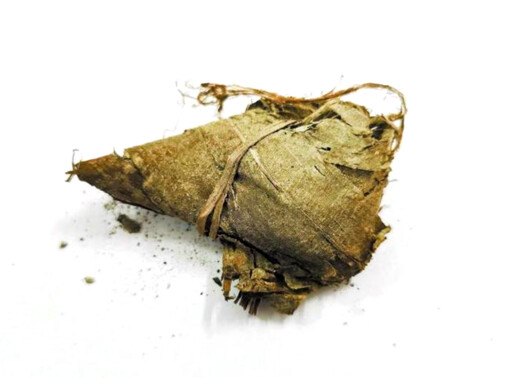
FILE PHOTO: A zongzi dating to more than 900 years ago unearthed from a Northern Song Dynasty tomb in Tieguai Village, Nanling County, Anhui Province and now housed at the Nanling County Museum
The Duanwu Festival, which falls on the fifth day of the fifth lunar month, is a traditional Chinese festival with a long history and rich cultural meaning. Now a globally recognized item of intangible cultural heritage, its origins can be traced to ancient people’s understanding of seasonal transitions. In midsummer, when yang energy reached its height and yin and yang began to alternate, illness was believed to become more prevalent. Early festival customs therefore centered largely on warding off evil, dispelling pestilence, strengthening the body, and praying for good fortune. From the Warring States Period (475–221 BCE) through the Han (206 BCE–220 CE) and Wei (220–265) dynasties, practices such as hanging mugwort, bathing in orchid-scented water, and tying five-colored silk threads embodied the wisdom of adapting to the rhythms of nature while resisting malevolent forces.
Over time, legends of local figures from different regions were gradually woven into the festival, with stories of sages and worthies such as celebrated patriotic poet of the Warring States Period Qu Yuan, prominent military strategist of the late Spring and Autumn Period (770–476 BCE) Wu Zixu, and famed filial daughter of the Eastern Han Dynasty (25–220) Cao E becoming deeply intertwined with Duanwu customs. Ancient folk practices, originally focused on averting disaster and preserving health, underwent a gradual transformation in their spiritual core, rising into commemorative rites honoring historical figures and promoting patriotism and familial devotion. Across more than two millennia, the festival shed much of its primitive shamanistic coloring and integrated natural rhythms, folk customs, and national spirit into an important vessel for the emotional and cultural beliefs of the Chinese people.
Evolution of the festival’s name
The Duanwu Festival has gone by many names—Chongwu, Tianzhongjie, Yulanjie, Longzhoujie, among others—each with its own origin, reflecting the interplay and convergence of different ancient calendrical systems and seasonal customs.
The festival emerged from the midsummer, whose seasonal associations were themselves derived from the Summer Solstice. As one of the two earliest major solar terms established in antiquity, the Summer Solstice marks the longest day of the year and the annual peak of yang energy, while also signaling the beginning of yang’s decline and yin’s ascent.
The ancients attached great importance to the Summer Solstice, which in most years fell in the fifth month of the lunar calendar. The entire month therefore came to be viewed as a special period of tension between yin and yang—a boundary between life and death.
In ancient calendrical systems, the solar calendar, the Heavenly Stems and Earthly Branches (Ganzhi) calendar, and the lunar calendar each defined differently the day when yang energy reached its peak. The solar calendar identified the Summer Solstice as the apex; the Ganzhi calendar held that the wu (seventh of the 12 Earthly Branches) day of the wu month—the fifth lunar month—marked the height of yang energy, hence the name Chongwu, or “Double Wu;” while the lunar calendar, which blended yin and yang elements, considered the fifth day of the fifth lunar month as the day of the year with the most potent yang energy. To make festivals easier to remember and transmit, the lunar calendar favored “double-number days,” which is why the fifth day of the fifth lunar month came to be known as Chongwu, or “Double Fifth,” and Wuyue Wu, or “Fifth Month, Fifth Day.”
The term “Duanwu” appeared relatively late, with the earliest known record found in Fengtu Ji (Records of Local Customs) by Zhou Chu, a minister of the Western Jin Dynasty (265–317). The character duan means beginning or initial, and originally referred to the first wu day of the fifth lunar month. In early times, the exact date of the wu day was not fixed, falling anywhere between the first and the twelfth day of the fifth month.
After the Han Dynasty, scattered seasonal practices gradually coalesced around a fixed date, and the fifth day of the fifth lunar month became the mainstream festival date. The Northern and Southern Dynasties (420–589) marked a critical phase in the festival’s development, as three dating systems—the Summer Solstice, the wu day of the wu month, and the fifth day of the fifth lunar month—fully converged. Customs that had previously been dispersed throughout the fifth lunar month, including taboos, herb gathering, and bathing rituals, were concentrated on the fifth day. Ultimately, Duanwu became the festival’s common name, carrying both cultural depth and poetic resonance.
Multiple origins
In ancient belief, the fifth month of the lunar calendar was considered an “inauspicious month,” and the fifth day of this month an even more “inauspicious day”—an idea that had already taken deep root by the Warring States Period. The Book of Rites, in the chapter “Proceedings of Government in the Different Months,” also explicitly prescribed that in the month of midsummer, one should “restrain indulgence in music and beautiful sights,” “make their diet spare,” and “keep their desires under rule,” among other injunctions.
Around core customs such as dragon boat racing, eating zongzi (glutinous rice dumplings), and the prohibition of fire, different regions developed their own legends of departed spirits. In the Wu-Yue region south of the Yangtze River, dragon boat racing became associated with Wu Zixu and Cao E: Wu Zixu, wrongfully accused and driven to suicide, was transformed into the Tide God of the Qiantang River, while Cao E threw herself into the river in search of her drowned father. Local people commemorated these souls through dragon boat races.
In the Chu region (present-day Hubei and Hunan), the story of Qu Yuan’s sacrifice by drowning due to political disillusionment spread widely, with locals rowing boats to search for him and casting zongzi into the water to feed the fish, gradually giving rise to the traditions of dragon boat racing and zongzi-making.
In central Shanxi, a distinct tradition emerged: Statesman of the Spring and Autumn Period Jie Zitui was said to have been burned to death on the fifth day of the fifth lunar month, leading to a local custom of prohibiting fire as an act of mourning.
In sum, the early customs of the Duanwu Festival had no single origin. Different regions interpreted the practices through their own local legends and figures, producing a pattern of “one custom, multiple origins.” These legends reflected the ancients’ primal understanding of life, death, and the soul, while also giving the festival a humanistic foundation—laying the groundwork for its eventual transformation toward a cultural core centered on commemorating historical sages.
One festival, celebrated three times
Zigui County in Yichang, Hubei Province, is the hometown of Qu Yuan, and its Duanwu customs are especially distinctive. A long-standing local saying holds that “the Duanwu Festival is more important than the Spring Festival.” Its most remarkable feature is the tradition of “celebrating one Duanwu Festival three times:” the fifth day of the fifth lunar month is the “First Duanwu Festival,” the 15th day is the “Grand Duanwu Festival,” and the 25th day is the “Final Duanwu Festival.” Each occasion has its own theme, progressing layer by layer and vividly expressing both the ancient customs of warding off evil and dispelling pestilence and the patriotic sentiments associated with commemorating Qu Yuan. In 2009, the Duanwu Festival, with the Zigui customs as an integral component, was inscribed on UNESCO’s Representative List of the Intangible Cultural Heritage of Humanity, bringing this millennia-old festival tradition to the world stage.
The First Duanwu centers on sacrificial rites. At daybreak, local residents set out to gather mugwort leaves and calamus covered with morning dew, then hang them over their doorways to ward off evil and pray for blessings—an ancient custom passed down for millennia. During the festival period, official, communal, and household sacrifices are held in cities and villages alike, across multiple settings and levels. Following ancient rites, offerings are arranged and eulogies recited, with solemn invocations calling for Qu Yuan’s spirit to return to his homeland. The ceremonies are dignified and reverent. Local cultural custodians believe that zongzi are wrapped in a triangular shape with sharp edges and corners to symbolize Qu Yuan’s uprightness and unyielding integrity. Bamboo leaves, glutinous rice, and red dates represent his noble character, pure conduct, and unwavering loyalty, respectively. A single zongzi thus becomes a vivid portrait of Qu Yuan’s personality.
The Grand Duanwu is a festive carnival, with dragon boat racing taking center stage. It is also the climax of the entire Duanwu series. On the river, rows of dragon boats stand ready, with rowers pulling their oars in perfect synchronization as spectators crowd the banks. The races are not merely contests of speed; they also feature traditional skills such as grabbing the red banner, snatching the target, and even performing handstands. Embracing the local ethos of “rather lose a year’s harvest than lose a year’s boat race,” residents participate with great enthusiasm.
The Final Duanwu brings the festival to a close. This period coincides with the completion of the summer harvest, when new wheat has ripened. In some areas, due to geography and local produce, zongzi are not the festive food of choice; instead, people make new-wheat pancakes, noodles, and other wheaten foods. During the festival, married daughters return to their parents’ homes, where the whole family gathers to enjoy the new grain, offer sacrifices to Heaven, Earth, and ancestors, and pray for favorable weather, bountiful harvests, and peace and harmony in the year ahead.
Seen through the tradition of “one Duanwu Festival, celebrated three times” in Qu Yuan’s hometown, the ancient rituals of warding off evil and praying for blessings have been preserved, while the commemoration of Qu Yuan has become the central thread running through the festival’s customs. From the impulse to dispel evil and avoid calamity, to present-day reverence for Qu Yuan the patriotic poet and the transmission of national integrity, the Duanwu Festival has undergone a profound cultural elevation. Its customs are both a living fossil of ancient folk traditions and a vivid embodiment of the Chinese nation’s patriotic spirit, retaining their vitality through millennia of inheritance.
Zuo Yibing is from the Center for Chinese Folklore Studies of the Institute of Literature at the Chinese Academy of Social Sciences.
Copyright©2026 CSSN All Rights Reserved