


24 Solar Terms as hallmark of Chinese civilization
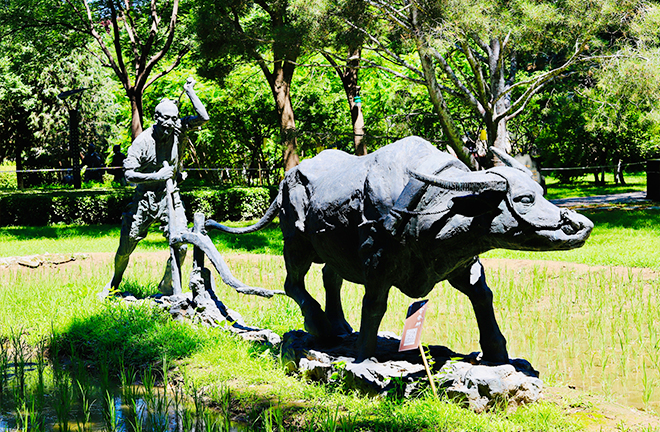
A sculpture work relating to the 24 Solar Terms at the National Agricultural Exhibition Center in Beijing showcases the wisdom of ancient Chinese people working in harmony with nature. Photo: IC PHOTO
In the international meteorological community, China’s 24 Solar Terms are recognized as the fifth great invention of the nation. Far more than a calendar, they constitute an integrated knowledge system spanning astronomy, climate, ecology, social customs, philosophy, and agriculture. As a vital pillar of traditional Chinese culture, the terms have evolved over millennia into an enduring symbol of Chinese civilization—one deeply woven into the cultural DNA of the Chinese people.
Timekeeping guide for agricultural production
The emergence of the 24 Solar Terms reflects the accumulated wisdom of thousands of years of astronomical observation and agricultural practice by the ancestors of Chinese civilization. The system took shape through a long process, developing roughly from the “two solstices” and “two equinoxes” to the “four seasons and eight nodes,” and eventually into the complete system of the “24 Solar Terms.”
It is generally accepted in academic circles that the earliest complete account of the 24 Solar Terms appears in the “Astronomical Teachings” chapter of the Daoist classic Huainanzi: “Between the two corners is a distance of 91 and 5/16 degrees. The sun moves one degree per day, and 15 days constitute one solar period, thus giving rise to the changes of the 24 Solar Terms.”
Observing celestial phenomena was essential to determining the seasons and, in turn, to supporting agricultural production. In ancient China, where agriculture formed the foundation of the state, the primary function of the 24 Solar Terms was to regulate farming activities, which depended on careful attention to seasonal timing. As the “System of Kingship” chapter of the Confucian text Xunzi states, “Spring plowing, summer weeding, autumn harvesting, and winter storing—when these four activities are not neglected at their proper times, the five grains will never fail, and the people will have more than enough food.” In this way, the 24 Solar Terms translated the complex patterns of the sun’s annual movement into practical seasonal markers that farmers could readily follow.
The 24 Solar Terms represent both a summary of natural sciences and the accumulated life experience of ordinary people over thousands of years. Through agricultural production, farmers developed a rich body of folk songs and proverbs that provide practical guidance for farming and describe the phenological patterns associated with each solar term, creating a practical timekeeping guide for agricultural production in ancient China.
Among these are sayings such as “at Lichun (Start of Spring), yang energy turns; at Yushui (Rain Water), water reaches the riverbanks; at Jingzhe (Awakening of Insects), crows call out; at Chunfen (Spring Equinox), the ground dries up,” “if it rains heavily at Yushui, the small rivers and large rivers will all swell,” and “if Yushui is overcast, Xiazhi (Summer Solstice) will be sunny.” Representative proverbs include “at Xiaoman (Grain Buds), the barley turns yellow; it’s time to tend to silkworms and plant rice seedlings,” “at Liqiu (Start of Autumn), walnuts ripen; at Bailu (White Dew), it’s time to pick pears; at Hanlu (Cold Dew), persimmons turn red,” as well as “at Xiaohan (Minor Cold) and Dahan (Major Cold), slaughter the pigs for the New Year; once Dahan passes, a new year begins.”
The 24 Solar Terms do not function as a fixed or rigid system; instead, they exhibit a high level of regional adaptability. China is vast and climatically diverse, a country where “a thousand miles apart, the winds differ; a hundred miles apart, the thunders do not echo the same.” While observing the basic principles of the solar-term system, different regions have integrated their ecological conditions and local distinctiveness into its overarching framework, giving rise to a rich body of supplementary regional proverbs. These proverbs reflect varying phenological patterns. For instance, during Xiaoshu (Minor Heat) and Dashu (Major Heat), northern regions generally receive more rainfall than in other seasons, while in Jiangnan, south of the Yangtze River, there is a saying: “At Xiaoshu, rain is as precious as silver; at Dashu, rain is as precious as gold.”
Intellectual foundation, life wisdom
The 24 Solar Terms are rooted in the Chinese philosophical tradition of “following the laws of nature and achieving harmony between Heaven and humanity.” They embody the Chinese nation’s profound understanding of the laws of the universe, while also containing a distinct aesthetics of life and wisdom for human existence.
Shuntian Yingshi—or following Heaven and responding to the seasons—is the fundamental philosophy underlying the 24 Solar Terms system. Here, tian is not a personified deity, but the objective order governing the operation of the cosmos; shi refers to the rhythmic unfolding of that order through time. Chapter 25 of the Dao De Jing states: “Man takes his law from the Earth; the Earth takes its law from Heaven; Heaven takes its law from the Dao [Way]. The law of the Dao is its being what it is.” This passage emphasizes that all things in Heaven and Earth follow their own inherent patterns, unfolding according to natural principles rather than human will. The 24 Solar Terms are a systematic response to precisely this principle: By observing the sun’s annual movement along the ecliptic, ancient Chinese divided that path into 24 equal segments, each corresponding to one solar term. This was not a human prescription imposed on nature, but a human discovery of—and conformity to—the laws of nature. The point of departure of the 24 Solar Terms as recorded in Huainanzi is precisely the cosmological view that “Heaven established the sun and moon, arranged the stars and constellations, regulated yin and yang, set in order the four seasons.” The 24 Solar Terms translate the wordless teachings of tian into a practical seasonal guide, enabling people to “revere Heaven and follow the seasons” in farming, rituals, and daily life, and thereby to pursue harmonious development between humanity and nature.
This wisdom runs through both the productive and everyday dimensions of Chinese life. In production, the 24 Solar Terms help agriculture keep pace with the farming seasons. By acting in accordance with the solar terms and instructing farmers on the proper timing of agricultural work, communities could ensure the normal operation of farming; when seasonal nodes were missed, poor harvests often followed. In this sense, the 24 Solar Terms embody a rudimentary idea of sustainable development: By conforming to the rhythms of nature, people can secure long-term and abundant returns.
The wisdom of “following Heaven and responding to the seasons” also permeates every aspect of Chinese daily life. Regarding diet, each solar term has associated seasonal ingredients and customary foods, such as “biting spring [eating spring food]on Lichun” and “eating dumplings on Dongzhi [Winter Solstice].” In health management, there are traditional practices such as “keeping warm in spring and cooling in autumn,” and “treating winter ailments in summer.” In rituals, there are spring prayers for a good harvest and autumn rites for the harvest, as well as ancestral worship on Dongzhi. Solar terms and festive occasions are interwoven, forming the distinctive solar-term customs of the Chinese people. The 24 Solar Terms are therefore not merely a timetable from the heavens, but a complete way of life—a philosophy of life for the human world that the Chinese people have refined through thousands of years of practice.
Modern value
On Nov. 30, 2016, the 24 Solar Terms were officially inscribed on UNESCO’s Representative List of the Intangible Cultural Heritage of Humanity. At the opening ceremony of the 2022 Beijing Winter Olympics, elements of the 24 Solar Terms were used with remarkable ingenuity, showcasing this uniquely Chinese sense of romance and wisdom about time to the world. Interest in the 24 Solar Terms has gradually spread beyond China, drawing increasing attention from international audiences.
With China’s accelerating urbanization and the development of modern agricultural technologies, the agricultural guidance function of the 24 Solar Terms is no longer as central as it once was. Yet the system continues to exert broad influence and retain practical value in modern life, displaying increasingly diverse contemporary meanings.
In agricultural production, for example, farmers in some regions still follow the ancient adage, “plow the land at the Awakening of Insects, and the insect eggs will meet their end,” turning over the soil in good time after the solar term of Jingzhe. In traditional Chinese medicine and health management, some hospitals of traditional Chinese medicine organize health-promotion activities at key seasonal junctures such as Chunfen, Qiufen (Autumn Equinox), Xiazhi, and Dongzhi. In the arts, the 24 Solar Terms provide an inexhaustible source of inspiration for fashion design, art exhibitions, and cultural and creative products. In intellectual and cultural life, people in recent years have hailed Xiaoman as the wisest of the 24 Solar Terms—a natural extension of the concept embedded in the solar-term system: conforming to nature, following Heaven, and responding to the seasons.
It is especially heartening that the 24 Solar Terms are also finding their way into the lives of young people and children through diverse and innovative forms. In 2019, for example, the Palace Museum planned and published the picture book series Wow! The 24 Solar Terms of the Forbidden City, which uses the 24 Solar Terms as a narrative thread to introduce children to the architecture, cultural relics, customs, and other facets of the Forbidden City through illustrated storytelling. In addition, some primary and secondary schools have established dedicated courses on the 24 Solar Terms or incorporated them into interdisciplinary curricula, exploring the cultural significance of the solar-term system from multiple angles—including poetry, geography, botany, festivals, and food culture.
As an important spiritual emblem of Chinese civilization, the 24 Solar Terms played a significant role in ancient Chinese society, making important contributions to astronomy, geography, climate studies, literature and art, agriculture, customs, cuisine, health preservation, and many other fields. Their profound intellectual connotations and the rich cultural system they have formed will continue to play an important role in modern life.
Fei Yi is an associate research fellow from the Institute of Literature at the Chinese Academy of Social Sciences.
Copyright©2026 CSSN All Rights Reserved