


Tang system forged Chinese legal and national identity
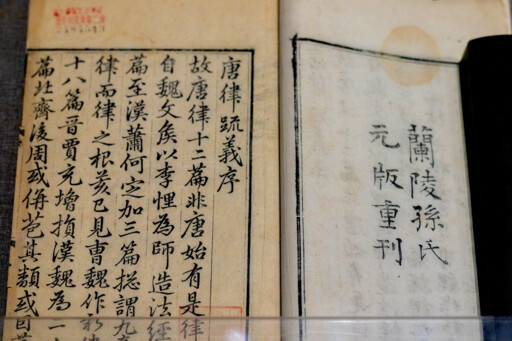
Qing Dynasty block-printed edition of the Tang Law with Commentaries, collected by the Chinese Archaeological Museum Photo: VCG
The Tang Dynasty (618–907) left an institutional legacy that long outlived the dynasty itself. Centered on the “Six Codes of Kaiyuan”—Kaiyuan Code, Kaiyuan Ordinances, Kaiyuan Regulations, Kaiyuan Formulas, Kaiyuan Rites, and Tang Six Codes—the Tang system held an enduring place in China’s orthodox legal tradition, becoming the most influential and longest-lasting legal framework in ancient Chinese history. Successive dynasties drew deeply on this inheritance, carrying its legal traditions forward across the centuries. The system also helped bind the emerging community for the Chinese nation together, giving it a shared institutional foundation on which cohesion and a sense of identity could take root.
Symbol of dynastic legitimacy
The Tang system carried a legal tradition forward while giving institutional form to the idea of “Chinese orthodoxy.” It became the cornerstone on which successive dynasties built their legal systems, lending authority to their claims of orthodox status. For the dynasties that followed the Tang, this inheritance offered a path to legitimacy: Each modeled its legal framework on the “Six Codes of Kaiyuan,” drawing on the prestige of Tang institutions to establish its standing as an orthodox Chinese dynasty.
In ancient China, the Tang system provided the Five Dynasties and Ten Kingdoms (907–979), Liao (916–1125), Song (960–1279), Western Xia (1038–1227), Jin (1115–1234), and other regimes that lacked territorial unity with institutional models and arguments to strengthen their claims to Chinese orthodoxy. From the Five Dynasties period through the Song, rival dynasties shared a fragmented political landscape, each facing the challenge of asserting its legitimacy without command of a unified realm.
The Jin Dynasty, for example, could not secure its claim to Chinese orthodoxy through territorial unification. In its middle and late periods, it therefore stepped up institutional development, concentrating particularly on law. With the Tang system as its foundation, it rapidly built a legal framework modeled on Tang institutions, seeking the legitimacy through this inheritance. This shift reflected the Jin’s pursuit of orthodox status while also revealing the capacity of the Tang system to draw China’s legal traditions into a more integrated whole.
As the Tang system became entwined with the idea of Chinese orthodoxy, its significance extended beyond the legal order. It emerged as a symbol in which political thought and culture converged, embodying China’s orthodox legal tradition. Thereafter, its institutional framework and specific provisions gave concrete form to what successive dynasties recognized as orthodox Chinese law.
Enduring institutional model
In ancient China, a dynasty’s laws, bureaucratic structures, and rites, together with the principles, policies, and customs developed through governance, were collectively known as its “system.” Thus, historians spoke of the Zhou (1046–256 BCE), Qin (221–206 BCE), Han (206 BCE–220 CE), Tang, Song, Yuan (1271–1368), Ming (1368–1644), and Qing (1644–1911) systems. Of these, the Zhou, Qin, and Tang systems exerted the greatest influence on the transmission and evolution of China’s legal traditions, though each occupied a different place in the thinking of later generations.
The Zhou system offered an ideal of governance to which they could trace their aspirations, while the Qin system more often served as a target of criticism and a cautionary example. Only the Tang system was openly embraced as a direct, concrete, and authoritative model for laws, bureaucratic structures, rites, and other institutions. Later dynasties inherited and applied it, or modified its provisions to suit their own legislation and institutional designs.
Writing in his Jian Gu Zhai Ri Ji (Diary of the Jian’gu Studio), Chen Shaoji of the Qing Dynasty judged the legal achievements of the Han and Tang to be the greatest since the Three Dynasties—the Xia (c. 2070–c. 1600 BCE), Shang (c. 1600–1046 BCE), and Zhou.
At the heart of the Tang system lay the laws promulgated during Emperor Xuanzong’s Kaiyuan era, preserved in six compilations revised during that period, known as the “Six Codes of Kaiyuan.” The first four were completed in 737, the 25th year of Kaiyuan, with the remaining two completed around the same time. From the Five Dynasties onward, these works were also commonly known by the shorter titles “Tang Law,” “Tang Ordinances,” “Tang Regulations,” “Tang Formulas,” “Tang Rites,” and “Tang Code.”
From the Five Dynasties onward, the Tang system came to embody the core of China’s legal tradition. Adherence to it became an important criterion for distinguishing Huaxia (the civilized Chinese) from Yidi (the barbarian peoples), as these categories were understood at the time. A dynasty’s comprehensive adoption of Tang institutions thus served as a legal marker of its standing within the orthodox Chinese tradition.
The Tang system also furnished later dynasties with a rich body of material on which to build their own legal institutions. Its compilations covered codes, ordinances, regulations, and formulas, as well as bureaucratic structures and rites, offering a written foundation for each field. Comprehensive in scope and systematic in organization, these works gave successive dynasties practical models for compiling their own legal texts. Legislation could thus proceed on an established footing, with a coherence and direction that might otherwise have been lacking.
Later dynasties, including the Song, Ming, and Qing, drew extensively on the Tang system when drafting legislation, particularly in matters of rites and bureaucratic organization. They often followed a comparative approach, taking Tang institutions as their point of departure while adapting and extending them to meet the needs of their own times.
Beyond providing a model for later legislation, the Tang system sustained the continuity and development of China’s legal traditions across the centuries. Its enduring institutional influence helped preserve the unity of Chinese culture and carry that culture forward from one dynasty to the next.
Shared institutions and Chinese identity
Long after the Tang Dynasty ended, the prestige of its legal achievements endured. The Tang system became both a symbol of China’s legal civilization and a shared legal bond among the ethnic groups inhabiting its territory. Through this institutional inheritance, those groups developed a richer sense of identification with Zhonghua (China), a concept whose meanings embraced culture, law, territory, and other dimensions. Chinese identity in ancient times therefore drew its strength from several sources: Alongside bloodlines and geography, it was deeply rooted in the shared institutions of law and rites.
The Liao Dynasty offers a telling example. Having inherited the Central Plains legal tradition centered on the Tang system, it regarded itself as an orthodox Chinese dynasty—a standing later recognized by the Jin and Yuan. Possession of ritual objects lent further weight to this claim.
The Liao acquired all the ritual vessels and objects of previous Chinese dynasties that the Northern Han (951–979) had preserved. Those held by the Later Zhou (951–960) and Northern Song (960–1127), by contrast, were regarded as imitations. Because the Liao’s objects were relics of the Qin and Han, they were seen as providing a firmer foundation for its legitimacy. The transmission and perpetuation of these rites expressed the identification of the Khitan and other northern peoples with Chinese civilization, while illustrating the power of law and rites to bind diverse peoples to a shared Chinese identity.
Territorial unity alone likewise did not settle the question of legitimacy for the Yuan Dynasty, established by Kublai Khan. Although it had unified the north and the Central Plains, ministers such as Xu Heng and Xu Shilong argued that securing orthodox Chinese status also required the deliberate development of laws and rites modeled on the Tang system.
From the Western Han onward, Da Yitong (grand unity) took root in dynastic political thought, with territorial unification at its core. Initially confined to the Central Plains, the ideal gradually acquired a broader reach as regimes founded by different ethnic groups pursued it in their own ways. Its meaning expanded alongside its geographical scope, gaining new cultural dimensions through ethnic integration.
The Liao, Jin, Yuan, Qing, and other dynasties founded by ethnic minorities secured their standing as orthodox Chinese dynasties by inheriting and developing the Tang system. Orthodoxy thus came to rest on more than the unification of territory: A dynasty’s place in China’s legal civilization also mattered, and could even carry the greatest weight.
The Tang system thus gave new depth and substance to the ancient Chinese ideal of “grand unity.” Enriched by a shared legal tradition, the concept grew beyond its purely political bounds. What had been an abstract political theory became a broadly accepted principle of governance, anchored in concrete laws and institutions. Tang institutions supplied an enduring legal foundation on which the unity of the state could rest.
Hu Xingdong is a professor from the Law School at Yunnan University.
Copyright©2026 CSSN All Rights Reserved