


Suzhou gardens: Jiangnan culture in miniature
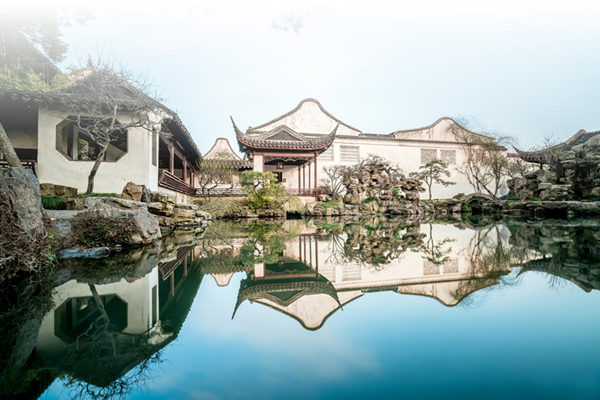
Part of the Master of the Nets Garden Photo: VCG
The architecture and landscapes of Suzhou gardens give tangible form to Jiangnan’s cultural heritage within a small, enclosed space. Taking “mountains and forests within the city” as their guiding principle, they blend natural scenery, architectural aesthetics, the literati ethos, and Confucian and Daoist thought into a world to explore and inhabit.
From Jiangnan’s landscapes to ‘mountains and forests within the city’
Suzhou gardens have their roots in an appreciation of landscape and a tradition of reclusion cultivated in Jiangnan over many centuries. Water abounds in the region, and the rhythms of daily life are closely bound to its presence. Jiangnan is also a land of hills and gullies, whose beauty lies in the delicate forms of lake stones, clear ponds, low ridges, and winding banks, in contrast to the grandeur of great mountains and rivers in north China. These surroundings nurtured in the people of Jiangnan a sensitivity to nature’s subtle changes, even in the smallest details. A pond of spring water, a few stalks of tall bamboo, half a mu of lotus pond—any of these could offer a place for the spirit to dwell. In keeping with this environment, Jiangnan culture came to prize literary pursuits, elegance, and quietude.
Suzhou gardens owe much of their character to the literati who created them. After the Tang (618-907) and Song (960-1279) dynasties, Suzhou gradually became an important center where officials took up postings, scholars delivered lectures, and the cultivated elite gathered. Guided by the Confucian commitment to ordering the world, the literati nevertheless often sought solace in landscape when faced with political setbacks or the uncertainties of an official career, using gardens to give form to their inner aspirations.
Suzhou gardens reached maturity during the Ming (1368-1644) and Qing (1644-1911) dynasties. The Humble Administrator’s Garden, the Lingering Garden, the Master of the Nets Garden, and others served variously as retreats for officials who had withdrawn from office, as venues for literati gatherings, or as settings for family life. Their prevailing aim was to evoke mountains and forests within an urban home, creating landscapes that invited both everyday living and leisurely exploration.
Reclusion in Suzhou gardens left ample room for participation in social life. Garden owners generally lived in the city, with gardens adjoining their homes, allowing them to close the gate for solitude or open it to welcome friends. Gardens commonly contained banquet halls, reading studios, and stages and waterside pavilions for listening to music and watching opera.
The garden was thus both a place of retreat and a setting for social interaction, accommodating the desire to rise above worldly concerns alongside the ethical obligations of everyday life. Building mountains and forests within the city gave these gardens a gentle tension. They opened a quiet realm amid worldly life, allowing their owners to preserve personal integrity while balancing public engagement with private retreat. The Jiangnan spirit of “combining firmness with gentleness” and of “openness and inclusiveness” took tangible form in the spaces of the garden.
Boundless composition within limited space
The architectural beauty of Suzhou gardens begins with their overall layout, guided by what Ji Cheng’s Yuan Ye, known in English as The Craft of Gardens, calls “skill in adapting and borrowing, refinement in siting each element where it belongs.” Suzhou gardens are generally modest in scale, yet they must accommodate landscapes, buildings, plants, and paths within a limited area. Their designers therefore rely on the careful composition of space to create a sense of breadth and variety.
Halls, pavilions, covered corridors and bridges, studios and lodges, walls, moon gates, and lattice windows work together to establish a rhythm of contraction and release, light and shade, solid and void, movement and stillness. The entrance is usually screened to keep the full garden from view. As visitors follow a winding corridor and turn a corner, the view suddenly opens, with water, rockeries, and plants unfolding before them in succession. This interplay of concealment and revelation gives a garden visit its changing rhythm, as the landscape gradually reveals itself to those moving through it.
Water gives Suzhou gardens their structure. The Humble Administrator’s Garden is organized around water, its broad expanses creating a sense of space and balanced proportions, its winding reaches lending depth and seclusion. The Lingering Garden excels in the interplay of buildings and courtyards, its central landscape, eastern court, and northern bonsai display each possessing a distinct character. The Master of the Nets Garden draws its water into a central pond, with pavilions arranged around it on an intimate scale—suited to quiet contemplation and unhurried strolling. Across these gardens, water brings the surrounding scene into its reflections, mirroring the light of the sky, passing clouds, the colors of trees, and the forms of buildings. These reflections transform the garden with each season, from dawn to dusk, and through sunshine and rain.
The art of building rockeries and arranging stones is another defining feature of Suzhou gardens. Each rockery is carefully composed, its peaks, ridges, caves, gullies, stepped paths, and ravines arranged to evoke a whole world of mountains and forests within the smallest compass. The Lion Grove Garden is renowned for its rockery of lake stones, with winding passages through caves and meandering paths that give visitors the sense of venturing deep into the mountains to explore their hidden recesses. The beauty of such a rockery lies in its power to evoke an entire landscape in the visitor’s imagination.
Chinese art prizes the interplay of solid and void, each bringing the other into being. In a garden, tangible forms open onto spaces of light, air, and reflection. A solid wall gives way to the openings of a lattice window, a mountain finds its counterpart in its reflection, and a building is balanced by the light of the sky. Between the solid and the void, space begins to breathe.
Ecological wisdom
The ideal of harmony between humanity and nature provides the philosophical foundation for Suzhou gardens and their cultural meaning. In shaping hills, creating ponds, and planting flowers and trees, garden makers follow nature’s example, working with its tendencies to create a harmonious whole. Hills assembled from stone must convey the sweep and energy of natural mountain ranges. Ponds dug by human hands must suggest water flowing from a living source, while carefully pruned plants must retain the vitality and exuberance of natural growth. Human artistry thus becomes an extension of nature.
Suzhou gardens weave nature into daily life, bringing those who live in them into close contact with the changing seasons, with wind and rain, plants and trees, light and shadow. Their design takes account of how water collects and circulates, favors native plants, and positions buildings in relation to prevailing winds, sunlight, and shade. Whitewashed walls and dark tiles, high walls and narrow lanes, pond water and plants work together to regulate the microclimate, creating a comfortable environment within the garden’s boundaries. Earlier generations developed these practices through experience, learning to respect natural rhythms and seek harmony with their surroundings long before the language of modern ecology emerged.
Confucianism and Daoism also complement one another in the spiritual life of Suzhou gardens. Confucianism values ethical order and self-cultivation in the service of the world, commitments expressed in the family ethics and worldly concerns conveyed by a garden’s halls, family precepts, plaques, and couplets. Daoism values naturalness, non-action, and the freedom found in emptiness and quietude.
A garden’s landscapes, caves and gullies, and images of the fisherman-recluse offer corresponding spaces for retreat and reflection. The name of the Humble Administrator’s Garden expresses the self-deprecation of “the governance of a clumsy man,” while that of the Retreat and Reflection Garden invokes the self-examination of “retreating to reflect on one’s faults.” The name of the Surging Waves Pavilion affirms the importance of “distinguishing the clear from the turbid.” Through these names, the owners articulated their search for a place of belonging between public engagement and private withdrawal. As a setting for both retreat and self-cultivation, the garden gives personal aspirations room to flourish while sustaining a sense of ethical responsibility to others.
Wang Ning is a professor from the City Culture and Communication College at Suzhou City University.
Copyright©2026 CSSN All Rights Reserved