


Silk Road witnessed vibrant exchanges on textile culture
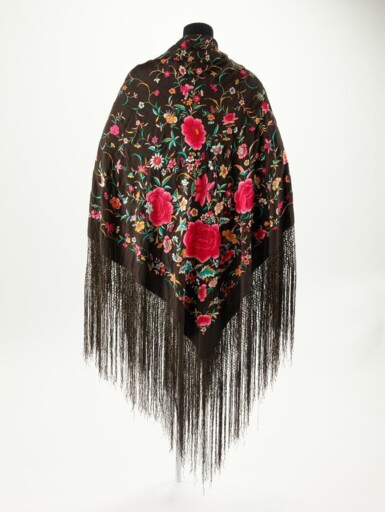
A Manila shawl Photo: PROVIDED TO CSST
Stretching across Eurasia and connecting East and West, the Silk Road has long been regarded as a vital artery for trade and geopolitics. Yet beyond the camel caravans, relay stations, and sailing vessels laden with goods, a closer look at the material flows reveals that this was also a corridor of textile culture in motion. Along this corridor, silk, cotton, wool, and linen were never mere commodities—they were material embodiments of technological wisdom, aesthetic sensibilities, belief systems, and even philosophies of governance. Textile exchanges along the Silk Road were therefore never simply about the export of materials, imitation of techniques, transplantation of patterns, or mutual appreciation of aesthetics. Rather, they constituted a dynamic, evolving, two-way, and multi-layered process of cross-civilizational exchange and mutual learning.
This trans-temporal and trans-spatial dialogue among civilizations unfolded across four progressive levels. It began with the encounter and exchange of material carriers, deepened through mutual learning and evolution in manufacturing techniques, advanced through the acculturation and reinvention of design concepts, and ultimately culminated in philosophical reflection and mutual learning in Eastern and Western approaches to governance. This journey not only bears witness to the richness of Chinese products, but also highlights the inclusiveness and capacity for reinvention that Chinese civilization, as an active agent, has demonstrated in absorbing foreign cultures.
Exchange of material carriers
In ancient Greek and Roman texts, China was referred to as Seres, meaning “the land of silk.” Historical records indicate that as early as the first century, Chinese silk had found its way into the upper echelons of Roman society, where it carried symbolic connotations of sanctity and nobility. The popularity of silk in ancient Rome became a material bond linking the two great civilizations of East and West, embodying the Western world’s earliest imaginations of a distant, prosperous, romantic, and mysterious Orient.
The westward transmission of silk represented a splendid outward diffusion of Chinese civilization, whereas the eastward spread and localization of cotton constituted a profound and quietly transformative internal revolution. Prior to the Song (960–1279) and Yuan (1271–1368) dynasties, silk, hemp, and kudzu were the dominant traditional textile materials in China. As an introduced crop, cotton followed a long and winding path into China, yet ultimately brought about structural transformations in planting patterns, textile technologies, and consumption concepts.
During the Tang (618–907) and Song dynasties, although cotton cultivation had begun in border regions, it was long regarded in mainstream Central Plains culture as a rare ornamental plant, grown only in gardens as an exotic flower. Around the turn of the Song and Yuan dynasties, advancements in cotton-spinning techniques by innovators such as Huang Daopo enabled cotton cultivation to expand on a large scale from border areas to the inland. By the Ming Dynasty (1368–1644), Emperor Zhu Yuanzhang issued decrees that forcibly promoted cotton farming, establishing its vital status as a national strategic material and an essential clothing resource for the people.
The widespread adoption of cotton in China not only helped address the basic clothing needs of ordinary people, but also profoundly reshaped the country’s agricultural structure and economic landscape.
Mutual learning of technologies
While silk production techniques had been developing in China for thousands of years, the Western world—despite its fascination with silk—long remained perplexed by the underlying technology. The westward transmission of sericulture and silk-reeling techniques thus became one of the most legendary chapters in the history of technological exchange along the Silk Road. According to the Great Tang Records on the Western Regions by seventh-century Chinese scholar-monk Xuanzang, the king of Kustana (present-day Hotan region in Xinjiang Uyghur Autonomous Region), eager to obtain silkworm eggs, sought to marry a princess from the Central Plains and secretly instructed her to smuggle silkworm eggs out of the region. The princess complied, concealing silkworm eggs and mulberry seeds within her tall headdress, thereby evading strict inspections at checkpoints and introducing sericulture into the Western Regions.
Far from mere legend, this account is corroborated by pictorial evidence in wooden panel paintings unearthed at the Dandan-Uiliq site in Xinjiang. In these paintings, a maidservant points to the headdress of a noblewoman, alluding to the concealed silkworm eggs, while spinning wheels and looms are depicted nearby. This pictorial narrative vividly captures the historic moment when sericulture and silk-reeling techniques escaped westward along the southern route of the Silk Road. The cross-regional diffusion of these techniques transformed silk from an enigmatic Eastern product into a shared technological and cultural achievement across civilizations.
If sericulture was the East’s gift to the West, then kesi (Chinese silk tapestry) emerged as the West’s return gift to the East. The distinctive weaving technique of continuous warp and broken weft originated in ancient Egypt, where wool was the primary material and the product was initially called kelim (tapestry-woven wool fabric). Fragments of a wool tapestry-woven warrior rug unearthed in Xinjiang, featuring the Western artistic techniques of figure modeling and chiaroscuro (light-and-shadow contrast), serve as clear evidence that kelim was indeed a product of Western civilization. This technique had already traveled eastward along the Silk Road as early as the Han (206 BCE–220 CE) and Jin (265–420) dynasties.
When the kelim technique reached the Central Plains, Chinese artisans, rather than merely reproducing the imported fabric, subjected it to a transformative process of localization and reinvention. First came the replacement of material: Chinese artisans replaced Western wool with Eastern silk, giving birth to kesi. Then came the elevation of aesthetics: Artisans of the Song Dynasty elevated tapestry weaving from decorative patterns to the realm of calligraphy and painting. Using the shuttle as a brush, they pursued the expressive qualities of ink-wash painting through the distinctive carved, sculptural texture unique to kesi.
Integration of aesthetics
During the Sui (581–618) and Tang dynasties, Chinese civilization demonstrated a remarkable capacity for inclusiveness and transformation. This quality is vividly reflected in the evolution of textile patterns, with the adaptation of Sasanian Persian pearl-round medallion motifs to the Chinese context serving as a quintessential example. Traditional brocades from the Sasanian Empire in West Asia employed pearl rounds as their structural framework and enclosed motifs of monarchs, mythical beasts, and hunting scenes, evoking a decorative style that was dynamic, powerful, and redolent of nomadic aesthetics. These brocades grew increasingly popular as Sogdian merchants entered China.
Confronted with this wave of exotic fashion, Sui and Tang artisans demonstrated remarkable ingenuity in adapting these motifs to local traditions. He Chou, a craftsman of the Sui Dynasty, succeeded in replicating Persian brocade based on a deep understanding of Sasanian weaving techniques, producing fabrics of even higher quality than those from the Western Regions—a testament to technological transcendence. Another craftsman, Dou Shilun, a designer of the early Tang Dynasty, played a key role in the transition from so-called barbarian styles to a distinctly Tang aesthetic. He retained the medallion framework of traditional Persian pearl-round motifs but replaced the exotic images of monarchs and mythical beasts with quintessentially Chinese auspicious symbols—winged horses, soaring dragons and phoenixes, Tang-style floral roundels, and the like. In doing so, he fused the vivid structural qualities of Western nomadic aesthetics with the refined symbolic language of Eastern agrarian civilization.
As history advanced into the Yuan period, the westward expansion of the Mongol army brought Eastern aesthetic sensibilities into resonance with the Ilkhanate in West Asia. During this period, large numbers of Chinese artisans migrated to Persia, bringing with them traditional Chinese decorative motifs such as dragons, phoenixes, qilins (a benevolent Chinese mythical creature), and cloud collars. Persian artisans did not mechanically copy these motifs; rather, they integrated them with local decorative elements. On Ilkhanate textiles, the Chinese dragon appears more formidable and is often juxtaposed with the griffin, a traditional Persian mythical beast. The phoenix’s tail feathers meander through dense vine-and-floral patterns, merging seamlessly with surrounding decorative elements. This deep fusion of Chinese decorative motifs with traditional Persian patterns represents both an early prefiguration of Chinoiserie in the West and a process of localized reinvention that foreign aesthetics inevitably undergo.
Philosophical reflection on governance
From the 17th to the 18th century, with the dawn of the Age of Discovery, the Silk Road extended all the way from inland Eurasia to the oceans, ushering exchange of textile cultures into an era of early globalization. By this time, encounters between East and West had long transcended materials and techniques, entering a deeper realm of spiritual institutions and philosophical reflection on governance.
The Manila shawl stands as one of the most representative cross-cultural artifacts of this early global trade network. Though named after Manila, it was actually produced in Guangzhou, south China’s Guangdong Province, employing techniques derived from Guangdong embroidery. Transported along the Manila galleon trade route, these Eastern silk products eventually crossed the Pacific, where they captivated markets across Spain. Alongside the silk brocades flowing into Europe came elements of Eastern philosophy and governance principles. Chinese opera stories—such as “The Romance of the West Chamber,” “The Peony Pavilion,” and “The Orphan of Zhao”—served as decorative motifs on Guangdong export textiles, becoming narrative patterns on Eastern silk destined for foreign markets. At this stage, Chinese textiles had long surpassed the material and aesthetic categories of fine garments and luxury fabrics—they had become cultural mirrors through which Enlightenment thinkers projected political ideals and reflected upon European institutions.
The history of textile cultural exchange along the Silk Road forms a grand tapestry, woven with time as its warp and space as its weft. On the temporal axis, it spans more than a millennium, witnessing the journey from the splendor of Han and Tang silk to the ubiquity of cotton in the Ming and Qing. On the spatial axis, it stretches across Eurasia, connecting vast territories from Chang’an, the capital of several ancient Chinese dynasties, to Rome, and from the Lingnan region in southern China to Latin America. This journey began with the encounter of material carriers, advanced through the mutual learning of manufacturing techniques, and ultimately arrived at the convergence of design philosophies and ideas of governance.
Song Yang is a professor from the Beijing Institute of Fashion Technology.
Copyright©2023 CSSN All Rights Reserved