


Revisiting Hongshan society from geographical environment
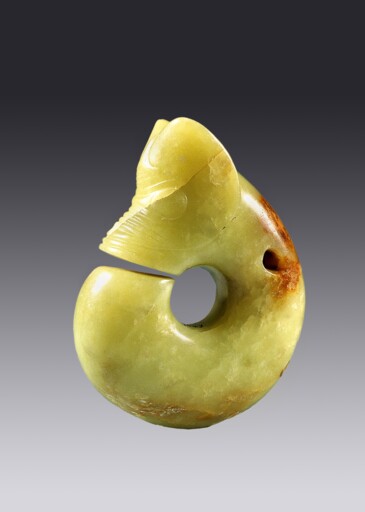
A jade artifact of the Hongshan culture Photo: PROVIDED TO CSST
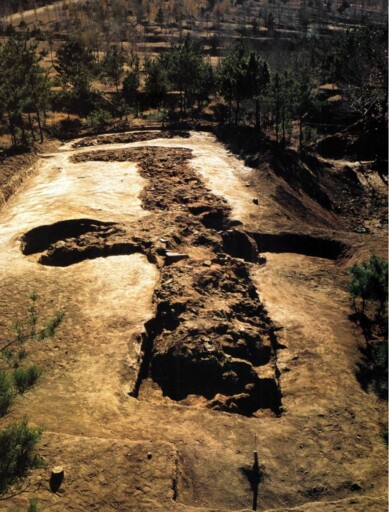
The ruins of the Goddess Temple at the Niuheliang site complex Photo: PROVIDED TO CSST
The Hongshan culture, a highly distinctive late Neolithic archaeological culture in the western Liaoning region of northern China dating back roughly 6,500 to 5,000 years, has drawn sustained scholarly attention for its sophisticated jade-artifact system, large-scale stone cairn tombs, and associated ritual remains. Scholars have generally advanced two views regarding its degree of social complexity. One, based on the Niuheliang site complex and its jade ritual system, holds that the Hongshan culture possessed a highly developed ritual order and strong capacity for social integration, and may already have entered an early stage of civilization centered on theocratic authority. The other, drawing on systematic regional survey data, argues that settlement hierarchy within the Hongshan culture was not yet pronounced, that no core settlement exerted region-wide control, and that caution is therefore warranted in judging whether it constituted a highly centralized political entity.
If one focuses only on either ritual remains or settlement patterns, this disagreement is difficult to resolve. Examining the social trajectory of the Hongshan culture more holistically, however, within the specific geographical setting of the western Liaoning region, may yield a fresh view of its distinctive path to social complexity. Although this article emphasizes the role of geography, it does not argue for environmental determinism. Rather, it treats geographical conditions as a structural context for understanding social complexity, helping reveal the particular developmental pattern that the Hongshan culture formed within its local ecological setting.
Geographical unit, cultural identity
The western Liaoning region has a semi-enclosed terrain: Mountains enclose it on three sides, while the Bohai Sea lies to the east, placing it at a considerable distance from the core areas of other contemporary cultures. In prehistoric times, this relative isolation effectively limited large-scale migration from outside the region and the direct replacement of local cultural systems, giving local traditions a stable geographical basis for continuity.
From the Xinglongwa culture and Zhaobaogou culture to the Hongshan culture, archaeological features in the region continued to evolve, yet core traditions—cylindrical jars and zigzag-patterned pottery, rows of semi-subterranean houses, the use of jade, and an emphasis on primitive religion—display clear lines of inheritance. In the late Hongshan culture in particular, the forms of jade artifacts, the structure of stone cairn tombs, and ritual vessels such as bottomless cylindrical jars show a high degree of consistency across a broad territory, including the Laoha River, Daling River, and even the Xilamulun River basins.
This broad convergence in material culture resulted from long-term interaction and the accumulation of cultural identity within a specific geographical space. It primarily took shape through continuous internal transmission and exchange under conditions of relative geographical isolation, rather than through dependence on a single political center.
Resource conditions, subsistence patterns
The western Liaoning region sits in an ecological transition zone between the Mongolian Plateau, the North China Plain, and the Northeast Plain. Its terrain includes medium and low mountains, hills, terraces, and sandy land, while its vegetation forms a complex landscape of intermingled forests, grasslands, and cultivated areas. Multidisciplinary research indicates that the Hongshan period fell within the warm and humid phase of the Holocene Climatic Optimum, and dryland farming of foxtail millet and broomcorn millet developed to some extent, but hunting, gathering, and fishing remained central—or at least extremely important—to the subsistence structure. This extensive use of and reliance on diverse wild resources was a rational adaptation by the Hongshan people to their local environment.
The mixed economic model profoundly shaped the evolution of Hongshan society. Diverse and complementary food sources reduced the risks of relying solely on agriculture and strengthened the stability and resilience of the social system, spurring a significant increase in both the number of Hongshan sites and the size of the population. At the same time, this model limited the large-scale, sustained accumulation of agricultural surplus. The concentration and control of agricultural surplus are often regarded as an important economic foundation for the deepening of social complexity, the consolidation of hierarchical systems, and the emergence of specialized administrative institutions.
The predominance of a mixed economy in the Hongshan culture implies that its path to social complexity likely lacked the powerful economic impetus—rooted in the centralized redistribution of agricultural surplus—that characterized regions such as the Central Plains. Social power in Hongshan society may have accumulated and found expression less through the control of grain surplus than through non-agricultural resources, such as ritual knowledge and skills, specialized craft techniques, and capacities related to long-distance exchange networks.
Living space, social organization
The internal topography of western Liaoning is extremely complex, with medium and low mountains, hills, and terraces as its main landforms, interspersed with river-valley plains and intermontane basins. Although the overall elevation is moderate, the terrain is rugged and cut through with ravines, leaving the space suitable for concentrated, continuous, large-scale agricultural production and compact settlement both limited and dispersed. Settlements were mostly located on river terraces, tablelands, gentle slopes, or hilltops along riverbanks, exhibiting a distribution pattern of broad regional clustering combined with dispersed small units. This settlement pattern was highly compatible with a mixed economy that required a degree of mobility and access to diverse resources.
The complex topography segmented the population into numerous relatively independent small geographical units, each with limited resource-carrying capacity and vulnerability to local hydrological hazards. This inherent spatial fragmentation and ecological vulnerability made it difficult for a large, densely populated core settlement with comprehensive functions and strong regional influence to arise organically. At the same time, the relative self-sufficiency of each geographical unit under a mixed economy reduced the internal demand for dependent economic ties between settlements.
Consequently, Hongshan society was likely organized primarily around clans or extended kin groups, which retained considerable independence and were widely dispersed. Under these conditions, a tightly structured regional political system with strong centralized control was unlikely to emerge spontaneously within the region.
Transportation networks, social integration
Transportation within the western Liaoning region was significantly constrained by its mountainous and hilly terrain. Major passageways extended along river valleys, forming a natural linear transportation network. Archaeological survey data indicates that Hongshan culture settlements were distributed mainly along rivers, with particularly dense concentrations on the western banks of north–south flowing rivers and the northern banks of east–west flowing rivers. This riverine distribution not only met the need for convenient access to water but also delineated the primary routes of movement and exchange at the time.
Because the landscape was fragmented, however, river-valley corridors tended to facilitate longitudinal connections while making lateral communication more difficult. Settlement groups distributed across different river basins could therefore maintain a relatively high degree of independence.
Within such a linear and constrained transportation network, and amid a pattern of relatively independent river basins, broad social integration across regions would have been difficult to achieve through a centralized system based on close economic dependency or military conquest. Instead, it was more likely to have proceeded through loose alliance. In the late Hongshan culture, ritual and ceremonial centers of varying scales and hierarchical ranks—such as Niuheliang, Dongshanzui, Zhengjiagou, and Caomaoshan—emerged in succession. Their significance may lie precisely here: By constructing a shared belief system and standardized ritual practices, they consolidated the cultural identity of different kinship and territorial communities and coordinated social relations beyond the level of primary-level settlements.
The jade ritual system became an important material vehicle and cultural symbol for marking status and hierarchy and for mediating between deities and humans. The construction of large platforms, altars, and stone cairn tombs required the mobilization and organization of considerable human and material resources. This process both exercised and displayed social management capacity while reinforcing a sense of collective belonging among participants. This mode of integration, dominated by religious rituals and ideology, represented an effective and distinctive way to achieve broad social integration in the absence of close economic ties and strong political structures.
Hongshan pattern of social complexity
The trajectory of social complexity in the Hongshan culture reveals a developmental path clearly distinct from the agricultural civilization of the Central Plains and deeply rooted in its regional context. The relatively enclosed geography of western Liaoning nurtured a continuous cultural tradition and a broad-based cultural identity, laying the historical foundation for the formation of a social collective. The resource conditions of this ecological transition zone shaped and stabilized a subsistence pattern dominated by a mixed economy, which gave society stability and supported population growth, but also limited the possibility of large-scale agricultural surplus, thereby affecting the economic foundation upon which complex societies typically develop and deepen.
The fragmented and dispersed living space directly contributed to a small-scale, decentralized settlement pattern and relatively independent primary-level social organizations, inhibiting the natural formation of a super-large political-economic center and a tightly structured hierarchical order. The constrained internal transportation network allowed settlement groups in different river basins to maintain a high degree of independence, which in turn fostered and reinforced a mechanism of social integration centered on shared beliefs, standardized rituals, and a jade ritual system.
By concentrating religious authority and ritual knowledge, organizing large-scale public ceremonial construction projects, and controlling specialized jade-working crafts, Hongshan society successfully coordinated and integrated relatively dispersed communities across a vast territory, achieving social prosperity and a high degree of cultural-ethical development. This model—led by theocratic authority and integrated through rituals—not only provides empirical evidence for understanding the process by which western Liaoning entered the guguo (ancient state) stage, but also offers a key case for elucidating the “sky full of stars” model of the pluralistic origins of Chinese civilization and the unique pathways to social complexity in northern China. The rudiments of the ritual system and the spiritual beliefs cultivated by Hongshan culture constituted one important source of later Chinese ritual and music culture, vividly embodying the inclusive, pluralistic yet integrated pattern and profound depth of Chinese civilization.
Chang Jingyu is an associate professor from the School of Law and Historical Culture at Yulin University. Sun Yonggang is vice president of Chifeng University and a professor at the university’s School of History and Culture.
Copyright©2026 CSSN All Rights Reserved