


Wisdom of knowing and doing in traditional Chinese philosophy of music
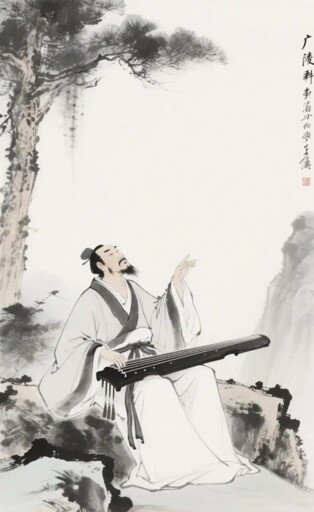
FILE PHOTO: A painting portraying Ji Kang playing the guqin
As a vital medium of the human spiritual world, music has always developed in close conversation with philosophical thought. Rooted in the pre-Qin era (prior to 221 BCE) and enriched through millennia of intellectual development, traditional Chinese music philosophy has formed a distinctive and sophisticated system of thought. The central thesis in renowned thinker and musician of the Cao Wei State during the Three Kingdoms Period (220–280) Ji Kang’s treatise Sheng Wu Ai Le Lun, meaning “music has in it neither grief nor joy,” challenged the conventional link between music and emotion from a radically new angle, dismantling the cognitive framework of the traditional liyue (rites and music) tradition. By contrast, the ideal of “yi yue yang xin” (cultivating the mind through music) has long underpinned traditional musical practice, expressing the spiritual value ancient Chinese thinkers found in music. Although these two perspectives may appear to diverge, they in fact constitute a coherent philosophical trajectory in traditional Chinese musical thought, moving from an examination of music’s fundamental nature to an understanding of its practical and ethical significance.
Redefining music
During the Wei and Jin periods (220–420), the rise of xuanxue (Neo-Daoist metaphysics) fostered an intellectual climate in which the literati increasingly pursued spiritual freedom and intellectual liberation. Against this backdrop, the traditional Confucian philosophy of rites and music came under unprecedented scrutiny. As one of the leading thinkers of Wei-Jin xuanxue, Ji Kang composed Sheng Wu Ai Le Lun from the philosophical standpoint of “transcending Confucian moral norms and following nature.” In doing so, he mounted a fundamental challenge to the conventional belief that music inherently conveys or expresses human emotions, proposing instead a radically innovative theory on the nature of music.
Ji Kang did not deny the relationship between music and human emotion; rather, he reconceived it at its foundation. At the very beginning of Sheng Wu Ai Le Lun, Ji Kang stated his central proposition: “Sound and the human mind follow different paths and operate according to different principles; they do not intersect.” This assertion establishes the independence of sound, or music, from the human mind and its emotions, and serves as the theoretical basis of his philosophy of music.
For Ji Kang, the essence of music lies in its status as the “harmony of nature.” Music is a configuration of sounds generated through the transformations of the qi (vital energy) of Heaven and Earth. As such, it possesses no inherent emotional qualities, and neither contains nor intentionally expresses feelings of sorrow or joy. Differences in pitch, intensity, tempo, and timbre are simply manifestations of the natural properties of sound. Like wind and rain, mountains and rivers, or grasses and trees, they are expressions of the natural world in its original state, independent of human emotions and moral judgments.
In Ji Kang’s view, the true value of music does not lie in moral instruction or in preserving an established social order. It lies instead in the beauty of music’s natural harmony and in its capacity to nourish the human spirit and liberate the mind. By redefining music in this way, Ji Kang broke decisively with the millennia-old Confucian conception of music as chiefly a tool of ritual and governance. His theory vividly reflected the Wei-Jin literati’s pursuit of spiritual freedom and resistance to ideological constraint, while at the same time bringing lasting intellectual vitality to the development of traditional Chinese philosophy of music.
Cultivating the mind through music
If Ji Kang’s theory of “sheng wu ai le lun” answers the fundamental question of what music is, then yi yue yang xin further defines the spiritual purpose of traditional Chinese music and represents one of the central aspirations of Chinese philosophy of music. Importantly, yi yue yang xin is not the exclusive doctrine of any single philosophical school. Rather, it is a cultural ideal that synthesizes insights from Confucianism, Daoism, and other intellectual traditions, and that has been continually transmitted and enriched through generations of musical practice. At its core, this concept affirms the transformative power of music on the inner life. Through listening to and performing music, individuals may calm inner restlessness, enrich their spiritual world, cultivate moral character, and attain personal refinement.
The Daoist interpretation of yi yue yang xin places greater emphasis on music as a means of returning to one’s original nature. Laozi’s famous proposition “da yin xi sheng” (the greatest sound is scarcely heard) suggests that the highest form of music is the authentic sound of nature, absent any artificial embellishments and ostentatious displays. Such music enables individuals to transcend worldly desires and recover the mind’s innate tranquility. Zhuangzi further advocated “ting zhi yi qi” (listening with vital energy), arguing that one should approach music without preconceived judgments or emotional expectations. Only through true emptiness and stillness of the mind can one perceive music’s natural beauty and attain a state in which the boundary between the self and the external world dissolves.
Yi yue yang xin, therefore, is far more than a doctrine of psychological or emotional cultivation—it embodies the dual pursuit of ethical self-cultivation and transcendence through a return to nature. While Confucianism emphasizes music’s role in shaping moral character, Daoism highlights its capacity to restore the mind to its natural state. Together, the two traditions complement and enrich one another, giving yi yue yang xin its full philosophical significance: Through music, individuals harmonize the mind, elevate the spirit, and ultimately transcend the ordinary condition of human existence.
Yi yue yang xin is not merely an abstract philosophical ideal; it also represents a practical path of self-cultivation. Through diverse musical practices, ancient Chinese sought to actualize this ideal of cultivating the mind, gradually shaping a rich tradition that progressed from aesthetic appreciation toward spiritual transcendence.
Among these practices, yayue (ritual or classical court music) was regarded as a principal medium for cultivating the mind. Ancient thinkers believed that its harmonious rhythms could soothe emotional agitation and restore inner equilibrium. By listening to yayue, the junzi (cultivated or exemplary person) not only moderated personal emotions but also internalized the moral values embodied in the music, achieving both emotional balance and ethical refinement.
Beyond listening, musical performance itself was considered an equally important means of yi yue yang xin. For the traditional literati, the qin (zither), chess, calligraphy, and painting constituted the four principal arts of self-cultivation, among which guqin (7-stringed zither) music played a particularly prominent role as a vehicle for nourishing the mind. Guided by aesthetic ideals of clarity, subtlety, simplicity, and remoteness, performers were expected to cultivate complete concentration and inner tranquility, free from distracting thoughts, so that the movement of the fingers, the rhythm of the music, and the emotions of the heart became fully integrated.
Playing the guqin was therefore far more than a mere act of musical performance. It was a refined process of entering into dialogue with the music, an engagement in self-reflection, and a cultivation of the inner self. Through this art, individuals could gradually release themselves from the distractions and restlessness of the mundane world, attain a state of inner composure, and deepen the richness of their spiritual being.
Unity of knowledge and practice
Although the theory of sheng wu ai le lun and the notion of yi yue yang xin may appear to represent divergent philosophical positions, they in fact form an integrated intellectual framework within traditional Chinese philosophy of music. Together, they trace the evolution of musical thought from inquiry into the essential nature of music to the realization of its spiritual and ethical value.
Sheng wu ai le lun broke decisively with conventional assumptions and offered a radically new understanding of music’s nature. By disentangling music from inherent emotional content, it laid the theoretical foundation on which the thought of yi yue yang xin could be further developed. Building on this inquiry into music’s essence, yi yue yang xin articulated music’s practical and spiritual significance, transforming abstract reflection into a lived practice of self-cultivation. Together, these two strands of thought established a coherent philosophical framework that progresses from understanding the nature of music, to defining its spiritual and ethical value, and finally to guiding human practice. Rather than standing in opposition, they are mutually reinforcing and complementary, jointly forming the spiritual core of traditional Chinese philosophy of music.
The intellectual development from sheng wu ai le lun to yi yue yang xin ultimately reflects a shift from the pursuit of intellectual emancipation to a profound concern for human flourishing, revealing the human-centered spirit at the heart of traditional Chinese philosophy.
Ji Kang’s theory of sheng wu ai le lun emerged from the intellectual milieu of Wei-Jin xuanxue, where its central aspiration was the liberation of thought and the attainment of spiritual freedom. By deconstructing the constraints imposed by the traditional Confucian philosophy of rites and music, Ji Kang offered the literati an entirely new understanding of music and a new ideal of spiritual fulfillment—one which affirmed the value of individual intellectual and spiritual autonomy.
The thought of yi yue yang xin, by contrast, transformed this ideal of intellectual liberation into a philosophy centered on the cultivation of human life. It emphasizes music’s capacity to nurture the mind, cultivate moral character, and elevate one’s realm of existence, reflecting the enduring concern of traditional Chinese philosophy with individual well-being and flourishing. Traditional Chinese philosophy of music was thus able to escape the confines of metaphysical speculation and engage closely with lived practices of self-cultivation, offering spiritual guidance that could enrich everyday life and support human flourishing.
This progression from intellectual emancipation to concern for human flourishing also reflects the traditional Chinese philosophical ideal of “zhi xing he yi” (unity of knowledge and practice). Sheng wu ai le lun represents the dimension of knowledge, providing a deeper understanding of the essential nature of music, while yi yue yang xin represents the dimension of practice, offering concrete ways to incorporate music into self-cultivation. Together, they bring knowledge and practice into a unified whole, ensuring that traditional Chinese philosophy of music possesses not only theoretical depth but also practical significance. In this way, music becomes more than an object of philosophical reflection; it becomes part of lived experience itself—a powerful means of spiritual nourishment, self-cultivation, and the elevation of human existence.
Yao Lan is an associate professor from Hunan University of Arts and Science.
Copyright©2026 CSSN All Rights Reserved