


Dongba literature: Living fossil of multiethnic integration
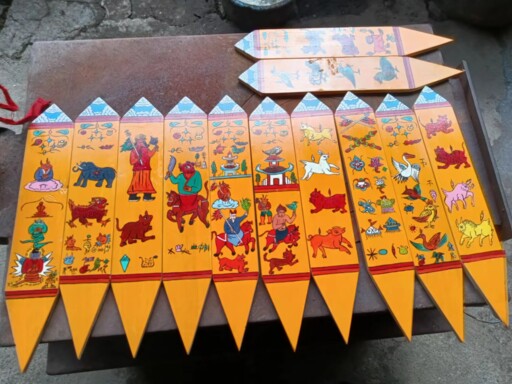
Dongba wooden tablet paintings Photo: PROVIDED TO CSST
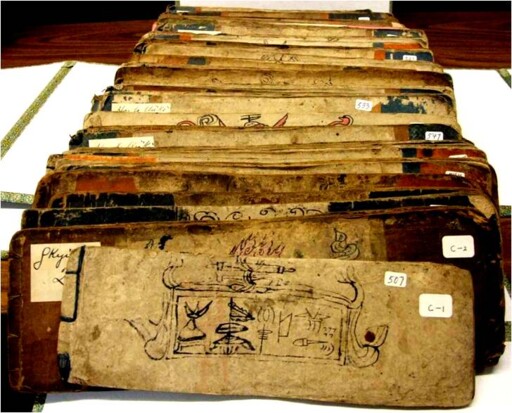
Dongba scriptures collected by the National Library of China Photo: PROVIDED TO CSST
Dongba literature refers collectively to the oral and written literary works created and transmitted by the Dongba, the priests of the Naxi ethnic group in China. Today, more than 30,000 volumes of Dongba manuscripts are held in collections at home and abroad, encompassing approximately 1,000 different types of Dongba scriptures, many of which contain a wealth of classical Naxi literary works. The broader manuscript tradition received international recognition in 2003, when the ancient Dongba manuscripts were inscribed on UNESCO’s Memory of the World Register.
Throughout their history, the Naxi people have engaged in extensive interaction, exchange, and integration with neighboring ethnic groups, including the Han, Tibetan, Bai, Yi, Pumi, and Lisu peoples. While retaining the distinctive cultural character of the Naxi people, Dongba literature has also absorbed diverse cultural influences, offering a microcosm of the pluralistic and integrated pattern of Chinese civilization.
Connections between Dongba and Central Plains cultures
The Naxi people trace their origins to the ancient Qiang tribe who inhabited the Huanghe and Huangshui valleys in northwest China during the pre-Qin period (prior to 221 BCE). This ancestral heritage has fostered deep cultural connections between the Naxi and the peoples of the Central Plains.
The “Heaven Worship” ceremony offers a telling example. The Naxi refer to themselves as “a people who worship Heaven,” and the ceremony, held each Spring Festival, is the first Dongba ritual of their annual cycle. The Confucian classic The Analects, in the “Ba Yi” chapter, records: “The Xia [c. 21st century–16th century BCE] sovereign planted the pine tree about them; the men of the Yin [Shang, 1600–1046 BCE] planted the cypress; and the men of the Zhou [c. 11th century–256 BCE] planted the chestnut tree, meaning thereby to cause the people to be in awe.” Likewise, the Naxi Heaven Worship ceremony uses pine, cypress, and chestnut as sacred trees.
The Dongba literary classic The History of Human Migration recounts: “A person’s maternal uncle is Heaven, and Heaven’s maternal uncle is the cypress. The cypress, taking deep root on the high cliffs, became Heaven’s maternal uncle. With lush cypress trees standing by the gate of Heaven, Heaven remains firm and unshaken.” From the ritual traditions recorded in pre-Qin texts to the living tradition of Heaven Worship preserved by the Naxi people today, these practices reveal a cultural connection extending across history.
Parallels in divination practices are equally noteworthy. Most Shang Dynasty oracle bone inscriptions consist of divination records carved on turtle shells and animal bones. Diviners heated the shells or bones to produce cracks, then interpreted their patterns and directions to determine whether an event would bring good or ill fortune. This practice of divination through heated bones, together with the interpretation of the resulting omens, has survived as a living tradition in Dongba sacrificial rituals to this day.
Parallels also appear in mythology. Motifs found in Central Plains traditions—including the creation of Heaven and Earth, the great flood, the shooting down of the suns, sibling marriage, birth from eggs, and metamorphosis—have their counterparts in Dongba mythology. The Shiji (Records of the Grand Historian), in the “Annals of Yin,” recounts that Jian Di, the ancestral founder of the Shang people, “was going with her two sisters to bathe, when she saw a dark bird drop its egg. Jian Di picked it up, and swallowed it, and thus being with child gave birth to Qi.” Dongba mythology similarly contains accounts of human ancestors emerging from eggs, as well as deities and animals being born from eggs.
Influence of Central Plains thought
The influence of Central Plains culture on Dongba literature extends beyond such external forms as the calendar, writing system, and classical texts to the deeper level of ideas and values. Throughout history, the Naxi people have sustained economic, political, cultural, and intellectual exchanges with other ethnic groups. These enduring interactions have fostered a strong sense of community for the Chinese nation.
During the Eastern Han Dynasty (25–220), the Bailang Qiang people, ancestors of the Naxi, presented three poems to the central court collectively known as the “Bailang King’s Odes to the Han Emperor,” titled respectively “Song of the Bailang People Rejoicing in Virtue,” “Song of the Bailang People Admiring Virtue,” and “Song of the Bailang People Cherishing Virtue.” Together, they expressed a sense of cultural identification encapsulated in the words “yearning for righteousness and turning to the benevolent rule, with hearts devoted to the caring motherland.”
After the Yuan Dynasty (1271–1368) established administrative institutions in the Naxi region, Han Chinese culture spread extensively throughout the region. During the Ming (1368–1644) and Qing (1644–1911) dynasties, the Mu chieftains took the lead in studying Han Chinese culture, giving rise to a literary circle known as the “Six Masters of the Mu Clan.” Following the reform of the native chieftain system in the first year of the Yongzheng reign of the Qing Dynasty, more than a hundred scholars from the Naxi region earned degrees through the imperial examination system. The values of Central Plains culture were gradually integrated into traditional Naxi culture, with filial piety and reverence for ancestors finding clear expression in Dongba literature.
Loyalty and trustworthiness are likewise strongly emphasized as core values in Dongba literature, particularly in the creation epic The Creation of the World and the heroic epic The War between Dong and Shu. This orientation resonates with the moral ideals of loyalty and keeping one’s word in Central Plains culture. Through literary narratives, these values have fostered a stronger sense of cultural identification with, and belonging to, the Chinese nation.
‘Brotherly peoples’ narrative in Dongba literature
As the Naxi people expanded their area of settlement from the Huanghe and Huangshui valleys at the confluence of Gansu and Qinghai provinces to the Jinsha River basin at the intersection of Yunnan, Sichuan, and Xizang, they engaged in extensive interaction, exchange, and integration with ethnic groups such as the Tibetan, Qiang, and Yi.
Dongba literary classics extensively document the cultural commonalities shared with descendants of the ancient Qiang, including the Tibetan, Yi, Lisu, Lahu, Hani, Achang, and Qiang. These shared cultural traits encompass nature worship, funeral customs, wooden tablet paintings, the father-son linked naming system, soul-sending traditions, tiger totem worship, black-and-white color culture, as well as traditional clothing, cuisine, and architecture. Such records provide valuable material for studying the historical distribution, interaction, and integration of ethnic groups, while revealing patterns of interaction and evolution among different peoples, cultures, and economic systems.
The narratives of ethnic origins in Dongba literature vividly reflect an ethos of multiethnic integration. The creation epic The Creation of the World recounts that after the great flood, the survivor Congren Li’en endured immense hardships and married the heavenly maiden Chenhong Baobai. Seeking to enable their three mute sons to speak, the couple offered sacrifices to Heaven and Earth with the assistance of a bat. The ritual had the desired effect: The sons began to speak Naxi, Tibetan, and Bai languages respectively, becoming the ancestors of the Naxi, Tibetan, and Bai peoples. In the version circulated in the eastern Naxi dialect region, the three brothers became the ancestors of the Tibetans, the Naxi, and the Han Chinese. This conception of cultural identity transcends the boundaries of a single ethnic group, reflecting an inclusive and open sense of community.
Although the heroic epic The War between Dong and Shu centers on the war between the Dong and Shu tribes, scholarly research indicates that it was influenced by The Battle of Ye and Ngam, a Tibetan classic of the Bon religion, as the two works closely parallel one another in textual structure, plot, and character portrayal. The influence of Tibetan culture is also evident in numerous ritual texts of the Dongba religion: Duoge sa Text is derived from the Bon text Drang rGan Text, while White Bat’s Search for Sacred Books is derived from the Bat Sutra. These examples illustrate the pervasive nature of cross-ethnic cultural borrowing in Dongba literature.
The value of Dongba literature extends beyond its academic status as the “only living pictographic writing system in the world” or an “encyclopedia of ancient Naxi society.” Its greater significance lies in the living evidence it provides of multiethnic interaction, exchange, and integration. From its ancestral ties to Central Plains cultures to its narratives of relations with other ethnic groups, and from the internalization of shared values to the formation of a regional cultural community, Dongba literature has remained in continuous cultural dialogue with surrounding multiethnic groups throughout its development, ultimately giving rise to a cultural system shaped by diverse and interwoven influences.
Yang Jiehong is a research fellow from the Institute of Ethnic Literature at the Chinese Academy of Social Sciences.
Copyright©2026 CSSN All Rights Reserved