


Hoofbeats of history: Horses in Shang and Zhou China
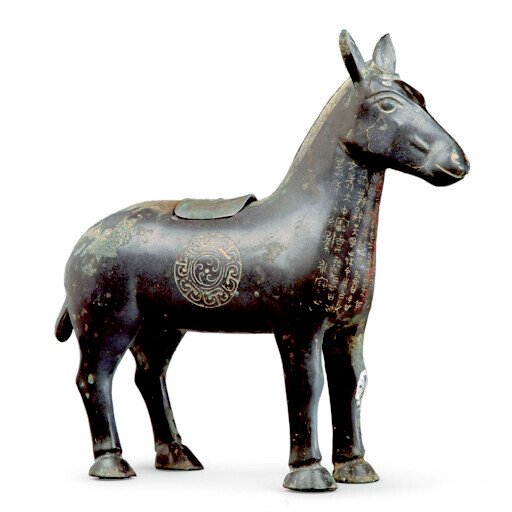
The liju zun dating to the mid-Western Zhou period, now housed at the National Museum of China Photo: PROVIDED TO CSST
In traditional Chinese culture, the horse came to embody vitality, ambition, and an unflagging drive forward, earning a cherished place in the writings of generations of literati. Yet horses were far more than cultural symbols. As prized livestock and vital instruments of warfare, their spread and use helped reshape patterns of population interaction, the military landscape, and even the course of civilization during the Shang (c. 1600–1046 BCE) and Zhou (1046–256 BCE) dynasties.
Origins of the domestic horse
The ancestry of the genus Equus can be traced back to Eohippus (Hyracotherium), which lived in North America some 58 million years ago. Over the course of its long evolutionary history, the horse passed through forms including Mesohippus, Merychippus, Pliohippus, Hipparion, and Plesippus before the emergence of the modern horse.
In China, possible remains of domestic horses dating to before the Xia Dynasty (c. 2070–1600 BCE) have occasionally been identified in the upper reaches of the Yellow River, including at the Yongjing Dahezhuang, Qinweijia, and Huoshaogou sites of the Qijia culture, as well as at Dashanqian in Harqin Banner, Inner Mongolia, and Shimao in Shenmu, Shaanxi, both associated with the Xiajiadian culture.
Further evidence comes from the Shimao site, where stone carvings showing a figure shooting a horse and cattle-and-horse motifs have been discovered in the southern passageway of the Huangchengtai platform. Finds such as these have often been taken as evidence that domesticated horses had appeared in China as early as 4,000 years ago. Yet the remains identified as domestic horse are exceedingly scarce and are generally found alongside those of wild horses. Recent genetic testing further suggests that the domestic horses present during this period were not necessarily bred locally, but were likely introduced from the steppe.
The archaeological record changes markedly in the late Shang. Although no horse bones or other horse-related remains have been found at major early Shang centers such as Yanshi Shang City, Zhengzhou Shang City, or Xiaoshuangqiao, large concentrations of domestic horse remains appear at Yinxu in Anyang, Henan, around 3,300 years ago. There, during the early phase of Yinxu Culture Period II, archaeologists uncovered more than 100 chariot-and-horse pits at the Xibeigang royal tombs and the Xiaotun North locus. The horses, buried in groups of one to 37, served as sacrificial offerings to deities and ancestors.
Similar chariot-and-horse pits have also been discovered at Laoniupo in Xi’an, Shaanxi, and Qianzhangda in Tengzhou, Shandong. Subsequent ancient DNA analysis and carbon-nitrogen stable isotope testing by zooarchaeologists confirmed that the sacrificial animals were domesticated horses. Taken together, these finds suggest that by the late Shang, communities along the middle and lower reaches of the Yellow River had developed the capacity to breed and manage horses on a large scale and had begun incorporating them into sacrificial and ritual practices.
Scholars have generally linked this late-Shang transformation to influences arriving from beyond the Central Plains. First, the late Shang coincided with the closing phase of the Holocene Climatic Optimum, as conditions became progressively drier and colder—changes that may have favored the introduction of domestic horses and horse-training techniques into the Central Plains. Second, the arrival of horses and horse-drawn chariots was likely bound up with both conflict and exchange between the Shang and northern ethnic groups. Oracle bone inscriptions from Yinxu record the Shang king raising horses, ordering outside groups to present horses as tribute, and employing two-wheeled spoked chariots.
Given the absence, so far, of Shang-period horses or horse-drawn chariots in Qinghai, Gansu, and neighboring regions, American sinologist Victor Mair has proposed a different route of transmission. He argued that the Tarim Basin in Xinjiang was generally too inhospitable for horses and that horses and chariot technology instead moved southward from the eastern Mongolian Plateau through populations associated with the Ulaanzuukh culture, reaching the Yinshan region around 3,500 years ago. From there, they had reached the Zhaigou site in Qingjian, Yulin, Shaanxi, by no later than 1260 BCE, before gradually spreading eastward to Yinxu in Anyang and into the heartland of the Central Plains.
Horses in war and ritual
The oracle bone character for “horse” is a classic pictograph: a long head, large eyes, four legs, and a flowing mane capture the spirited bearing of a fine steed. Divination inscriptions further show that by the late Shang, specialized offices had emerged to oversee horses, including duoma (official for many horses), zouma (mounted messenger), duoma qiang (Qiang horse-officer), and maxiaochen (minor minister of horses).
Further clues come from the Yinxu burials: Chariot drivers interred in chariot-and-horse pits, as well as individuals buried in sacrificial pits, were often accompanied by Ordos-style weapons and tools. This evidence suggests that northern groups with steppe backgrounds took part in late-Shang military activities, raising horses and driving chariots for the Shang nobility. Tigers may also have posed one of the greatest threats to domestic horses during this period, helping explain why horses in the Central Plains were generally kept in pens.
The Zhou inherited the Shang tradition of horse raising and developed it further. In 2013, a Ma Yu you—a bronze wine vessel—was unearthed from early Western Zhou (1046–771 BCE) Tomb No. 126 at the Yejiashan site in Suizhou, Hubei. Its inscription records that “Ma Yu began to raise horses... [and] made this precious ritual vessel for Father Wu.” This is the earliest known Western Zhou record of horse raising. Ma Yu, the vessel’s owner and a descendant of the Shang, had been rewarded for his service in raising horses and subsequently commissioned the vessel for his father.
The Zhou frontier offers further evidence of the central role horses played in Zhou life. At Yaoheyuan, the Zhou people’s northwestern-most military outpost, archaeologists have recovered the remains of more than 100 horses over successive excavation seasons, most of them young adults—a pattern consistent with heavy military demand for horses.
Their importance also extended into court ritual. The Zhou king regularly took part in the zhiju (horse inspection) ceremony, and the liju zun, a bronze foal-shaped vessel unearthed at Zhouyuan in Shaanxi, offers vivid material evidence of the practice, including the royal bestowal of foals as rewards. Its inscription closely corresponds to accounts of the zhiju ceremony in the Rites of Zhou, attesting to the growing formalization of horse-raising rituals in the Western Zhou and the court’s high regard for horse breeding. The vessel’s enduring cultural resonance is reflected in the 2026 CCTV Spring Festival Gala mascot “Qiqi,” whose design was modeled on the liju zun.
By the Eastern Zhou (770–256 BCE), the horse’s military role had become still more pronounced. Horse remains from this period are commonly found in the capitals of major states and at military strongholds, including the Guo State cemetery at Sanmenxia, the cemetery of the Zheng rulers, the tomb of Zhao Yang, a minister of the Jin state, and the Spring and Autumn Period (770–476 BCE) Houli chariot-and-horse pit in Zibo, Shandong.
Chariot driving accordingly became an essential part of aristocratic education. The Rites of Zhou records that from the Western Zhou through the Spring and Autumn Period, young aristocrats were expected to master yu, the art of driving a horse-drawn chariot.
In an age dominated by chariot warfare, mastery of the reins mattered in military campaigns, diplomatic missions, and sacrificial ceremonies alike. Chariotry was also understood as a form of self-discipline: The ancients likened controlling a horse to controlling the mind. For aristocratic youths, driving thus became a compulsory discipline combining technical skill, ritual propriety, military training, and self-cultivation.
As contact intensified between the Central Plains states and northern ethnic groups, mounted warfare began to spread into the Central Plains as well. Historical records recount that in the late Warring States Period (475–221 BCE), King Wuling of Zhao recognized that both chariot warfare and the loose robes worn by Zhao troops placed them at a disadvantage in battle. He therefore introduced the reform known as Hufu qishe (Hu-style dress and mounted archery), adopting northern attire and organizing cavalry forces. The reform strengthened Zhao’s military and expanded its territory, prompting other states to develop cavalry forces of their own.
Historical accounts describe the State of Yan as possessing “several hundred thousand armored soldiers, six hundred chariots, and six thousand cavalry”; Qin, “a thousand chariots and 10 thousand cavalry”; Chu, “a million armored soldiers, a thousand chariots, and ten thousand cavalry”; and Wei, “six hundred chariots and five thousand cavalry.” In the ensuing wars of annexation and unification among the Seven Warring States, Qin—a state renowned for horse breeding—ultimately prevailed, underscoring just how central the horse had become to warfare among various states.
Zhao Yanjiao is a research fellow from the Institute of International Confucian Studies at Shandong Academy of Social Sciences.
Copyright©2023 CSSN All Rights Reserved