


Chinese, Uzbekistani scholars exchange insights into governance
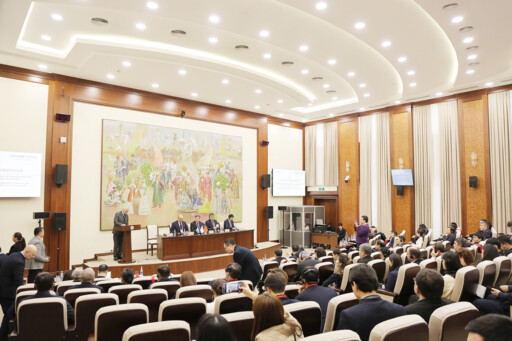
A scene from the symposium Photo: PROVIDED TO CSST
On Jan. 29, a China–Uzbekistan symposium on “global dynamics and state governance” was held in Tashkent, the capital of Uzbekistan.
Building consensus on development
In his keynote address, Javlon Vakhabov, director of the International Institute for Central Asia in Uzbekistan, underscored the significance of the symposium against the backdrop of what President Xi Jinping has described as “profound changes unseen in a century,” noting that promoting open and pragmatic diplomacy and creating favorable conditions for modernization across countries have become critical priorities.
In this context, Vakhabov said, Uzbekistan’s mutually beneficial cooperation with countries committed to safeguarding security and development in Central Asia is of particular importance, with China serving as a core partner. In recent years, Uzbekistan–China relations have advanced steadily, encompassing political dialogue, security cooperation, economic and trade exchanges, people-to-people interactions, and other key areas. Regular political dialogue between the heads of state of the two countries, he added, constitutes a key driving force for deepening bilateral cooperation, with Uzbekistan–China collaboration increasingly seen as a model of pragmatic partnership supporting the sustainable development of both nations.
In his keynote speech, Liao Fan, director general of the Institute of World Economics and Politics at the Chinese Academy of Social Sciences (CASS), stated that China and Uzbekistan should further strengthen platforms for cooperation and exchange, learn from each other, and complement one another’s strengths, in order to provide intellectual support for high-quality development and enhanced governance capacity in both countries.
The two economies are highly complementary and enjoy a solid foundation for cooperation, Liao noted. By leveraging their respective resource endowments and technological advantages, and by focusing on cultivating new quality productive forces, the two sides can deepen synergistic cooperation in emerging fields such as the digital economy, green energy, and high-end manufacturing. This, he said, would facilitate high-quality economic and social development in both countries and ensure that the benefits of cooperation are more widely shared.
Liao added that the rapid iteration of new-generation information technologies, including artificial intelligence (AI) and big data, has opened new pathways for global connectivity and created vast spaces for China–Uzbekistan cooperation. Building on existing momentum, both countries should further enhance synergistic coordination in the digital domain.
Sharing practical outcomes
Jasur Salikhov, rector of the Academy of Public Policy and Administration under the President of Uzbekistan, affirmed that amid global transformation, digitalization and technological change are placing higher demands on state governance. In this context, the governance experiences of Uzbekistan and China offer valuable points of mutual reference. Salikhov noted that Uzbekistan has creatively adapted China’s experiences to its own national conditions and places high value on cooperation with relevant Chinese institutions. His academy has established specialized centers focusing on digital governance transformation and the application of AI tools, contributing to improvements in the quality and efficiency of national governance decision-making.
Du Zhixiong, Party secretary of the Rural Development Institute at CASS, shared insights into poverty reduction, describing China’s poverty alleviation efforts as a historic undertaking. Through the targeted poverty alleviation strategy, he said, all 98.99 million rural poor were lifted out of poverty as scheduled, achieving the poverty reduction target of the United Nations 2030 Agenda for Sustainable Development 10 years ahead of schedule.
China’s contribution of more than 70% to global poverty reduction, Du explained, stems from a range of institutional and policy safeguards. He acknowledged Uzbekistan’s progress in poverty reduction and emphasized that experience sharing in this field is of great significance for consolidating achievements and preventing a relapse into poverty.
Promoting high-quality development
Murat Bakhadirov, an associate professor from the Department of International Relations at the University of World Economy and Diplomacy in Uzbekistan, believes that the “Uzbekistan-2030” strategy aligns closely with the core priorities of China’s 15th Five-Year Plan (FYP, 2026–30), with the cooperation model evolving from isolated projects toward a more integrated system linking industries, institutions, and capabilities.
Bakhadirov identified three key drivers of future collaboration: next-generation industrial cooperation centered on new quality productive forces, digital transformation, and ecological and energy transitions. He also proposed building a portfolio of interconnected flagship projects, establishing a “capacities-for-investment” mechanism, and strengthening institutional safeguards, stressing that aligning Uzbekistan’s 2030 Strategy with China’s 15th FYP would inject sustained growth potential into the bilateral partnership.
Cai Yuezhou, deputy director general of the Institute of Quantitative and Technical Economics at CASS, observed that the economic structures of China and Uzbekistan are highly complementary, while the opening of the China–Kyrgyzstan–Uzbekistan Railway will further shorten the distance for cooperation. In the short term, computing infrastructure in China’s Xinjiang region can support Uzbekistan’s industrial intelligent transformation, while over the longer term it can assist Uzbekistan in building its own computing capacity, pointing to broad prospects for cooperation.
Editor:Yu Hui
Copyright©2023 CSSN All Rights Reserved