


Chinese, Kyrgyz scholars explore paths for joint development, modernization
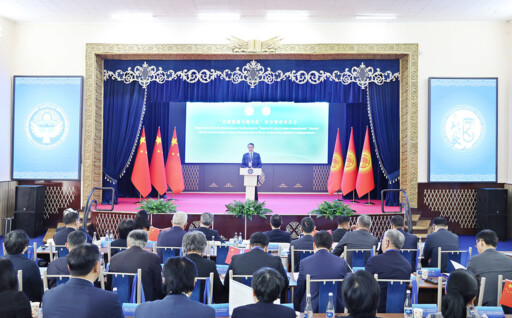
A scene from the dialogue Photo: Zhu Gaolei/CSST
On Jan. 28, a China–Kyrgyzstan think tank dialogue themed “common development and modernization” was held in Bishkek, the capital of Kyrgyzstan. Participants included Gao Xiang, president of the Chinese Academy of Social Sciences (CASS); Arslan Koichiev, state secretary of Kyrgyzstan; Karim Khanjeza, deputy speaker of the Parliament of Kyrgyzstan; Liu Jiangping, Chinese ambassador to Kyrgyzstan; Gulzat Isamatova, minister of Science, Higher Education, and Innovation of Kyrgyzstan; and Dogdurbek Chontoev, rector of Kyrgyz National University (KNU).
In his keynote address, Sun Zhuangzhi, director general of the Institute of Russian, Eastern European, and Central Asian Studies at CASS, noted that China will align its 15th Five-Year Plan (2026–30) with the medium- and long-term development strategies of Central Asian countries, jointly creating and sharing new development opportunities.
Through concrete actions, Sun said, China aims to embody the “China–Central Asia Spirit,” deliver more tangible outcomes from practical cooperation to benefit people across the region, and work together to build a community with a shared future. Under the Belt and Road Initiative (BRI), extensive cooperation and alignment have opened up a new path toward good-neighborly friendship and win-win outcomes, setting an example for a new type of international relations.
Timur Abelayev, deputy director of the National Institute for Strategic Initiatives under the President of Kyrgyzstan, observed that Kyrgyzstan and China are connected not only by economic and trade ties, but also by their active exploration of governance, reform, and modernization pathways. For Kyrgyzstan, the practical dimensions of Chinese modernization are especially noteworthy. “We have a special interest in China’s experience in poverty reduction and improving the efficiency of local institutions, which we see as a valuable source of solutions suited to our national conditions,” Abelayev said.
Forging strategic consensus
“In the process of modernization, we are all latecomers, yet modernization is by no means the privilege of a select few nations. Achieving modernization is a common right for all peoples, including those of China and Kyrgyzstan,” said Lin Jianhua, Party secretary of the National Academy of Chinese Modernization (NACM) at CASS, highlighting from a broad modernization perspective the profound significance of China and Kyrgyzstan advancing development together.
“China’s development achievements demonstrate that forging strategic consensus and pooling momentum for development are the two pillars for the successful implementation of any strategy,” remarked Sheradil Baktygulov, director of the Institute for World Policy Study in Kyrgyzstan and head of the Research Department of the Kyrgyz-Chinese Research Institute at KNU. For scholars and researchers from both countries, Baktygulov suggested, “we shoulder a significant mission—to explore a mutually agreed-upon path that mobilizes our peoples to work together toward the grand goals of sustainable development and to address global and regional challenges.”
Zhang Ning, director of the Central Asia and Caucasus Department at the CASS Institute of Russian, Eastern European, and Central Asian Studies, stressed that strategic consensus is key and foundational to ensuring the steady and long-term development of bilateral relations. He outlined the core framework of strategic consensus between China and Kyrgyzstan, underscoring the solid foundation and clear direction of cooperation. Figures such as the $22.7 billion in bilateral trade recorded in 2024, he added, serve as tangible evidence of the partnership’s effectiveness.
Deepening collaborative innovation
“China–Kyrgyzstan collaborative innovation and connectivity cooperation not only serve as an engine for high-quality development of bilateral relations, but also provide crucial support for regional integration,” said Xu Xiujun, deputy director general of the NACM. He emphasized that under the BRI, bilateral relations have continued to deepen, yielding substantial results in collaborative innovation and connectivity cooperation. These achievements are specifically reflected in closer strategic alignment, notable progress in infrastructure connectivity, the steady expansion of economic, trade, and production-capacity cooperation, and the continued strengthening of cultural and technological exchanges.
Kanatbek Aziz, a corresponding member of the National Academy of Sciences of the Kyrgyz Republic, underscored the importance of regional-level cooperation at a time when global cooperation faces mounting challenges, the old international order is under strain, and a new order has yet to fully take shape. Since the establishment of diplomatic relations, China–Kyrgyzstan bilateral ties have maintained a stable development trajectory. Under the BRI, pragmatic cooperation in areas such as green agricultural exports, logistics, and infrastructure has delivered visible results, although significant potential for deeper cooperation remains to be realized.
Civilizational exchange as a bridge
Translation serves as a vital bridge for advancing China–Kyrgyzstan relations, providing key support for deepening economic, cultural, and political ties between the two countries. Major projects such as the China–Kyrgyzstan–Uzbekistan Railway have created pressing demand for the translation of documents, contracts, and technical materials, while the mutual translation of literary works has also yielded fruitful results. The two countries have planned to translate 150 works from each other, calling for greater efforts to address challenges such as a shortage of qualified bilingual translators and differences in linguistic and cultural norms.
Adili Jumatuerdi, a research fellow from the Institute of Ethnic Literature at CASS, has been deeply devoted to a project for mutual translation of classic works. He noted that a memorandum signed in 2022 commits the two countries to translating and publishing at least 50 classic works within five years. “This will further enhance the people’s understanding and appreciation of each other’s fine cultures, and promote cultural exchange and mutual learning,” he said, expressing confidence that “literature will play an irreplaceable and crucial role in civilizational exchange.”
Editor:Yu Hui
Copyright©2023 CSSN All Rights Reserved