


Returning youth harness digital media to drive rural revitalization in China
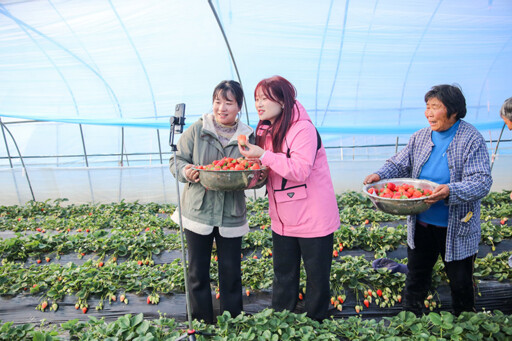
Young village officials in Banjing Town, Jiangsu Province, promote rural revitalization through livestreaming e-commerce. Photo: IC PHOTO
With the widespread adoption of digital technologies and the restructuring of urban–rural relations, returning youth are leveraging social media, short video platforms, and other emerging communication tools to reshape their identities, information practices, and social networks. Through these efforts, they are becoming an increasingly important force in advancing comprehensive rural revitalization. Their distinctive communication practices challenge traditional urban-rural dichotomy narratives and inject new vitality into the digital countryside. At the same time, however, challenges such as the digital divide, cultural tensions, and questions of sustainability remain.
Fundamental identify shift
As China’s rural revitalization strategy advances and digital technologies penetrate more deeply into rural areas, a new “homecoming wave” is quietly emerging. Unlike earlier generations who returned to the countryside largely due to economic cycles, the new generation of returning youth is characterized by initiative, development-oriented thinking, and digital fluency. Even while living in rural areas, digital media enables them to remain connected in real time with urban information flows, capital flows, and social networks amid globalization. As such, they are both rooted in the countryside and active participants in the digital world.
This new mobility paradigm traces its origins to the “mobility turn” in communication studies, which emphasizes mobility itself as a central analytical lens. It focuses on the movement of people, goods, capital, and information across space, as well as the socio-cultural implications of these flows.
Under this “new mobility paradigm,” the identity of returning youth has undergone a fundamental shift. No longer confined to the roles of physical laborers or passive recipients of urban civilization, they have become “super communication nodes” linking urban and rural areas. By combining knowledge, skills, and social capital accumulated in cities with digital tools, they transform these resources into new factors of production for comprehensive rural revitalization. What they disseminate is not only information, but also new lifestyles, market concepts, and governance philosophies.
Innovative communication practices
After returning to the countryside, many young people document the entire process of planting, nurturing, and harvesting in family orchards using short videos. Through authentic narratives emphasizing “all-natural” production and “no additives,” they build trust with audiences and subsequently engage in sales via livestreaming. This process embodies the principle that “communication is commerce,” bypassing traditional multi-tiered distribution channels, restructuring agricultural supply chains, and shifting the paradigm from “consumers seeking products” to “products reaching consumers.” While the act of communication itself directly generates economic value, it also draws consumers into imaginative and emotional connections with rural life.
Returning youth also record rural traditions—such as local festivals, regional cuisine, dialects, and everyday life—from a first-person perspective, using short videos as a form of self-expression. Rich content combined with relaxed, humorous, or warm storytelling styles attracts external attention while fostering cultural pride among local villagers, particularly younger generations. In this way, rural culture undergoes a process of “re-localization.”
Historically, mass outflows of young people often resulted in the “hollowing out” of rural communities, weakening traditional social bonds. Returning youth, however, bring digital skills back to the countryside and establish various functional online communities where villagers can discuss public affairs, organize cultural activities, and coordinate production on online platforms. In this process, returning youth often emerge as opinion leaders, drawing on their broader perspectives and technical expertise to help foster new forms of rural public life.
The identity of returning youth has long been stuck between the roles of “farmer” and “worker.” Social media now provides a space for negotiating and integrating these dual identities. On platforms such as WeChat, they showcase the idyllic charm of rural life while also sharing perspectives on urban affairs and industry trends. This multifaceted identity breaks away from singular narratives and, through communication practices, helps construct a new form of urban–rural integrated identity. Now able to flexibly mobilize resources from both rural and urban settings, returning youth maintain ties with cities while putting down roots in rural development, becoming a stabilizing force in rural demographics and a driver of endogenous vitality.
New model for rural development
Communication empowerment also leads to a phenomenon akin to the “Matthew effect.” Returning youth, adept at using digital tools, are more likely to succeed, while those with lower educational attainment or limited digital skills may risk further marginalization, causing digital stratification within rural communities. The pursuit of online traffic may also steer content creation toward sensationalism, vulgarity, or to homogenized “idyllic” templates, eroding local uniqueness and authenticity.
When individual online personalities become overly dominant, they may foster new forms of individualism that challenge traditional collectivist rural culture. The involvement of external capital may also divert rural development away from the shared interests of local communities. Stable internet infrastructure, efficient logistics, professional training, and inclusive policies are crucial for the sustainable and healthy development of the “new mobility paradigm,” yet such conditions remain lacking in many remote regions.
Liu Yanchun is a lecturer from the College of Educational Science and Technology at Nanjing University of Posts and Telecommunications (NJUPT). Zhang Luyun is a special research fellow from the institute of artificial intelligence and communication at NJUPT.
Editor:Yu Hui
Copyright©2023 CSSN All Rights Reserved