


How people’s experience enters public scholarship
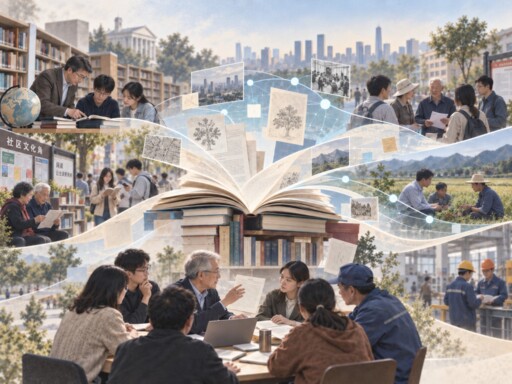
Public scholarship is emerging as a new paradigm of knowledge production. Image generated by AI
Discussion of “public scholarship” has recently gathered momentum, drawing broad attention across society. Growing numbers of academic researchers and members of the public interested in particular issues are coming together across traditional academic boundaries to exchange ideas and collaborate, giving scholarly expression to experiences previously dispersed throughout everyday life.
Bringing individual experience into grand historical narratives
Reflections on “knowledge co-creation” in oral history begin with incorporating people’s everyday experiences into historical writing. Over the more than 70 years since the founding of the PRC, every major transformation in the state and society has been closely bound up with ordinary people’s daily lives. The significance of oral history lies, first and foremost, in bringing these grassroots, micro-level, and everyday individual experiences into broader historical narratives.
For example, oral history research on the PRC’s industrial development conducted by the Institute of Contemporary China Studies at Nanjing University found that rank-and-file workers involved in Third Front construction could not necessarily explain the broader historical context in which the factories were built, yet could clearly recall how their work units were mobilized and how, despite repeated difficulties, the projects ultimately built workshops and plants for the national aviation industry.
It is through the lived experiences shared by those who witnessed these changes firsthand that the PRC’s decades of industrialization and modernization—and broader concepts such as jianku fendou (“hard work and plain living”)—take on a tangible form that can be perceived, experienced, and understood.
Individual life trajectories may appear vastly different on the surface, yet close textual analysis combined with computational data verification reveals that, over the past 70-odd years, an experiential structure of “hard work and plain living” has recurred across the life courses of people throughout China. This structure both underpins many of the country’s achievements in national development and serves as a rich repository of practical knowledge. Moving from the recovery of individual experience to the identification of an “experiential structure” thus marks a shift from uncovering individual stories to the systematic discovery of knowledge.
Interpretive community in knowledge co-creation
An oral history interview is not a one-way extraction of an interviewee’s personal memories; it is a process in which the interviewer and interviewee jointly interpret a life course within its particular historical and social context.
Individual memory, therefore, is not static. Through present-day narration and dialogue, memories continually interact and acquire new meaning through shared interpretation. What witnesses, interviewers, and audiences encounter together is not a past with a fixed meaning, but an experiential world that calls for shared understanding.
Through this continuing process of questioning, responding, revising, and reinterpreting, individual experience transcends the boundary of private memory and gradually becomes knowledge that can be collectively understood and discussed.
Traditional knowledge production has often rested on a division of labor: The public provides experience, while researchers assume responsibility for producing academic knowledge. This division has its rationale, but if lived experience itself is recognized as capable of generating knowledge, this binary separation warrants reconsideration.
Today’s discussion of “public scholarship” has deep historical roots. It carries forward the CPC’s longstanding emphasis—dating back to the Long March in the mid-1930s—on oral history narratives as a means of mobilizing the public, while also drawing on the intellectual legacy of the nationwide debate over the proposition that “practice is the sole criterion for testing truth.”
Under new technological and social conditions, public scholarship further expands the relationship between practice and knowledge. Scholars must do more than test knowledge through practice. They must also work with the public to discover and produce knowledge through China’s own social practice. In this way, researchers and the public can gradually form an “interpretive community of experience.” Its members need not share the same age, identity, or intellectual background, nor arrive at identical views. Through sustained exchange and discussion, however, they can deepen their understanding of China’s past and develop clearer judgments about its future course.
In this sense, oral history serves as a key mode of knowledge production within “public scholarship,” allowing dispersed social experience to be brought together through sustained interpretation across generations and gradually incorporated into China’s independent knowledge system.
Zhou Haiyan is a professor from the School of Journalism and Communication at Nanjing University.
Editor:Yu Hui
Copyright©2023 CSSN All Rights Reserved