


Nurturing family endogenous motivation to prevent relapse into poverty
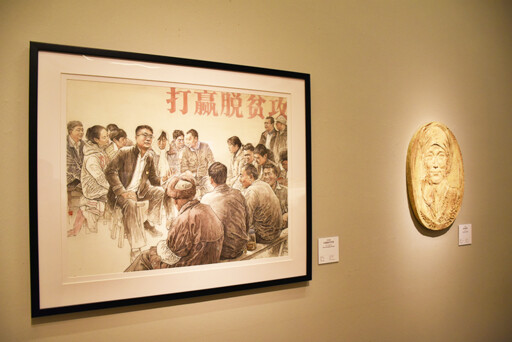
In 2020, the year China declared victory over absolute poverty and achieved its goal of building a moderately prosperous society in all respects, the National Art Museum of China (NAMOC) presented “Promote Wisdom through Beauty: Exhibition of Artistic Works on Poverty Alleviation.” Photo: IC PHOTO
Chinese modernization is the modernization of common prosperity for all, and eliminating poverty is a major challenge in achieving this goal. Since the 1980s, China has made remarkable progress in poverty reduction. As the country enters a new stage of development, the focus of poverty governance has shifted toward consolidating the gains of poverty alleviation and lowering the risk of relapse among families already lifted out of poverty. At the outset of a new journey, activating the endogenous motivation of these households is essential for safeguarding progress, preventing large-scale relapse into poverty, advancing rural revitalization, and ultimately promoting common prosperity.
Activating sustained will for poverty reduction
The family, as society’s basic unit, is both a direct target of poverty governance and a crucial link between macro-level policy and micro-level practice. While external policy support and improved market conditions can ease poverty in the short term, the risk of relapse lingers without sustained internal momentum from within the family. Endogenous motivation refers to a family’s subjective psychological will and objective capacity to improve its economic situation and pursue sustainable development. This motivation emerges through the synergy of four mutually reinforcing elements—economic foundation, cultural literacy, psychological development, and social networks—which together shape a family’s responsiveness to policy and its ability to use available resources effectively.
A stronger economic foundation provides the material basis for enhancing cultural literacy, which in turn offers intellectual support for economic activities. Psychological development strengthens initiative and resilience against adversity, while expanding social networks creates access to additional resources and opportunities, strengthening economic foundations and enhancing the spread of cultural literacy. Together, these factors form a virtuous cycle that drives a steady upward trajectory in a family’s development capacity.
First, families lifted out of poverty can diversify their income sources by engaging in specialty agriculture or animal husbandry, participating in rural tourism, or increasing wage income through migrant work, thereby reducing risk at its source. Second, greater investment in education can enhance knowledge and skills, improving family members’ competitiveness in the labor market. Third, cultivating a mindset of “prospering through hard work” encourages formerly impoverished families to pursue development proactively, allowing them to adjust production strategies in response to natural disasters or market fluctuations rather than wait passively for assistance. Fourth, expanding social networks broadens access to resources, reducing the likelihood of slipping back into poverty.
The core function of endogenous motivation is to reconstruct a family’s understanding of and drive for development, strengthen its sense of self-efficacy, and establish a positive feedback loop in which effort yields tangible rewards. This, in turn, supports the formation of a long-term, self-sustaining mechanism for poverty alleviation and facilitates the shift from a survival-oriented mindset to a development-oriented one.
Systematic nurturing of endogenous motivation
Nurturing endogenous motivation requires closely following the inherent logic of its four components and constructing a systematic support system.
Cultivating a stable economic foundation necessitates a multi-pronged approach. First, developing specialty industries suited to local conditions, expanding employment and entrepreneurship opportunities, and diversifying income sources are key steps. Moreover, families should be encouraged to make full use of industry support policies, employment incentives, and education subsidies, while appropriately leveraging credit tools. Lastly, purchasing agricultural insurance can further reduce the impact of natural disasters, adding an essential layer of protection.
Cultivating cultural literacy aims to curb intergenerational poverty through educational investment, enhance the competitiveness of families through skills training, and spark intrinsic motivation by reshaping values.
Developing psychological capital can be achieved through cognitive reshaping, emotional activation, and motivation enhancement, with a particular focus on addressing the post-alleviation psychological states that may undermine development—such as diminished motivation, unclear goals, or risk aversion—through precise interventions.
Social network development can be achieved by promoting local mutual aid and cooperation, connecting households with external resources, and harnessing the strengths of rural returnees. For example, establishing cross-border e-commerce platforms has helped local residents share development benefits.
When the endogenous motivation of families shifts from a “latent condition” to one of “tangible efficacy,” China will be better positioned to guard against widespread relapse into poverty while consolidating the gains of poverty alleviation, thereby steadily advancing toward the goal of common prosperity.
Chen Mo is an associate professor from the College of Economics and Management at Yanbian University.
Editor:Yu Hui
Copyright©2023 CSSN All Rights Reserved