


Upholding cultural core of traditional festivals amid commercialization
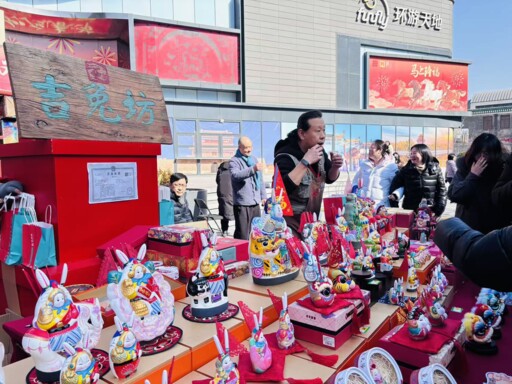
A vendor introduces Tu’er Ye, known as the Rabbit God and celebrated as a traditional Beijing folk craft, to visitors at the Longfusi commercial area in Dongcheng District, Beijing, on Feb. 12, 2026, ahead of the Spring Festival. Photo: Rong Zhi/CSST
Traditional festivals embody long-standing historical heritage and profound cultural value. Folk activities held across regions during these occasions are not only a “living” expression of traditional culture, but also provide a solid foundation for the development of cultural and tourism industries. In recent years, China’s cultural and tourism sectors have shifted from a sightseeing-oriented model toward one centered on experience. Whereas cultural tourism once relied primarily on ticket revenue from scenic attractions, consumption upgrading has gradually redirected tourist demand toward immersive and interactive cultural engagement. Against this backdrop, expanding commercial participation has accelerated the integration of culture, tourism, and business within traditional festivals. While this trend has stimulated economic vitality, it has also introduced new governance challenges.
Changing role of commercial activities
In earlier periods, merchandise sales were common in festive settings, yet they generally played a secondary role, complementing and supporting cultural activities. In recent years, commercial forces—through product innovation, technological empowerment, and global dissemination—have reshaped the value chain of traditional festivals and have played an increasingly central role in revitalizing cultural traditions and promoting industrial upgrading.
First, the development of immersive experiential products has transformed traditional folk customs into interactive, market-oriented cultural offerings, significantly deepening tourists’ cultural engagement and enhancing the efficiency with which cultural value is translated into economic value. For instance, intangible cultural heritage (ICH) workshops—such as sugar painting and Shu embroidery—have been incorporated into temple fairs in Chengdu, Sichuan Province, combining hands-on craft experiences with the sale of finished works. Under the guidance of artisans, visitors can create sugar paintings or embroidered sachets themselves, and in the process, purchase personalized ICH items at accessible prices while gaining a more immediate and concrete understanding of traditional craftsmanship.
Second, technological empowerment has driven the deep transformation of cultural resources into commercial spaces, offering immersive experiences through digital technology and thereby stimulating consumption. Datang Everbright City in Xi’an, Shaanxi Province, built around Tang-Dynasty (618–907) culture as its core intellectual property, exemplifies this approach. Through technologies such as augmented reality (AR), historical scenes are rendered into interactive consumer environments. Equipped with AR glasses, visitors can “travel” to a Tang market and follow guided routes that lead to Tang-style clothing rentals or palace-themed snack shops. Such integration not only increases daily foot traffic, but also extends visitors’ average length of stay, boosting revenue for surrounding dining, retail, and entertainment businesses.
Finally, through the innovative development and market-oriented operation of cultural IPs, commercial activities have transformed traditional festivals into cultural products with broader global communicative reach, becoming an important vehicle for fine traditional Chinese culture to “go global.” In recent years, cultural IPs such as the “Monkey King” and “Nezha” have, through animation, film, derivative merchandise, and themed events, fostered new narrative paradigms for Chinese culture on a global scale. These IPs are not only deeply integrated into traditional festivals such as the Spring Festival and the Dragon Boat Festival, but have also reshaped pathways of cultural communication through internationally oriented forms of expression.
Latent risks of over-commercialization
As traditional activities are adapted to modern contexts, commercial forces have spurred their revitalization through new business models and operational strategies. Yet under the combined pressures of globalization and modernity, these activities face the dual risk of cultural dilution and superficial external dissemination.
First, within the current model of industrial development that integrates culture, tourism, and business, the encroachment of commercial expansion on cultural significance has become increasingly salient. Traditional temple fairs illustrate this tension. In some ancient towns, temple fairs have been reduced to commercial exhibitions, with more than 80% of space occupied by stalls selling “internet-famous” snacks and tourist souvenirs, while cultural content—such as explanations of the fair’s historical origins, folk legends, and demonstrations of ICH craftsmanship—accounts for less than 15%. In such cases, temple fairs risk becoming little more than commercial streets clad in traditional attire.
Second, commercialization has given rise to tendencies toward entertainment-oriented and superficial cultural dissemination. Short-video platforms, while expanding channels for transmitting the cultural elements of traditional festivals, have also accelerated their fragmentation and shift toward entertainment. While certain ICH projects—such as iron flower performances and oil-paper umbrellas—have gained renewed visibility online, data indicates that much of the related content is packaged in overtly promotional formats, including “limited-edition ICH blind boxes” or “flash sales of handicraft trial classes.” Such approaches foreground consumer products and consumption scenarios while often neglecting the historical roots and cultural depth of these traditions.
Traditional festivals, as treasures of fine Chinese traditional culture, are imbued with profound cultural depth and constitute important vehicles for strengthening national identity and cohesion. In future development, it is essential to strike a precise balance between cultural transmission and commercial expansion—avoiding the erosion of cultural significance through excessive commercialization while enhancing influence and long-term sustainability through prudent commercial operations.
Liu Yiran is an associate research fellow from the Institute of Sociology at the Chinese Academy of Social Sciences.
Editor:Yu Hui
Copyright©2023 CSSN All Rights Reserved