


Inheritance, renewal of civilization: Mission of Chinese classical studies
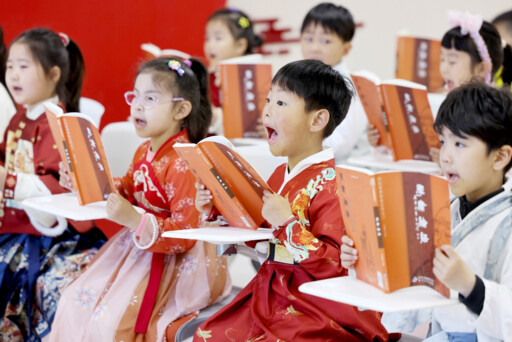
Children chant Chinese classics in a community in Lianyungang, Jiangsu Province, on April 21. Photo: IC PHOTO
The rise of Chinese classical studies in the new era is closely intertwined with a new phase of Chinese modernization. It also embodies the endeavor to sustain and rejuvenate Chinese civilization amid profound changes unseen in a century. Civilizational renewal is not a matter of creatio ex nihilo; rather, it is a dynamic process in which “the old and the new mutually enrich one another, thereby renewing the old.” It is this historical imperative that both gives rise to Chinese classical studies and entrusts it with a vital mission.
The main branches of modern Chinese humanities took shape during the Republican Era (1912–49). Traditional Chinese classical scholarship—such as sibu zhixue, a system that organized knowledge into the categories of classics, history, philosophy, and literature—was absorbed into the disciplines of literature, history, and philosophy, where it came to be framed largely through broad historical approaches such as literary history and the history of philosophy. Yet classical studies did not emerge as a distinct academic discipline. Why was this the case? One possible explanation lies in the course of China’s modern transformation.
During the late Qing Dynasty (1644–1911) and the Republican Era, both Chinese society and scholarship faced a transition from tianxia (all under Heaven), in cultural and civilizational terms, to the nation-state as a unit of political power. The goal of this transformation was to enter the modern world system and secure a place within it. This shift in political and intellectual orientation was closely linked to the national imperatives of preserving the race and saving the country against the backdrop of national salvation and survival. To enter the modern world system, the self-preservation of the nation and the country had to proceed through the formation of a nation-state.
As modern China has reflected more deeply on its own identity, the significance of Chinese civilization has come into ever sharper focus. Tianxia, once relegated to the distant background, has gradually emerged from an implicit undercurrent into an explicit presence. More importantly, intensifying competition among major countries has underscored the need to draw upon resources at the level of civilization—beyond the confines of nation and state—thereby encouraging a renewed identification with tianxia as the expression of China’s classical civilizational tradition. Chinese classical civilization is no longer regarded as something to be dismantled or overturned, as it often had been since 1840, nor is it conceived as external to China itself. Instead, it is increasingly recognized as intrinsic to China and as an indispensable dimension of what China is. In the new era, tianxia has once again moved to the forefront, standing in a mutually reinforcing and enriching relationship with “China.”
In the context of the new era, and under the guidance of the “second integration” (the integration of the basic tenets of Marxism with China’s fine traditional culture), the question of antiquity versus modernity is no longer bound up with the question of China versus the West. The civilizational foundation of Chinese modernization is not the Western Way, but the Chinese Way. Classical civilization has emerged as a deep wellspring of intellectual and cultural resources for Chinese modernization. Without China’s 5,000-year civilization, where would Chinese characteristics come from? The distinctive “Chineseness” of Chinese modernization and Chinese civilization, together with the “independence” of China’s independent knowledge system, are rooted in and sustained by the fertile heritage of Chinese classical civilization.
The emergence of Chinese classical studies as an academic discipline is therefore no accident. Although its disciplinary and institutional development remains a work in progress, it is closely tied to the institutionalized return of Chinese civilization as a holistic body of knowledge. As a major undertaking in the course of Chinese modernization, the establishment of Chinese classical studies is intimately connected to a renewed understanding of the relationship between antiquity and modernity. Chinese classical studies is by no means a value-neutral body of systematic knowledge about ancient civilization. Rather, it constitutes the principal vehicle through which the Chinese nation articulates its civilizational narrative. As a mode of self-understanding and self-interpretation for Chinese civilization, Chinese classical studies embraces the inheritance and renewal of civilization as its central mission.
The rise of Chinese classical studies serves as a vital bridge linking antiquity and modernity, China and tianxia. Unlike Western classical studies, which focuses primarily on the West’s own classical traditions, Chinese classical studies has, from its inception, embraced a multi-civilizational perspective. It takes Chinese classical scholarship as its principal object of inquiry while also bringing Western, Indian, and other classical traditions into its intellectual horizon, establishing itself through mutual learning and interpretation among Chinese and foreign classics. In this sense, Chinese classical studies is rooted in the civilizational practice, experience, and wisdom accumulated by the Chinese nation over more than 5,000 years. At the same time, by absorbing and critically transforming the classics of other civilizations, it has emerged as an important contemporary representative of world classical studies.
Chen Yun is a professor from the Institute of Modern Chinese Thought and Culture at East China Normal University.
Editor:Yu Hui
Copyright©2023 CSSN All Rights Reserved