


Toward AI as an international public good
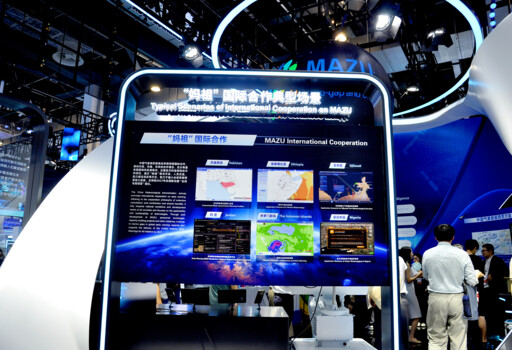
An introduction to international cooperation through the AI-powered meteorological early-warning system MAZU at the 2026 World Artificial Intelligence Conference in Shanghai Photo: VCG
The essence of artificial intelligence (AI) governance lies in coordinating innovation, risk sharing, and benefit distribution under new technological conditions. From the perspective of global economic development, AI governance should not be reduced to technological regulation, nor should it be dictated entirely by geopolitical and geo-economic competition among major countries.
Open global innovation network needed
Technological revolutions and economic globalization are deeply intertwined. New technologies continually transcend the geographic boundaries of production, division of labor, and exchange, enabling knowledge, capital, products, and people to be reorganized on a broader scale. Global markets, meanwhile, provide the conditions for technological diffusion, large-scale application, and continued iteration. As a general-purpose technology with significant spillover effects, AI relies even more heavily on innovation networks built through broad collaboration.
AI’s dependence on global innovation networks is particularly evident in two respects: the specialized division of labor across the innovation chain and the economies of scale and network effects generated by AI research and development (R&D) and application.
First, AI R&D and deployment span multiple stages, including basic research, chip manufacturing, computing infrastructure, model training, software tools, application development, and safety assessment, forming a highly specialized and closely interconnected global innovation chain. No country can sustain innovation across all these stages over the long term while remaining isolated from global knowledge exchange and industrial collaboration.
AI R&D also requires substantial upfront investment. Expanding the use of models, tools, and infrastructure helps distribute R&D costs and improve the efficiency with which innovation resources are used, creating significant economies of scale.
At the same time, as more actors participate in AI development and use, and application scenarios become more diverse, the links among knowledge feedback, tool provision, and technological iteration grow stronger. This, in turn, enhances the overall value of the AI innovation ecosystem and creates network effects in which developers, users, and application scenarios reinforce one another.
Sharing development benefits
Emphasizing openness and cooperation among countries does not mean ignoring the risks associated with AI. As AI becomes increasingly embedded in production, finance, healthcare, transportation, and public governance, risks such as algorithmic bias, privacy violations, misinformation, technological misuse, and loss of control over systems can spill across national borders.
A single country’s regulatory framework may struggle to fully address these cross-border externalities. Without effective coordination among regulatory frameworks, gaps in oversight, conflicting standards, and rising compliance costs may result. Therefore, as AI becomes increasingly globalized, the need for corresponding global governance capacity grows.
Viewing AI as an international public good does not simply mean providing a particular technology, product, or service. Rather, the core aim is to make technology more accessible, usable, and governable through sustainable institutional arrangements. A people-centered approach and the sharing of development benefits represent a distinctive value orientation of Xi Jinping Thought on Economy, while also reflecting China’s position that the benefits of intelligent technologies should reach people around the world more broadly.
President Xi Jinping stated in his congratulatory letter to the World Smart Industry Expo 2025 that “AI should be an international public good that benefits humanity.” In his keynote speech at the 2026 World Artificial Intelligence Conference, he further announced that, over the next five years, China will provide 5,000 AI training opportunities for developing countries and establish international AI application cooperation centers with ASEAN, the League of Arab States, the African Union, the Community of Latin American and Caribbean States, the Shanghai Cooperation Organization, and BRICS. China will also promote the deployment of the AI-powered meteorological early-warning system MAZU in 30 countries. These initiatives translate the principle of inclusiveness into concrete public good provision through talent cultivation, platform building, and practical applications.
AI is expanding the technological foundations of the global division of labor and cooperation, while placing greater demands on the inclusiveness, coordination, and capacity for action of global governance. Looking ahead, countries should expand the space for innovation through open cooperation, manage cross-border risks through shared rules, and promote inclusive development through international public goods. In this way, technological progress can become a new driver of economic globalization toward greater openness, inclusiveness, shared benefits, balance, and mutual prosperity, rather than a force that creates divisions and widens disparities.
Zhang Tianding is a professor from the Economics and Management School at Wuhan University.
Editor:Yu Hui
Copyright©2023 CSSN All Rights Reserved