


When AI ‘recalls’ knowledge: Limits of the Socratic analogy
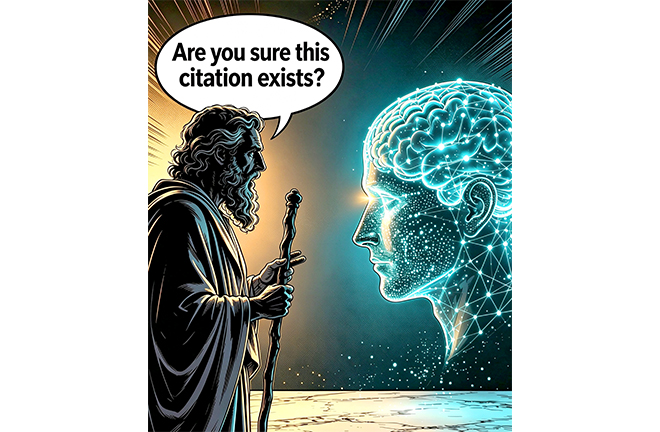
Image generated by AI
Plato records a remarkable conversation in his dialogue Meno: Socrates questions an uneducated slave boy, offering no instruction but simply asking one question after another. He draws a square on the ground and asks: If its area is four, how long should the sides of a new square be to double that area? The boy immediately answers, “Four.” Wrong—the area would then become four times as large. He changes his answer to “Three.” Still wrong. After several rounds of questioning, he eventually arrives at the answer himself: the length of the original square’s diagonal.
The boy had never studied geometry, yet the answer seemed to have lain dormant deep within his soul, waiting only to be awakened by the right question. Plato, speaking through Socrates, calls this the doctrine of “recollection” (anamnesis). Socrates does not claim to have invented the theory himself, describing it instead as an ancient teaching he heard from priests and poets. But the claim he seeks to defend is clear: Knowledge is not poured into the mind, but brought forth from within it. He calls his method “midwifery”—the midwife’s task is to deliver babies, while his is to deliver truth.
Twenty-four centuries later, a strikingly similar process unfolds in everyday interactions with AI. Give a large language model (LLM) a sufficiently precise prompt, and it can “recollect” latent connections between pieces of knowledge from its vast parameter space. Plato called this “recollection,” while today it is known as “in-context learning.” The name has changed, but the structural parallels are clear: Knowledge is already latent within the neural network, waiting to be summoned by the right line of questioning.
Socrates never gives the answer directly, but creates the conditions for it to emerge on its own. Today, AI researchers are engineering those “conditions.” The key lies in what the model should already know. The midwifery of truth has an indispensable premise: Truth is already present within the other person’s soul, merely obscured. The same premise applies to AI. A model trained on an enormous body of literature encodes almost all of humanity’s published knowledge within its parameters. The question is how to bring that knowledge to the surface. A good question is not so much a command as a way of establishing a context that allows the model to “remember” connections it was already capable of making.
At this point, the analogy begins to show its first crack, though the parallels initially seem to hold. On the surface, different LLMs do seem like different souls, each “recollecting” different things. Yet most of the time, their answers converge. Given the same mathematical problem, different models will often produce the same answer. This convergence is not accidental: Humanity’s published knowledge itself tends toward statistical agreement, while the training data of different LLMs overlap substantially, especially on core facts.
Plato believed that all souls would ultimately arrive at the same destination because they shared a single “world of Forms.” Such convergence is reassuring, but it also exposes a weakness in the analogy. For Plato, convergence signifies truth, because the shared world of Forms itself serves as a metaphysical guarantee of truth—it cannot be wrong. In the world of AI, by contrast, convergence merely means that all models have followed the same statistically biased path. If a particular prejudice is sufficiently widespread and stable in the training data, all models will “recollect” the same prejudice.
The analogy truly breaks down not at the point of error, but in what follows. Socrates remains unperturbed because he knows what will happen next: The boy will become perplexed and realize that he does not actually know the answer. Perplexity functions like a cognitive immune system—detecting that something is “not quite right,” triggering correction, and recalibrating the recollection. In this way, error becomes a stepping stone toward truth.
AI has no such immune system. It may confidently supply the title of a paper that does not exist, or describe a set of fabricated experimental data in convincing detail. This is not simply a case of “remembering incorrectly.” By the logic of Socratic midwifery, it is more like “recollecting” a Form that never existed and then, under continued questioning, “recollecting” still more nonexistent Forms. Even when it produces two mutually contradictory hallucinations, it experiences no discomfort or perplexity, no moment of hesitation that says, “Wait—something doesn’t seem right.”
When Socrates asks the slave boy “Is the side four?” it is the boy himself who senses that something is wrong—he feels uneasy, hesitates, reconsiders, and then corrects his answer. The perplexity arises within the person being questioned. When a human user asks an AI “Are you sure this citation actually exists?” the AI does not feel uneasy or pause to reflect. It simply generates another answer under new contextual constraints.
The problem cannot be reduced to “AI is untrustworthy, so don’t use it.” The situation is more subtle: AI can bring users closer to the truth, yet give them no sense that they are being misled. It has no intention to deceive, but neither does it have any intention to be honest—it is simply generating responses. The responsibility for distinguishing truth from error therefore falls entirely on the user. Users must take on the role of questioner, first recognizing their own perplexity, then translating it into a more precise follow-up question, evaluating the response, and allowing renewed perplexity to drive the inquiry further. This is something a user can accomplish together with AI, but cannot delegate to it.
In Plato’s Apology, Socrates says, “The unexamined life is not worth living.” In the age of AI, this maxim acquires a technical corollary: An answer that has not been questioned is not worth trusting—and receiving an answer is no reason to stop asking questions.
Li Jianhui is a professor from the School of Philosophy at Beijing Normal University.
Editor:Yu Hui
Copyright©2026 CSSN All Rights Reserved