


Earliest known ancient Chinese bayberry tree in China discovered at Shi’ao site
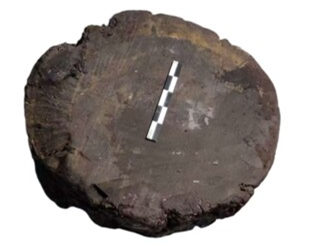
The tree pit of ancient Chinese bayberry remains Photo: PROVIDED TO CSST
Trees are indispensable resources for human survival. They not only provide essential supplies such as food, energy, medicine, and timber, but are also deeply woven into the broader trajectory of human civilization. Wood and charcoal remains unearthed from archaeological sites offer direct evidence of ancient human activities, preserving rich information about behavioral patterns and social life in the past. Through the identification and analysis of ancient wood species, researchers can clarify historical patterns in the distribution and use of different trees. Such studies also help illuminate the central role forest resources played in ancient production and everyday life, providing crucial material evidence for reconstructing ancient diets and understanding subsistence economies.
The Shi’ao site in Yuyao, Ningbo City, Zhejiang Province, lies on the eastern NingShao Plain along the southern bank of the Qiantang River, in the Yaojiang Valley between Cuiping Mountain and Siming Mountain. It is located 7.5 kilometers southwest of the Hemudu site and 400 meters southeast of the Tianluoshan site. The ancient rice paddies discovered here represent the largest, among the earliest, the most complete in cultural sequence, and the most fully substantiated remains of rice agriculture currently known in the world. Surveys indicate that prehistoric rice paddy deposits in this small valley cover an area of about 80,000 square meters. Between 2020 and 2021, archaeologists excavated nearly 8,000 square meters in the area, uncovering layered rice field remains from both the early and late Hemudu culture as well as the Liangzhu culture. In the southwestern corner of the site, two segments of tree trunks were found lying parallel to one another. One segment measures 0.27 meters in diameter and 2 meters in length, while the other measures 0.49 meters in diameter and 2.2 meters in length.
Based on stratigraphic analysis and associated pottery fragments, archaeologists determined that the ancient tree trunks date to the Liangzhu culture period. Researchers first conducted dendrochronological analysis of the tree rings from the ancient wood remains with clear archaeological context. Samples were then taken at intervals of several growth rings, with three samples forming a sequence for radiocarbon dating. Using specialized software, the latest tree-ring calibration curves, and wiggle-matching analysis based on the ring intervals of the three samples, the researchers concluded that the tree grew around 2520 BCE, corresponding to the Liangzhu culture period.
Through observation and comparison, the wood structure of the two ancient trunk segments was found to match that of yangmei (Chinese bayberry) branches collected from the area around the Shao’ao Reservoir in Cixi, about 11 kilometers from the site. The wood was therefore identified as belonging to the genus Myrica in the family Myricaceae. Further analysis using pyrolysis–gas chromatography–mass spectrometry (Py/GC–MS) was conducted on both the ancient yangmei and modern yangmei samples. Researchers obtained the GC–MS total ion chromatogram of the ancient wood and analyzed the mass spectra of each peak using the NIST14 mass spectral database alongside manual interpretation. 13 major compounds were detected in the ancient yangmei sample, while 12 of the same compounds were identified in the modern yangmei sample. The chemical compositions of the two samples are almost identical, indicating that they belong to the same species. The ancient tree was therefore identified not only as belonging to the genus Myrica but specifically as the species Myrica rubra. This makes it the earliest clearly identified yangmei tree discovered in China to date.
Comparative analysis using Py/GC–MS further shows that a compound present in the ancient tree—stigmasterol, which is known to help prevent osteoporosis and alleviate conditions such as hypertension, hyperlipidemia, and arteriosclerosis—is absent in modern yangmei samples. This difference in chemical composition may reflect the combined effects of environmental change, human selection, and long-term cultivation. In the process of breeding new varieties, attention has often been placed on traits such as larger fruit size, sweeter flavor, and higher yields. Yet such selective cultivation may also have resulted in the loss of certain compounds associated with distinctive health benefits.
This finding serves as a reminder that while pursuing higher yields and improved quality in crops and fruit trees, it is equally important to protect wild genetic resources and maintain biodiversity. These wild resources not only help illuminate the evolutionary history of species but also represent valuable assets for responding to future environmental changes, mitigating agricultural risks, and safeguarding human health.
The study of the ancient yangmei tree remains from the Shi’ao site offers important data for understanding the dietary composition and subsistence economy of ancient inhabitants. In China, the genus Myrica includes only four species: yangmei (Myrica rubra), Myrica esculenta, Myrica adenophora, and Myrica nana. Among them, yangmei is an evergreen tree widely distributed and extensively cultivated for its delicious fruit, while the other three species are small trees or shrubs with relatively poor fruit quality. In Zhejiang Province, only one species—yangmei—occurs naturally.
Yangmie, a classic example of a fruit that combines nutritional and medicinal value in traditional Chinese culture, is rich in carbohydrates, anthocyanins, and other nutrients. It can be eaten fresh or preserved through methods such as salting, honey curing, and sugar preservation, each producing distinctive flavors. Medicinally, yangmei has long been believed to quench thirst, stimulate bodily fluid production, and nourish the internal organs. Yangmei fruit specimens have previously been unearthed from several Han Dynasty (202 BCE–220) tombs, including the Mawangdui Han tomb and the Shazitang Western Han tomb in Changsha, Hunan Province; the No. 2 Western Han tomb in Tangpai Village, Hepu County, Guangxi Zhuang Autonomous Region; as well as the Western Han Nanyue King tomb and Eastern Han tombs in Guangzhou, Guangdong Province. Historical records also document yangmei cultivation. For example, the Song Dynasty (960–1279) Tiaoxie Leibian (Health Maintenance Classification Compilations) records techniques for yangmei grafting and pest control, while the historical Han text Yuejun Zhi (Records of Yue Commandery) describes the Kuaiji yangmei as “extraordinary fruits under heaven.” Research indicates that as early as the Liangzhu culture period, yangmei at the Shi’ao site had already been incorporated into the diet of local inhabitants. Their consumption history can therefore be traced back several thousand years, offering tangible evidence of the fruit’s long history and the origins of Yuyao’s reputation as the “hometown of yangmei.”
Archaeological excavations at the Shi’ao site have revealed ancient rice paddy remains with clear stratigraphic relationships spanning the early Hemudu culture, the fourth phase of the Hemudu culture, and three phases of the Liangzhu period. These discoveries provide strong evidence for the continuous development of rice cultivation in this region. The remains of the ancient yangmei tree were found on a gently sloping area at the foot of the mountain, west of the Liangzhu rice paddies. Together with the paddy field remains, they form a distinctive wetland agricultural landscape and offer important evidence for exploring the subsistence economy of the Liangzhu culture in the NingShao Plain.
In straight-line distance, the Shi’ao site lies only a few hundred meters from nearby sites such as Tianluoshan and Jiangqiaotou. Considering the activity radius and food resource zones of prehistoric communities, the Shi’ao and Tianluoshan sites likely belonged to the same resource territory.
The Tianluoshan site contains remains from the middle and late phases of the Hemudu culture. Charcoal remains from economic forest and fruit trees have been unearthed there. Numerous acorn pits have also been discovered, along with seeds or fruit stones of pinecones, peach, plum, cherry, hog plum, persimmon, Actinidia, and yangmei-like fruits. The inhabitants of Tianluoshan were both cultivators and gatherers. While cultivating rice, they also collected nuts as well as aquatic plants such as water chestnuts and gorgon fruit.
During the Liangzhu culture period, rice production in core areas reached a relatively high level of development. Large, standardized rice paddies appeared, accompanied by irrigation facilities, fertilization practices, and possibly centralized storage of rice harvested from different regions.
However, in the NingShao Plain—situated along the northern and southern margins of the Liangzhu cultural sphere—prehistoric inhabitants continued to rely to some extent on the gathering of wild resources. Compared with cultivating crops or raising domesticated animals, collecting fruits from forest and orchard trees required far less time and labor, while offering nutritious and flavorful food sources. Yangmei generally ripens in June and July, whereas staple foods such as rice, acorns, water chestnuts, and gorgon fruit typically mature after August or September. Fruits such as yangmei, wild grapes, and kiwifruit could therefore supplement food supplies between June and September, bridging seasonal gaps in staple availability.
By utilizing fruit-tree resources, aquatic plants, and various nuts, prehistoric inhabitants were able to reduce the risks associated with relying on a single agricultural system and ensure a more stable food supply. The paddy field landscape surrounded by fruit trees reflects a subsistence economy in which gathering remained an important component of life in the NingShao Plain during the Liangzhu culture period, resulting in a diversified food structure. The study of the ancient yangmei tree remains from the Shi’ao site thus offers valuable evidence for comprehensively understanding the dietary composition and subsistence economy of prehistoric communities.
Wang Shuzhi is a research fellow from the Key Laboratory of Archaeological Sciences and Cultural Heritage Protection at the Chinese Academy of Social Sciences.
Editor:Yu Hui
Copyright©2026 CSSN All Rights Reserved