


Faith, technology and social development: Insights from Niuheliang site
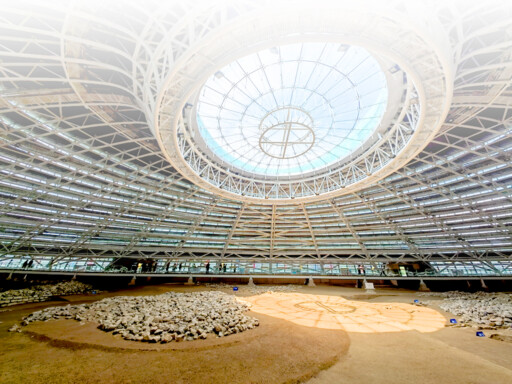
On Aug. 3, 2024, the Niuheliang National Archaeological Site Park in Jianping County, Chaoyang City, Liaoning Province, reopened to the public after renovation. Photo: IC PHOTO
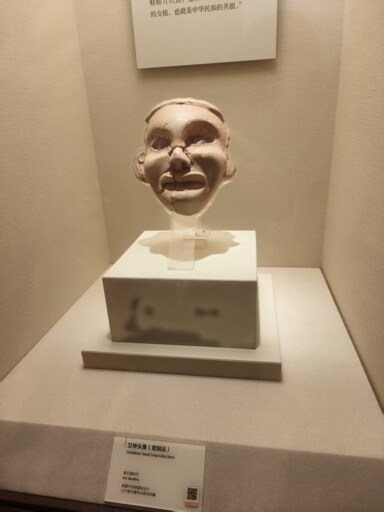
Replica of the clay facial sculpture of Hongshan Goddess, Liaoning Provincial Museum Photo: Fang Ke/CSST
The Niuheliang site represents the most flourishing period of the Hongshan Culture, a Neolithic civilization that emerged around 6,500 years ago in north China, and has garnered significant scholarly attention largely due to the discovery of remains associated with sacrificial and ritual activities. Yet in the absence of substantial evidence from the sphere of everyday life, understanding of Hongshan society must therefore be approached largely through these remains.
Belief system
The earliest discoveries to draw attention at Niuheliang were three types of ritual remains: altars, temples, and tombs. Chinese archaeologist Su Bingqi creatively related them to ritual architecture found in historical capitals—the Temple of Heaven, imperial ancestral shrines, and imperial mausoleums—revealing a cultural tradition that has continued for more than five millennia. The discovery of this high-level ritual architectural complex also established Niuheliang’s central place in the development of Hongshan society.
By distinguishing the functions of these three types of remains, scholars have been able to form a broad understanding of the different sacrificial activities conducted in different places and under different circumstances. Altars and tombs are both stone-built remains, and the presence or absence of burials is an important criterion for distinguishing between them. At Niuheliang, the altars appear in both square and circular forms. The shape of the circular altar and the proportions of its three concentric rings are closely related to the sun’s apparent path, and its identification as a round altar for worshipping heaven has gradually gained acceptance in academia. The square altars are smaller in scale and have been found only at sites where multiple stone mounds coexist. None contain burials, suggesting that they may likewise have served ritual purposes similar to those of the circular altars.
Temples and tombs, by contrast, are associated with ancestor worship. Some scholars have suggested that the two differ in the objects of veneration, marking a distinction between distant ancestors and more recent ones. Tombs were sites for rituals centered on the burial of the principal occupant of a central grave, with the recently deceased becoming the objects of worship. Artifacts unearthed from temples consist mainly of various sculptural figures. Among them, the well-known “Hongshan Goddess,” with its clearly defined facial features, may represent an important figure in Hongshan society—a socially significant “distant ancestor.”
The variation in sacrificial objects across different ritual settings suggests that Hongshan society had already distinguished among heaven, earth, and ancestors as separate objects of worship.
In addition to these clearly identifiable ritual sites, recent archaeological work has uncovered a wider range of ritual remains, offering new evidence for a fuller understanding of the Hongshan belief system. These include reddened baked clay surfaces left by wood-burning rituals, fruit pits found among the fuel, and pieces of burnt jade; sacrificial pits containing various burial objects and fill; and fixed assemblages of pottery, including earthenware vats, bowls, and cylindrical vessels, along with circular pottery discs. The three categories of ritual remains found at Niuheliang can each be correlated with the worship of “heavenly deities, earthly deities, and ancestors” recorded in later texts. Here, “heavenly” and “earthly” deities do not refer to single gods, but to groups of divinities that were already arranged in a certain hierarchy. Although no clear differences have yet been found in the sacrificial methods used for deities of different rank in the heavenly sphere, the variation among sacrificial pits suggests that the worship of earthly deities had already developed into a more differentiated and complex set of ritual practices.
The elaborate sacrificial activities directed toward heaven, earth, and ancestors in the Hongshan Culture do not point to faith in a single god. Rather, Hongshan society developed a ritual system of revering heaven, honoring earth, and venerating ancestors that rested on a broader animistic worldview while imposing a clear hierarchy upon the world of spirits. In this system, heaven, earth, and ancestors each occupied their proper place. Through systematic ritual practice, this became an open and socially inclusive belief structure—one capable of incorporating existing traditions while rendering them more orderly.
Technological developments
Given the limits of the available evidence, what can currently be said about technological development in Hongshan society pertains mainly to the design and construction of large public buildings, as well as the production of jade and pottery.
The main architectural platform complex at Locality 1 covers roughly 60,000 square meters and consists of at least nine raised platforms arranged in a terraced layout descending along both sides of a ridge. These platforms were built according to a unified plan: the stone walls of the platform buildings on the eastern and western slopes run exactly parallel. The southwestern building complex, laid out along the central axis extending from the Goddess Temple, made full use of the terrain, with three platform buildings forming a north-high, south-low composition symmetrical along the axis. Through adjustments in masonry methods and structural design, and through the construction of a complete drainage system, the site achieved what may be regarded as the earliest example of regional “landscape planning.” The platform complex at Locality 1 demonstrates Hongshan society’s considerable planning and design capabilities, and also supports the view that the Niuheliang site complex was conceived as a unified whole.
Jade processing was an important branch of handicraft production in Hongshan society. The jades unearthed at Niuheliang are notable not only for their size and fine material, but also for the range of techniques used in their production. Ring- and bracelet-like jades defined by circular forms are thin and remarkably uniform, with the thinnest specimen measuring just 0.5 centimeters thick—evidence of the precision and consistency achieved by Hongshan craftspeople. Slab-cutting techniques were equally sophisticated: The largest slab-cut jade object unearthed at the site is 28.6 centimeters long and only 0.6 centimeters thick. The diversity and technical refinement of the jades from Niuheliang reflect the high level of jade-working in Hongshan society.
Pottery, meanwhile, was the most common class of artifacts. Developments in Hongshan pottery production reveal two very different tendencies. Everyday vessels changed little in form and were relatively simple to make, likely within individual households. Ritual pottery, however, was far more varied and complex in shape, and appears to have been produced through a more elaborate system. A division of labor resembling assembly-line production made short-term mass manufacture possible. The coordination and management required by this process were themselves an important aspect of Hongshan society’s productive development.
Technological and managerial innovation in Hongshan society was thus closely tied to ritual activity, underscoring the central role of faith.
Social hierarchy order
Evidence suggests that Hongshan society exhibited a relatively well-developed hierarchical social order. Stone cairn tombs served as the basic burial units, or cemeteries. Although each cairn contained multiple burials, the tombs differed markedly in scale and in the type and quantity of grave goods. The highest-ranking tombs were distinguished not only by their burial goods but also by associated tomb walls. The neatly arranged cylindrical vessels near these walls appear to be remains left from rituals performed for the tomb occupant. Analysis suggests that those buried according to these elevated standards were not only leaders within their respective burial groups but also the highest-ranking individuals in the wider Niuheliang area. This indicates that the Niuheliang site complex belonged to a hierarchical society composed of multiple groups under a single supreme leader.
The types, combinations, and quality of jade artifacts were important markers of the tomb occupant’s rank and status. This ritual order extended beyond Niuheliang itself. Evidence from the Hutougou site, located some 150 kilometers away, reveals the same hierarchical pattern. The formation and spread of this ritual order provided the institutional basis for Hongshan society’s transition from a relatively simple, egalitarian social structure to a more layered and complex one.
Much like the objects of worship, which were diverse yet clearly ranked, Hongshan jade ritual objects and the norms governing their use combined complexity with standardization, reflecting the formative stage of a ritual system. Standardized sets such as the later “six ritual objects” and “six auspicious objects,” along with their strict rules of use, had not yet emerged. Nor had the simpler canonical grouping of cong, bi, and yue taken shape. Aside from the relatively standardized slant-mouthed cylindrical jade objects and jade bi discs, most Hongshan jades were zoomorphic, and few were identical in form. This wide range of animal imagery is often linked to the use of animal intermediaries in shamanic ritual. In other words, Hongshan jade ritual objects still retained traces of shamanic belief. Like the broader system of “worshiping heaven, honoring earth, and venerating ancestors,” these zoomorphic jades can also be divided into two broad categories: birds associated with heaven, and land-dwelling creatures—such as turtles, bears, and soft-shelled turtles—associated with earth. The composition of these jade ritual objects likewise suggests that Hongshan society was built on the basis of locally prevalent cultural and religious traditions to foster social unity.
Archaeological discoveries at the Niuheliang site reveal sacrificial rituals as the core of Hongshan social development—an attempt to integrate and order various beliefs. By embracing diverse local faiths, reclassifying deities, and establishing hierarchical order, Hongshan constructed an open, inclusive belief system, reinforced through rituals. Its core was not absolute worship of deities but faith in “order,” a crucial path for social organization.
Although evidence relating to material production remains limited, advancements in ritual-related technologies and innovations in management both suggest that faith was the central force guiding the development of Hongshan society. The social hierarchy established on the basis of this belief system provided the institutional foundation for the cohesion of a complex, multi-group society and for the formation of an early state.
Guo Ming is a research fellow at the Liaoning Provincial Institute of Cultural Relics and Archaeology.
Editor:Yu Hui
Copyright©2026 CSSN All Rights Reserved