


AI upends capital-labor ratio
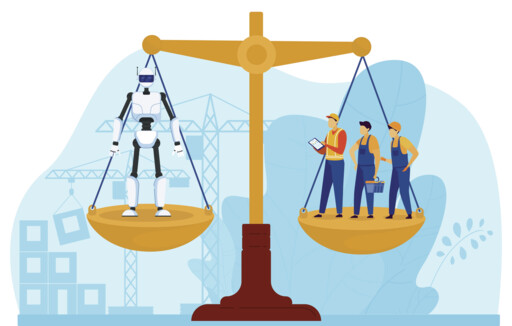
AI has disrupted the traditional paradigm where the impact of technological progress on K/L followed relatively clear pathways, making it no longer a simple linear substitution relationship. Photo: IC PHOTO
In economic theory, the capital-labor ratio (K/L) is a core metric for assessing technological choices and factor intensity. It is both a decision-making variable for profit maximization at the micro-firm level and a key parameter shaping macroeconomic growth trajectories. Historically, the impact of technological progress on K/L followed relatively clear pathways. The rapid development of artificial intelligence (AI), however, has disrupted this traditional paradigm. As the most representative general-purpose technology (GPT) in the latest technological and industrial revolution, AI can not only substitute for repetitive physical and cognitive labor, but also augment human cognition, restructure production processes, and even create new factors of production. This complexity means its impact on K/L is no longer a simple linear substitution relationship. Instead, it operates through distinct, even contradictory, mechanisms at both micro and macro scales. Understanding these mechanisms is crucial to assessing the future trajectory of global industrial division.
Substitution & complementarity effects
From the perspective of substitution, AI drives a rapid rise in the organic composition of capital. In the traditional industrial era, the introduction of machinery increased the ratio of constant capital, such as machines and factories, relative to variable capital in the form of wages. AI extends this logic from the “physical world” into the “cognitive world.” When enterprises adopt AI, they are in effect replacing low-variable-cost repetitive labor positions with high-fixed-cost intelligent capital. As a result, micro-level K/L rises in a discontinuous leap.
From the perspective of complementarity, AI leads to the “capitalization” of high-skilled labor. Rather than simply replacing all labor, AI acts as a “decision-support” tool that greatly increases the marginal productivity of highly skilled workers. In hospital radiology departments, for example, AI imaging systems have not fully replaced radiologists, but have freed doctors from time-consuming preliminary screenings, allowing them to focus on diagnosing complex and difficult cases. In this context, the “doctor + AI” combination forms a new “human-machine collaborative unit.” From an accounting perspective, enterprises pay higher salaries to these highly skilled workers, but within the production function, the value attributes of such workers have changed. They are no longer merely “labor,” but have become key elements in managing and optimizing “capital,” leading to micro-level “labor polarization.” Within enterprises, K/L undergoes structural differentiation. For low-skilled, highly repetitive positions, K/L rises sharply, as capital substitutes for labor. For high-skilled, highly creative positions, K/L takes the form of “capital empowering labor,” meaning that labor becomes more scarce. Statistically, however, because capital stock increases substantially, overall K/L still rises.
Complex non-equilibrium
At the macro level, AI’s impact on the capital-labor ratio displays a more complex “non-equilibrium.” Since countries at different stages of development vary in their factor endowments, industrial structures, and institutional environments, AI affects K/L in sharply different ways, giving rise to a “substitution divide.”
In advanced economies, where capital is already relatively abundant and labor relatively expensive, the introduction of AI accelerates the process of “capital deepening.” Data indicates that intellectual property products represented by software and algorithms have accounted for a steadily rising share of non-residential fixed investment in developed countries, even as labor compensation as a share of GDP has declined at an accelerating pace in some industries. While this macro-level rise in K/L signals potential gains in labor productivity, AI-driven productivity gains are not distributed evenly. AI’s complementarity is biased toward high-skilled labor, widening the “skill premium” and hollowing out middle-skilled jobs at the macro level.
For developing economies that rely on low-cost labor advantages, the macro-level shock of AI is more disruptive. Traditionally, these countries have integrated into global value chains (GVCs) by leveraging cheap labor to take on labor-intensive production, thereby accumulating capital and gradually raising K/L—a path China itself followed after reform and opening up. However, AI is now eroding this comparative advantage. Data reveals that in some developing economies, the share of manufacturing employment has begun to decline in absolute terms before reaching its historical peak. This substitution occurs not only within domestic factories, but also at the source of global supply chains. For these countries, stagnant or declining labor input, combined with slow growth in capital stock, may push macro-level K/L upward passively. Yet this increase is often accompanied by rising unemployment and structural economic imbalances, making it a “destructive” form of capital deepening.
From ‘offshoring’ to ‘intelligent agglomeration’
The reshaping of the capital-labor ratio is driving the evolution of GVCs from “offshoring” toward “intelligent agglomeration.” As K/L is reshaped at both the micro and macro levels, these changes ultimately converge into a powerful force transforming the structure of global industrial division. This shift is reflected mainly in three logical transformations.
First, value chain morphology is shifting from a “smiling curve” to a “weeping curve.” As the theory of the silent curve suggests, the spread of intelligent manufacturing is allowing the manufacturing segment itself to regain high added value. The curve no longer “smiles,” but tends to flatten, and profit margins in manufacturing may even surpass those in R&D and marketing. At the same time, AI is eroding both ends of the “smiling curve.” AI-assisted design lowers barriers at the R&D end, while AI-driven precision marketing and intelligent customer service are changing how brands connect with consumers. Ultimately, the distribution of added value along the value chain becomes flatter, and may even take on a “block-like” pattern. Value is no longer distributed linearly along the chain, but concentrated in nodes that possess the “iron triangle” of data, algorithms, and computing power.
Second, comparative advantage is shifting from “factor endowment” to “algorithmic and data endowment.” The core logic of comparative advantage theory lies in differences in labor productivity and factor abundance. AI, however, is creating a new comparative advantage—“intelligence endowment.” A country’s comparative advantage no longer depends only on the size of its labor force or its natural resources, but on the scale and quality of its data, its capacity for algorithmic innovation, and its computing infrastructure. This means that the structure of global industrial division is shifting from an “offshoring” model to an “intelligent cluster” model. Thus, countries and regions capable of building an “AI-manufacturing” closed loop will attract the return or agglomeration of high-end manufacturing.
Third, the spatial layout is shifting from “globalization” to “regionalization.” AI’s substitution effect on K/L sharply reduces the room for labor arbitrage. Traditionally, the core logic of multinational corporations’ global layouts was to seek the lowest labor costs. When AI reduces the share of labor costs in a factory based in the United States from 30% to 5%, however, the total cost difference between keeping a factory in Asia and moving it back to the United States or Mexico becomes far less significant. More importantly, in the AI era, supply chain agility and resilience matter more than cost alone. The greater the distance, the higher the data latency and logistics uncertainty. AI is therefore pushing global industrial division away from a globally dispersed layout oriented toward extreme efficiency and toward a regionally concentrated layout that balances efficiency and security. As a result, GVCs are shortening, and the granularity of division is becoming coarser.
Although AI’s reshaping of K/L in both senses and its reconfiguration of global industrial division bring efficiency gains, they also carry deep-seated contradictions. The first concerns income distribution and employment polarization. Micro-level labor polarization and the macro-level substitution divide may shrink middle-income groups worldwide and widen wealth gaps. For developing countries, avoiding being locked into the role of raw material suppliers in the AI wave is thus an urgent challenge. The second concerns data sovereignty. As data becomes a key form of capital, new dependencies are emerging within global industrial division. Countries with advanced AI technologies and data platforms may use algorithms to control the “interfaces” of GVCs. Countries lacking independent AI capabilities may be reduced to data suppliers or consumer markets for AI products, with their paths to industrial upgrading blocked by technical standards. The third concerns the redefinition of human-machine relations. As the meaning of labor within K/L undergoes a qualitative change, future labor may increasingly refer to the capacity to collaborate with AI. Education systems and social security systems will both need to adapt to this transition from “human capital” to “human-machine capital.”
For policymakers, navigating this transformation requires striking a new balance between encouraging technological innovation and ensuring employment stability, between maximizing efficiency and safeguarding supply chain security, and between embracing globalization and preventing digital dependency. For enterprises, future core competitiveness will no longer depend simply on scale or cost, but on whether they can organically integrate human “labor” with “AI capital” to form a new production function that is efficient, agile, and resilient. In the AI era, the evolution of the capital-labor ratio is, in essence, another large-scale migration of human civilization across the “human-machine boundary.” Understanding and steering this migration will determine the position of countries and enterprises in the new global industrial landscape—a major strategic issue that demands close attention and advance assessment.
Zhao Changwen is a professor from the Lingnan College at Sun Yat-sen University.
Editor:Yu Hui
Copyright©2026 CSSN All Rights Reserved