


Explaining China’s rural poverty reduction from integrated perspective
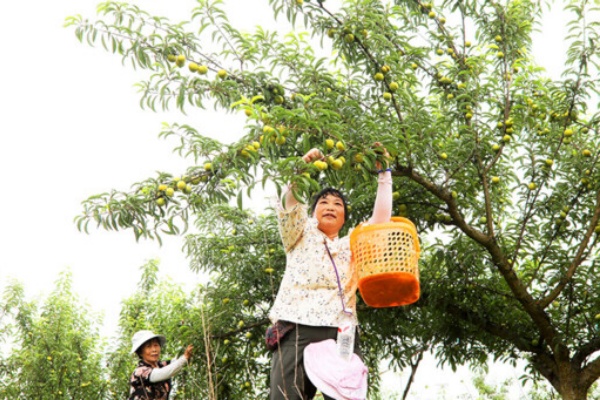
Recently, a plum orchard operated by an agricultural company in Longfengqiao Village, Chongqing Municipality, entered its harvest season. After being picked, transported, sorted, and packaged locally, the fresh plums will be shipped to markets across China. This “leading enterprise + production base + farmers” model allows villagers to earn a stable income close to home. Photo: IC PHOTO
Over more than four decades since Reform and Opening-up, China has lifted approximately 770 million rural residents out of poverty. China’s experience is unparalleled in world history, whether measured by the scale of poverty reduction, the proportion of the poor population lifted out of poverty, or the speed at which this was achieved. More than 70% of global poverty reduction during the same period occurred in China, making an outstanding contribution to the achievement of the United Nations Sustainable Development Goals. Existing theoretical frameworks remain insufficient to fully explain this remarkable achievement or to reconcile poverty reduction theories with Chinese characteristics with mainstream international poverty theories. A more comprehensive explanation requires an integrated examination of economic development and poverty reduction, and a more generalizable interpretation from the perspective of Chinese economics.
Pathways to rural poverty eradication in China
Poverty research is a foundational field within development economics. To understand how poverty reduction is achieved, development economics literature has traditionally adopted a dichotomous framework of growth and inequality, treating economic growth as the main driver of poverty reduction while viewing inequality associated with growth as a negative factor that constrains poverty alleviation. World Bank experts proposed the “poverty-growth-inequality triangle” as an analytical framework, arguing that this dichotomous approach is overly simplistic because it overlooks the interaction between growth and inequality in primary income distribution, while redistribution can, under certain circumstances, improve this relationship and promote poverty reduction. From a comparative international perspective, China’s long-term, large-scale targeted rural poverty alleviation efforts are highly unusual, and equating them with conventional redistributive policies may obscure their distinctive significance. This article argues that China’s poverty reduction strategy can be understood through three principal dimensions.
First, sustained and inclusive economic growth was the most important route through which China eliminated poverty. China’s early rural reforms granted rural households autonomy over production and management decisions, along with residual claims, a shift that released substantial agricultural productive potential and generated rapid growth in agricultural output and rural residents’ incomes. As improvements in agricultural production conditions and structural transformation gradually reduced both the scale of agricultural employment and the poverty-reducing effects of agricultural growth, rapid expansion of the national economy became the primary driver of poverty reduction. This broader growth process facilitated the transfer of rural labor—including poor laborers—into non-agricultural employment and increased wage income.
Second, pro-poor redistribution provided another important mechanism. Redistribution is one of the universally recognized poverty reduction instruments of the modern state. Beginning in the early 21st century, the Chinese government implemented redistributive reforms aimed at reducing income disparities and rebalancing urban-rural relations, producing profound effects on poverty reduction. First, agricultural taxes and fees, along with compulsory education charges, were abolished and replaced by agricultural subsidies and free compulsory education. Rural social security systems were also gradually established, fundamentally altering the direction of income transfers between the state and rural residents. Second, once the rural social security systems were in place, it provided institutionalized, stable income support for households vulnerable to poverty. Finally, a range of social protection measures was adopted during the targeted poverty alleviation campaign.
Third, developmental poverty alleviation played a crucial role. Development-oriented poverty alleviation creates market conditions in poor regions, or for poor households, that would not emerge spontaneously, expanding opportunities for the poor to participate in economic activities. Although such practices are not unique to China, China succeeded in institutionalizing and sustaining them over the long term. In its early stages, rural poverty alleviation focused on utilizing local resources in poor areas to develop commodity production, meet basic subsistence needs, and generate income growth. Over time, this approach evolved into a strategy of encouraging and assisting poor regions and poor populations to achieve prosperity by developing productive activities and strengthening their capacity for self-sustained development.
Created markets
While the principles of development economics help explain the mechanisms through which rural poverty reduction was achieved in China, they do not fully explain why such success was possible. Throughout the processes of Reform and Opening-up and rural poverty alleviation, China gradually developed an anti-poverty theory rooted in its own national conditions. Many of its insights—including the roles of the socialist system, Party leadership, an active government, and market creation—offer important contributions to poverty studies. However, many existing explanations, despite being grounded in China’s national context, tend to overemphasize the uniqueness of Chinese institutions and consequently remain difficult to reconcile or bring into dialogue with international poverty reduction theories. A more persuasive explanation requires transforming these “Chinese characteristics” from exogenous factors into endogenous variables and re-examining the relationship between government and market from a political economy perspective—beginning from conditions of low development and widespread poverty—and considering economic development and poverty reduction as an integrated process.
Following Reform and Opening-up, China first restored the commodity economy and subsequently pursued the construction of a socialist market economy. The emergence of local markets in coastal regions and the gradual formation of a unified national market were not spontaneous developments, but rather the result of deliberate market creation. This process became a precondition for China’s prolonged period of rapid economic growth and established the economic foundation for large-scale poverty reduction. In addition to income growth generated through this nationally created market system, poverty reduction in China also relied on incomes generated within markets shaped by state intervention. Through developmental poverty alleviation, China actively created markets in poor regions, promoted labor market participation among poor populations, increased labor productivity, and fostered local market institutions. Improvements in labor productivity and disposable income among China’s rural poor were thus achieved through two forms of created markets: an inclusive national market and pro-poor markets specifically targeted at poor regions and populations. Together, these generated both spontaneous trickle-down effects and extended trickle-down effects, encompassing heterogeneous groups of poor people and producing more comprehensive poverty reduction outcomes.
Active government
China’s economic success has generated diverse interpretations regarding the role of government in development. In the context of poverty reduction, the Chinese government assumed the role of an active government. First, under the leadership of the Communist Party of China, the socialist system was established, and the contemporary mission of the state became the development of socialism with Chinese characteristics, the elimination of poverty, and the advancement of common prosperity. Second, guided by the principle that “development is the absolute principle,” the government took economic development as its central task, formulated development strategies consistent with comparative advantage, engaged in market creation that served market participants, and implemented proactive industrial policies, all with the aim of sustaining rapid economic growth. Third, with the objectives of improving public welfare and narrowing developmental disparities, the government promoted reforms in income distribution and social security while also implementing industrial, social assistance, and other public policies that leveraged governmental capacity and initiative.
Beyond promoting poverty reduction through inclusive growth generated by market creation at the national level, the Chinese government actively assumed and fulfilled primary responsibility for eliminating rural poverty, which was reflected in three additional respects. First, rural poverty alleviation was institutionalized as a core responsibility of Party committees and governments in poor regions, which implemented developmental poverty alleviation over an extended period. Second, helping all poor people escape poverty was regarded as an explicit governmental obligation. Third, the state established time-bound national targets for the eradication of poverty.
Definitions of poverty, and understandings of its underlying causes, imply distinct policy orientations. China’s anti-poverty practice effectively defined poverty as a manifestation of insufficient development, and on this basis developed a poverty governance strategy centered on poor households and oriented toward poverty exit. To address constraints on poverty alleviation resources, China extensively mobilized society through its institutional arrangements and assembled substantial resources through mechanisms corresponding to primary, secondary, and tertiary distribution. In this framework, primary distribution refers to market-based allocation, in which enterprises were the principal actors, mainly through investment in poor regions and the employment of poor laborers, supplemented by certain forms of state investment. Secondary distribution refers to government-led redistribution, in which the state played the leading role through fiscal transfer payments. Tertiary distribution refers to voluntary social contributions, involving socially responsible enterprises, households, and social organizations, which contributed through donations and direct participation in poverty alleviation initiatives.
The redistributive mechanisms embedded in China’s anti-poverty strategy can be characterized as developmental redistribution closely integrated with developmental poverty alleviation. With the exception of relief and social assistance, most poverty alleviation resources were not distributed directly to households through cash transfers. Instead, they were invested in productive activities in poor regions, including infrastructure construction, enterprise development, and household economic activities. The objective was to establish sustainable pathways out of poverty by enabling poor populations to achieve self-reliance and reduce developmental disparities through their own productive efforts.
The eradication of rural poverty requires adequate poverty alleviation resources as a necessary supporting condition. Because the depth and severity of poverty vary across individuals and regions, those who escape poverty earlier generally require relatively limited resources, while those lifted out of poverty later require progressively larger investments. The final stage of poverty reduction, involving deeply impoverished regions and populations, demands disproportionately greater resources. Although the efficient allocation of scarce resources is a basic principle of economics, the Chinese government’s objective extended beyond substantial reductions in poverty to its complete eradication. China therefore increased and allocated poverty alleviation resources in accordance with the rising difficulty and cost of poverty reduction. During the 13th Five-Year Plan period (2016–2020), China continuously innovated methods of resource mobilization and investment, overcoming the “last mile” challenge in poverty alleviation.
Chinese anti-poverty theory internalizes “Chinese characteristics” as institutional, developmental, and structural features of the state. Through the historically specific combination of “efficient market” and “effective government”—manifested in the forms of created markets and an active government—these characteristics contributed to the elimination of rural poverty. In doing so, Chinese anti-poverty theory has advanced the construction of an independent Chinese knowledge system in the field of poverty studies, while enriching and expanding the global theoretical repertoire on poverty reduction.
Tan Xuewen is a research fellow from the Rural Development Institute at the Chinese Academy of Social Sciences. This article has been edited and excerpted from Journal of Renmin University of China, Issue 6, 2025.
Editor:Yu Hui
Copyright©2026 CSSN All Rights Reserved