


Advancing high-quality industrial cooperation between eastern and western China
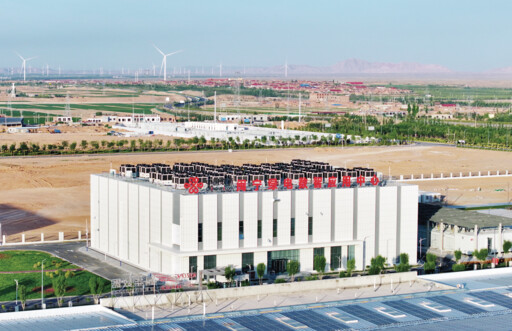
The Minning Green Electricity and Digital Intelligence Application Center commenced operations on June 17 in Minning Town, Yongning County, Yinchuan City, Ningxia Hui Autonomous Region. Photo: IC PHOTO
East-west collaboration is an important means of promoting coordinated regional development and common prosperity in the new era. The initiative began in 1996, when the CPC Central Committee arranged for developed eastern coastal provinces and municipalities to assist impoverished areas in western China, and has now entered its fourth decade. Industrial cooperation is the centerpiece of east-west collaboration and a key to building a high-quality pattern of coordinated regional development. A clear understanding of its strategic value, synergy laws, and practical pathways is therefore essential to opening a new chapter in regional coordination and steadily advancing common prosperity.
East-West industrial cooperation
A clear understanding of the strategic value and broader significance of upgrading east-west industrial cooperation is the necessary starting point for ensuring that cooperation continues to deepen and deliver substantive results. Viewed within the broader framework of national development, higher-quality industrial cooperation between eastern and western China is an important policy instrument for deepening coordinated regional development, accelerating the construction of a unified national market, and advancing common prosperity. It can help optimize the country’s industrial layout, strengthen domestic economic circulation, and narrow income gaps between regions.
First, deeper industrial cooperation can strengthen the coordinated regional development strategy. The effectiveness of that strategy depends substantially on the depth of industrial cooperation. As assistance enters a regular, long-term stage, the established pairings between eight eastern provinces and 10 western provinces are continuing to deepen. At the same time, industrial cooperation is evolving from one-way transfers toward a more reciprocal pattern of interaction.
Higher-quality cooperation can also accelerate the construction of a unified national market. Eastern enterprises investing and establishing operations in the west, together with western specialty products entering eastern consumer markets, create supply-and-demand networks stretching across thousands of kilometers. These ties also promote the cross-regional allocation of technology, talent, data, and other factors of production. In this way, industrial cooperation helps break down regional segmentation and market barriers, facilitates the free flow of production factors, and strengthens domestic circulation.
Improving industrial cooperation is also a key lever for achieving common prosperity. The core logic of east-west industrial cooperation is a shift from short-term “blood transfusions” to building the capacity for self-sustaining growth, offering a durable way to narrow both regional and income gaps. By supporting skills training, human capital accumulation, and the growth of local businesses and other market participants, such cooperation embeds development capacity within local economies. Over time, this reduces dependence on external resources and helps less-developed regions move toward self-reliant growth.
Grasping regional synergy laws
Three decades of east-west collaboration across China show that industrial growth depends on expansion across regional boundaries, and that upgrading regional industrial cooperation requires adherence to the regional synergy laws of industrial development. More specifically, cross-regional industrial development must rest on three foundations: complementary factor endowments, greater industrial specialization, and the fair distribution of benefits.
Complementary factor endowments provide the material basis for cross-regional industrial coordination. Eastern and western China differ markedly in their resource profiles. The eastern coastal regions have ample capital, rapidly evolving technology, and mature market channels, but face increasingly tight constraints on land, energy, and other resources. Western regions possess abundant energy and mineral reserves, lower labor costs, and greater room for industrial development, but have less accumulated capital and weaker technological capabilities. These differences create the conditions for cross-regional cooperation and, when used effectively, can become complementary industrial advantages.
Three decades of Fujian-Ningxia collaboration have validated this logic: Fujian has helped address Ningxia’s industrial weaknesses through its strengths in capital, technology, and markets, while Ningxia has offered land, sunlight, and distinctive local resources that expand the development space available to Fujian enterprises. This has produced cooperation models ranging from cultivating southern fruit in the north and the “East Data, West Computing” initiative to aging Ningxia wine in Fujian cellars and supplying Fujian with green electricity. Effective market mechanisms can thus turn differences in factor endowments into complementary strengths and provide a solid foundation for east-west industrial cooperation.
Greater industrial specialization provides the operating mechanism for cross-regional production. Regional cooperation is not simply a matter of relocating or replicating industries. Its purpose is to build specialized networks of production and collaboration around each region’s comparative strengths. In east-west industrial cooperation, this division of labor is advancing across technology, industrial, and value chains.
Along the technology chain, mature and applicable technologies from the east are diffused westward, while western regions provide large-scale settings in which they can be applied. Along the industrial chain, the east focuses more on R&D, design, and brand marketing, while the west undertakes manufacturing, processing, and assembly, creating stable upstream and downstream relationships. Along the value chain, the two regions specialize in different value-adding stages of the same product and share the resulting gains. Guangdong-Guizhou collaboration offers a representative example. Through a model of “design in Macao, production in Zheng’an, and sales in Hengqin,” the two regions have jointly developed Zheng’an, Guizhou, into the “Guitar Capital of China.” In 2025, the value of the county’s guitar exports reached 248 million yuan. This specialized division of labor moves cooperation beyond the transfer of production capacity toward an integrated production system, raising the overall efficiency of east-west industrial cooperation.
Fair distribution of benefits is the fundamental guarantee of sustained, mutually reinforcing regional development. The long-term viability of cross-regional industrial cooperation ultimately depends on whether the additional gains it generates are distributed fairly, particularly whether regions with weaker industrial foundations receive tangible benefits. In practice, east-west collaboration generally seeks to balance industrial development, higher collective revenues, and rising household incomes.
The full-chain coffee partnership between Shanghai and Baoshan, Yunnan, is one example. Supported by east-west collaboration, Baoshan’s Arabica coffee industry has helped more than 30,000 growers achieve stable income growth. Average annual coffee-related income now exceeds 20,000 yuan per person in participating farming households, while local processing plants have created jobs close to home for more than 2,000 people. Since east-west industrial cooperation brings together multiple factors of production across regions, each factor should receive returns commensurate with its contribution. Only a fair system of benefit-sharing can sustain mutually reinforcing development and enable cooperation to advance steadily over the long term.
Building new pattern of high-quality development
Building a new pattern of high-quality regional coordination through stronger east-west industrial cooperation requires translating a theoretical understanding of the regional synergy laws of industrial development into practical policy. Future efforts in this regard should therefore proceed along three dimensions: broadening cross-regional collaboration, deepening industrial chains, and enhancing mutual benefit and win-win outcomes.
First, cross-regional collaboration should be broadened to create a denser spatial network for coordinated development. High-quality regional coordination requires breaking through administrative boundaries, building a multi-level network of industrial cooperation, and allocating production factors across a wider geographic area. While consolidating long-term provincial pairings, east-west cooperation should therefore extend further into cities, counties, townships, and industrial parks, channeling cooperation resources closer to the local level.
As of June 2026, Zhejiang-Sichuan collaboration had jointly established 100 industrial parks, attracted more than 2,000 Zhejiang enterprises, and secured over 200 billion yuan in investment, with cooperation extending across numerous prefectures and counties. Fujian-Ningxia collaboration has likewise built a five-tier pairing network covering provinces, cities, counties, towns, and villages, enabling resources to be directed more precisely to local communities. Cooperation across these different spatial scales expands the scope for coordinated factor allocation and strengthens the geographic foundations of regional development.
Second, industrial chains should be deepened to reinforce the productive foundations of regional coordination. The quality of regional integration ultimately depends on the strength of its industrial system and the depth of cooperation within it. East-west industrial cooperation is now moving toward a more systematic, full-chain model. This requires encouraging leading eastern enterprises to bring upstream and downstream supporting firms westward, forming clusters in which large, medium-sized, and small enterprises are integrated and different segments of the supply chain work in coordination. It also means helping locally distinctive western industries move beyond primary processing into higher-value manufacturing and brand development, thereby raising value added throughout the chain.
The widespread application of digital technology has further expanded the scope of cooperation: remote collaboration and cloud-based coordination have become routine, western specialty agricultural products can connect directly with eastern consumer markets, and workers can access flexible employment through digital platforms. Together, these changes are strengthening the industrial foundations of regional coordination and opening new channels through which eastern and western markets can complement one another.
Third, cooperation should deliver more effective and broadly shared gains. The ultimate measure of higher-quality east-west industrial cooperation is whether it improves the overall performance of regional development. This requires stronger incentive and accountability mechanisms that align the goals of the participating regions. Evaluation should shift away from an emphasis on capital investment and project numbers toward quality, efficiency, and the development of locally rooted growth capacity. Implementation should respect market forces, focus on reducing institutional transaction costs, and avoid interfering in the independent decisions of market participants. Most importantly, the basic test of results should be whether people see tangible benefits and are satisfied with the outcomes. Only when cooperation produces fairly shared gains—through expanded employment, higher incomes, and stronger capabilities in both eastern and western regions—can its full contribution to coordinated regional development be realized.
Upgrading east-west industrial cooperation is a long-term, systemic undertaking. At this new stage of development, China should build on the mature experience accumulated through initiatives such as Fujian-Ningxia collaboration and strengthen cooperation simultaneously in geographic reach, industrial-chain depth, and the distribution of mutual benefits. A more complete industrial cooperation system can further promote two-way flows of resources, stronger economic integration, and coordinated development between eastern and western China. This will reinforce the industrial foundations of common prosperity and lay firmer groundwork for both a new pattern of high-quality regional development and the broader goal of building a modern socialist country in all respects.
Zhang Keyun (professor) and Yu Xiaokun are from the School of Applied Economics at Renmin University of China.
Editor:Yu Hui
Copyright©2023 CSSN All Rights Reserved