


Big data, AI are transforming oracle bone studies
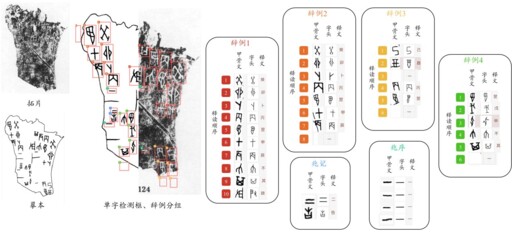
FILE PHOTO: Oracle Bone Inscription Multi-modal Dataset (OBIMD), jointly developed by Anyang Normal University, Tencent, and Xiamen University
Since the turn of the 21st century, the deep integration of big data and artificial intelligence (AI) has emerged as a transformative force in the preservation, study, transmission, dissemination, and utilization of oracle bone inscriptions. These technologies are also opening new paths for uncovering the foundational historical and cultural information on the Shang Dynasty (1600–1046 BC) preserved in oracle bones, and for analyzing the evolution of religious belief and intellectual thought in early China. Their impact extends well beyond the introduction of new research tools and methods. Big data and AI are reshaping the field’s research agenda, modes of knowledge production, and wider scholarly ecosystem. Together, these shifts have given rise to the emerging interdisciplinary field of “digital–intelligent oracle bone studies” and are steering the field of oracle bone studies toward a form of “computational history”—a paradigm characterized by data-driven approaches, human-machine collaboration, and macro-level exploration.
Holistic data acquisition, high-quality data generation
The effective use of big data and AI in oracle bone studies fundamentally depends on the availability of systematic, accurate, and high-quality primary data. Holistic acquisition, documentation, and organization of oracle bone materials are therefore essential to building large-scale databases and conducting AI-assisted research.
Holistic acquisition involves far more than simply digitizing existing records. It is an artifact-centered approach to multidimensional, high-precision information acquisition and integration. Every oracle bone is treated as a carrier of multiple forms of evidence whose value extends well beyond the inscription on its surface. Documentation may therefore encompass provenance, authentication, material composition, fragment joining, traces of cinnabar or ink infilling, drilling and carving techniques, microscopic tool marks, three-dimensional modeling, conservation history, and every other recoverable feature of the object.
In practice, holistic acquisition comprises three principal components: emergency conservation of cultural relics together with comprehensive inventories of extant collections, high-resolution imaging and processing, and the intelligent generation of digital facsimiles. Of these, high-quality imaging represents the technological core. Three advanced techniques are currently in use. High-resolution digital photography is the most widely used and has become standard practice in the digitization of oracle bone artifacts. The other two are reflectance transformation imaging (RTI) and ultraviolet-induced visible fluorescence (UVF) photography.
Holistic acquisition and detailed documentation are enormous undertakings—both labor- and technology-intensive—and depend on sustained cooperation across disciplines. In recent years, major projects and sustained institutional investment in China and abroad have supplied much of the momentum behind the construction of oracle bone big-data resources and the expansion of AI-assisted research. A representative example is the Third Supplement to the Corpus of Oracle Bone Inscriptions, launched in 2008 by Song Zhenhao’s team from the Institute of Ancient History at the Chinese Academy of Social Sciences (CASS). The project collects inscriptions omitted from both the Corpus of Oracle Bone Inscriptions and its supplementary volume, together with scattered materials and newly identified fragment joins, and will ultimately document more than 32,000 oracle bone pieces. Museums, universities, and research centers in China and overseas have likewise undertaken systematic programs to digitize and document their holdings. Their coordinated efforts toward the “digital repatriation” of oracle bones have laid a firm foundation for big-data and AI-assisted research, encompassing the documentation of excavated artifacts, the large-scale digitization of museum collections, and the digitization of overseas holdings and international cooperation.
Big data integration, knowledge platform construction
The sheer volume of oracle bone materials has made reliance on traditional printed catalogues increasingly impractical for efficient research. A growing range of digital databases and large-scale information repositories now forms an ecosystem that has greatly improved access to materials for contemporary scholarship.
Traditional databases—including inscription catalogues, paleographic character databases, fragment-joining databases, and museum collection databases—have made invaluable contributions to the field. Yet because they were developed independently, they share several limitations. First, documentation, metadata, and character-encoding standards differ across institutions, making interoperability difficult. Second, most databases also operate as closed systems with few mechanisms for interconnection, hindering cross-database comparison, integration, and retrieval. Third, data quality varies considerably, while inadequate long-term maintenance has left some resources no longer updated or their links inactive, undermining their scientific reliability and lasting scholarly value. Finally, access presents a further obstacle: Most databases are not freely open to the public, restricting the wider circulation of oracle bone scholarship and creating barriers to AI applications.
To overcome these systemic limitations, a new generation of integrated data platforms has emerged, most notably the Yinqi Wenyuan Oracle Bone Inscriptions Data Platform and the Jingyuan Oracle Bone Digital Platform. Developed by the Key Laboratory of Oracle Bone Inscriptions Information Processing of the Ministry of Education at Anyang Normal University (AYNU), Yinqi Wenyuan is the world’s largest nonprofit big-data platform devoted to oracle bone resources. It brings together six major databases covering inscription catalogues, character forms, bibliographic materials, fragment joins, duplicate verification, and comprehensive inscription catalogues. Its inscription catalogue database alone contains 154 published catalogues and nearly 240,000 oracle bone images, allowing vast quantities of material to be managed and retrieved through a unified system.
Jingyuan, designed and developed by Qin Peichao, a doctoral researcher from the Department of East Asian Studies at the University of Cambridge, represents another important digital initiative. Its first major achievement was the Jingyuan High-Definition Oracle Bone Character Database. The platform also incorporates a powerful multimodal search engine, an intelligent input system, and visualization tools such as the Global Distribution Map of Oracle Bones and the Chronology of Oracle Bone Studies, providing new technological infrastructure for digital research, teaching, and public engagement.
Key AI applications in oracle bone studies
As big data and AI technologies have matured, advances in deep learning and pattern recognition have accelerated the intelligent transformation of oracle bone studies in the 21st century. These developments have fostered innovative research across multiple dimensions while overcoming many of the constraints of traditional methods.
The first major application is the digitization and restoration of oracle bone materials. Converting original, often heavily degraded rubbings into structured datasets that computers can analyze is the starting point for digital research. Rubbings are frequently marred by cracks, stains, and other forms of visual noise that obscure the inscriptions, prompting researchers to develop automated methods for image segmentation, character recognition, and annotation. Image segmentation isolates the inscribed characters from complex backgrounds, producing high-quality datasets for subsequent recognition and analysis. Character recognition and annotation then link individual character images to their transcriptions and identify the characters themselves. Research in this area has increasingly shifted from traditional methods dependent on manually engineered features toward deep-learning models capable of extracting patterns directly from the data.
Reassembling scattered fragments into more complete artifacts is another central challenge—one in which AI-assisted fragment joining has already produced significant advances. In 2019, AYNU’s Key Laboratory of Oracle Bone Inscriptions Information Processing employed a system developed in-house to produce the first AI-assisted oracle bone join confirmed against the physical fragments. A number of efficient tools have also emerged for the automated identification of duplicate materials.
A second major direction is the transition from data association to knowledge discovery. Two technological approaches currently dominate AI research: knowledge graphs (KGs), which represent structured factual knowledge, and large language models (LLMs), which generate probabilistic textual outputs. At the foundational stages of data organization and integration, high-precision KGs offer a crucial means of uncovering the intrinsic logical relationships embedded within oracle bone data while avoiding the hallucination risks associated with generative models. To this end, the Yinqi Wenyuan platform has collaborated with the China National Knowledge Infrastructure (CNKI) to explore deep data mining based on the concept of the “CNKI Node.”
As intelligent data linkage and KGs develop, digital–intelligent oracle bone studies are moving beyond the organization of source materials toward deeper semantic interpretation. Using AI and advanced data mining to analyze syntax and semantics, interpret inscriptions and textual examples, and reconstruct the historical, cultural, and intellectual worlds reflected in oracle bone inscriptions has become one of the research frontiers of the discipline.
The rapid development of generative foundation models is also pushing oracle bone research tools toward increasingly integrated intelligent agents. One recent example is Yinqi Xingzhi, an intelligent agent that draws on the DeepSeek and Tencent Hy foundation models while incorporating algorithms for digital facsimile generation, character detection, and character recognition. Built upon a large-scale multimodal oracle bone dataset, the system explores the potential of AI for understanding ancient Chinese writing.
These preliminary efforts to construct semantic networks of Shang history through advanced computational techniques not only create new possibilities for reconstructing the social landscape underlying oracle bone inscriptions, but also signal the gradual transition of oracle bone studies toward a data-driven paradigm of computational history.
Cultivating interdisciplinary talent, innovating the scholarly ecosystem
As big data and AI become increasingly integrated into oracle bone studies, traditional approaches rooted exclusively in the humanities are confronting new challenges. Future development of the field depends on closer collaboration between the humanities and the sciences through interdisciplinary, coordinated, and open research. Accordingly, this urgently requires the cultivation and long-term training of stable teams of scholars with expertise not only in oracle bone studies, history, archaeology, and museum conservation, but also in computer science and information processing. Such teams will provide the human foundation for a new paradigm of digital–intelligent oracle bone studies.
To meet this demand, a growing number of forward-looking research institutions have begun to dismantle traditional disciplinary boundaries and explore new models of education and research. Examples include AYNU’s Key Laboratory of Oracle Bone Inscriptions Information Processing, the Oracle Bone Intelligent Computing Laboratory at Henan Normal University, and the incubator project for the Laboratory of Scientific Analysis of Oracle Bones at CASS. At the same time, China’s long-standing centers of oracle bone scholarship are actively promoting broader change across the discipline. Tsinghua University, Peking University, Zhengzhou University, Renmin University of China, Fudan University, Nanjing University, and other institutions have incorporated oracle bone studies majors into their pilot plans for strengthening basic academic disciplines in the study of ancient characters, marking the first large-scale inclusion of the discipline in undergraduate admissions.
Today, AI-enabled digital–intelligent technologies have become a powerful force supporting the preservation and dissemination of oracle bone inscriptions. By bringing together research institutes, archaeological and museum organizations, universities, leading technology companies, and local governments, these initiatives are fundamentally changing how people engage with cultural heritage. They are breaking down institutional and disciplinary barriers while making large-scale social collaboration, wider public participation, and the global sharing of knowledge and resources increasingly possible. The interpretation of oracle bone inscriptions is thus beginning to move beyond a specialized academic domain and into a broader process of collaborative knowledge creation.
Zhi Xiaona and Song Zhenhao are from the Institute of Ancient History at the Chinese Academy of Social Sciences. This article has been edited and excerpted from Journal of Chinese Historical Studies, Issue 1, 2026.
Editor:Yu Hui
Copyright©2023 CSSN All Rights Reserved