


New horizons and approaches in disaster history research
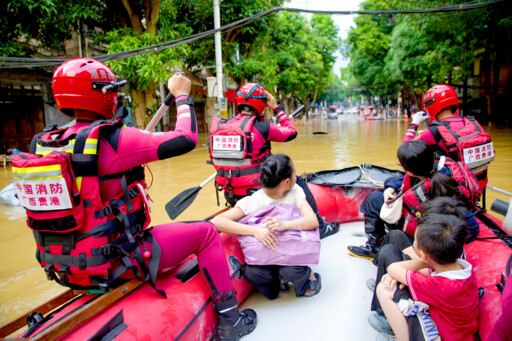
Firefighters evacuate trapped residents on Aug. 24 in Longzhou, Guangxi Zhuang Autonomous Region, where heavy rainfall from Typhoon “Zitan” and upstream inflows caused the water level of the Left River section in Longzhou County to keep rising, flooding some urban roads. Photo: VCG
Disaster history as a modern field of study has developed over the past century, gradually forming a relatively mature research system. The dominant approach during the 20th century traced the natural evolution of disasters, focusing primarily on their natural dimensions. Scholars mapped the spatial and temporal distribution and frequency of floods, droughts, locust plagues, epidemics, and other disasters and examined their natural causes, thereby establishing a chronological framework for disasters in ancient China.
Evolution and limitations
Since the reform and opening up, historians began to examine disasters in relation to broader social development, exploring their effects on economic order, social structure, and people’s livelihoods, as well as the social unrest and institutional adjustments they could trigger. This marked a shift toward a social-historical approach, tracing the broad trajectory of disasters across successive periods, identifying the principal forms and institutional practices of official relief and private charitable assistance, and illuminating the close relationship between disasters and social change.
In recent years, disaster history research has undergone a profound transformation: from a focus on “disaster events” to the processes shaping human-environment relations, from “historical textual research” to “digital humanities,” and from “regional narratives” to a global perspective. This shift reflects a growing concern with contemporary problems as well as renewed scholarly vitality. Research has also moved from “post-disaster response” toward tracing the conditions that precede disasters, examining the deeper connections among long-term environmental change, land systems, patterns of resource use, and their cascading consequences, while exploring how environmental vulnerability has been produced by human activity over the course of history.
However, the limitations of traditional approaches have become increasingly apparent. First, the range of topics remains relatively narrow, with much research concentrated on the spatial and temporal distribution of disasters, disaster statistics, and textual studies of famine-relief measures. Disasters are often treated primarily as natural shocks, with insufficient attention to their social construction and historical continuity. Research has also tended to be fragmented, focusing on individual dynasties, disaster types, or regions in ways that obscure the continuity of disaster evolution and the long-term interactions among disasters, ecology, society, and governance. This makes it difficult to identify the deeper historical dynamics underlying changes in disaster patterns. Second, research perspectives have often remained relatively rigid, following a linear disaster-response narrative and concentrating on the documentation of post-disaster relief and emergency measures. Less attention has been paid to the full cycle of disaster governance, from prevention and control to recovery, leaving the systematic experience accumulated in ancient disaster governance insufficiently explored.
Third, research methods remain comparatively limited, relying largely on documentary study and qualitative analysis, with insufficient interdisciplinary integration and quantitative methods. The collection, interpretation, and cross-referencing of disaster data also remain underdeveloped, constraining the precision and analytical rigor of the field. Fourth, research is not always closely aligned with practical needs. Some studies emphasize historical reconstruction while giving less attention to contemporary applications, creating a disconnect between knowledge production and its translation into decision-making. As a result, the traditional ideal of applying historical knowledge to practical affairs has yet to be fully realized, limiting the field’s contribution to public issues.
New horizons in new era
Traditional research has often treated disasters as isolated or contingent events. A holistic historical perspective instead moves beyond the spatiotemporal boundaries imposed by dynastic divisions and administrative jurisdictions, situating disasters within the broader development of Chinese civilization. Rather than examining them in isolation, this approach traces changes in disaster patterns and governance systems across successive dynasties while also examining their connections with population migration, economic development, institutional change, and cultural evolution. It thereby reveals how disasters, as historical variables, have shaped broader processes of civilizational development, while clarifying the reciprocal relationship between environmental change and human activity and building a more integrated body of knowledge linking past and present.
Scholars have often attributed disasters primarily to natural anomalies, while giving insufficient attention to imbalances in human-environment relations. An environmental history perspective, grounded in the idea of symbiosis between humanity and nature, moves beyond a narrow understanding of “natural disasters” to examine the relationships among environmental change, human productive activity, and disaster occurrence. By considering ecological factors such as vegetation loss, changes in soil and water conditions, and climate fluctuations, this approach probes the deeper causes of recurrent disasters across successive dynasties. It also examines how activities such as military-agricultural reclamation, water conservancy projects, and ecological protection reshaped disaster patterns, helping to build an understanding of disasters based on human-environment symbiosis and reciprocal interaction and aligned with the principles of contemporary ecological civilization.
From a national governance perspective, contemporary disaster history research focuses on emergency relief to situate disaster governance within the broader framework of state governance. Rather than concentrating only on post-disaster relief and tax exemptions, it examines the full governance cycle across successive dynasties, from early warning and preparedness to emergency coordination, post-disaster reconstruction, livelihood support, and institutional reform. It also explores the coordination between official administration and private relief, including patterns of resource allocation and the operation of power, while assessing the institutional strengths and shortcomings of past disaster governance as a historical reference for modernizing contemporary emergency management.
Disaster history research urgently needs to move beyond the confines of local narratives and pursue cross-regional and cross-civilizational comparison from a global history perspective. By comparing disaster types, patterns of occurrence, response strategies, and approaches to governance across different periods in China and other parts of the world, scholars can identify both common features and regional particularities in disaster governance, while examining differences among civilizations in understandings of human-environment relations, approaches to disaster relief, and governance models. Such comparative research can draw on historical experience from around the world while also distilling the distinctive insights of traditional Chinese disaster governance, helping to develop a theoretical framework that combines Chinese characteristics with a global perspective.
This shift in perspective means that disasters are no longer understood as isolated events, but as acute manifestations of long-term imbalances in human-environment relations. Research can thus move beyond natural causes to examine the political ecology surrounding disasters, as well as the differing experiences of social groups during disasters. In this way, disaster history can more clearly trace the evolving dynamics of human-environment relations and show how many of today’s “new problems” are, in essence, historical problems reappearing in new forms.
Innovative development paths
Disasters have both natural and social dimensions. Disaster history research should remain grounded in historical scholarship while actively drawing on theories and methods from climatology, geography, ecology, sociology, public administration, disaster science, statistics, and other disciplines. Climate reconstructions based on proxy data such as tree rings, ice cores, and stalagmites can help reconstruct the climatic conditions surrounding disasters and clarify their relationship with periods of extreme climate events. Spatial analysis can reveal patterns in the spatiotemporal distribution of disasters, while ecological theory can illuminate mechanisms of human-environment interaction. Sociological perspectives can shed light on how the effects of disasters spread through society, and public administration theory can help explain the operation of disaster-governance systems. Together, these approaches can move research beyond the confines of a single discipline and strengthen its analytical rigor and systematic scope.
The growing use of modern technologies such as big data, geographic information systems (GIS), and digital modeling has opened up new possibilities for disaster history research. Digital humanities tools such as spatial modeling and data visualization can reconstruct disaster trajectories, map their geographical reach, and track changes in frequency, while helping scholars trace the course and impact of historical disasters and visualize shifts in disaster patterns over time. These methods are moving the field beyond predominantly empirical and qualitative approaches toward more precise, data-driven analysis. The wider adoption of digital humanities has already reshaped the field, while AI now makes it possible to organize large-scale historical disaster data systematically, visualize them spatially, and identify broader patterns.
Given the traditional emphasis on post-disaster measures at the expense of prevention, contemporary disaster history should develop an integrated research framework encompassing “prevention, response, relief, and recovery.” Particular attention should be paid to historical approaches to disaster prevention, including water conservancy projects, grain reserves, climate observation, ecological conservation, and disaster-prevention education, with a view to identifying the experience underlying routine prevention mechanisms. Research should also systematically examine emergency coordination and multi-actor relief during disasters, together with the full course of post-disaster livelihood recovery, ecological restoration, and institutional reform, while clarifying the relationship between long-term governance mechanisms and short-term measures. Such a full-cycle approach can provide a more complete picture of the structure of disaster governance in ancient China.
Disaster history has long been shaped by an academic tradition of applying historical knowledge to practical affairs, with a mission to draw lessons from the past, carry forward governance experience, and serve contemporary development. In the new era, the field should engage directly with practical concerns such as disaster prevention and mitigation, the modernization of emergency management, and ecological civilization, while adapting historical experience to contemporary needs and contributing to disaster preparedness, risk awareness, and the strengthening of social resilience. Disaster historians have long regarded themselves as participants in the broader work of disaster relief, and this strong practical orientation has kept the field closely connected to the strategic needs of national disaster prevention and mitigation.
By focusing on practical challenges such as the prevention and management of extreme disasters, grassroots coordination of relief efforts, ecological approaches to disaster prevention, and post-disaster social governance, disaster history research can draw useful lessons from the governance experience of the past and explore how traditional knowledge can be integrated with modern governance systems. In doing so, historical research can respond more directly to contemporary needs and provide a stronger historical and theoretical foundation for improving the national disaster prevention, mitigation, and relief system in the new era.
Zhou Qiong is a professor from the School of History and Culture at Minzu University of China.
Editor:Yu Hui
Copyright©2023 CSSN All Rights Reserved