


Decision neuroscience: from opening black box to embracing intelligence
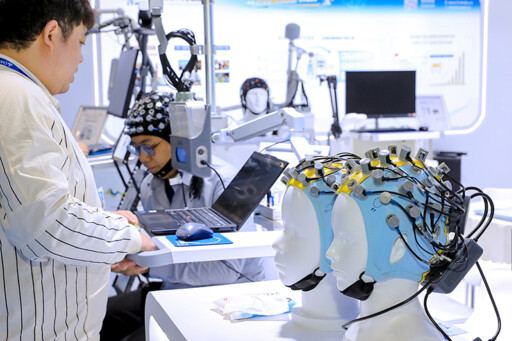
The NirSpace fNIRS 3D positioning system, developed by China’s Danyang Huichuang Medical Equipment Co., Ltd., on display at the 93rd China International Medical Equipment Fair in Shanghai, Apr., 2026 Photo: CFP
Management is decision-making—American scholar Herbert A. Simon’s assertion more than half a century ago captured the essence of management science. Yet traditionally, both the rational-choice models of economics and behavioral research in management largely focused on describing the “inputs” and “outputs” of decision-making. This allowed researchers to observe what people choose, but made it difficult to answer a more fundamental question: How does decision-making actually occur in the brain? As long as the organ governing human behavior and mental processes remains a “black box,” explanations of human decision-making are likely to remain superficial. It was from this challenge that the convergence of cognitive neuroscience and decision science gave rise to the emerging field of decision neuroscience. Using advanced neuroimaging and electrophysiological techniques to look directly inside the brain, decision neuroscience investigates the neural mechanisms underlying economic and managerial decision-making. It seeks both to uncover deeper foundations for existing theories of decision-making and to develop more accurate decision models incorporating physiological variables. Today, decision neuroscience has become one of the most dynamic interdisciplinary frontiers in economics and management.
Inside ‘black box’ of individual decision-making
Looking back at the evolution of research on individual decision-making, a clear progression emerges. Early studies primarily approached decision-making at the behavioral level, examining people’s choices under specific circumstances. As research advanced, the focus extended to the psychological and cognitive levels, and ultimately to the physiological level in an effort to uncover the deeper mechanisms underlying decision behavior. This progression from “behavior to cognition to neural processes” constitutes the logical starting point for the emergence of decision neuroscience.
Supporting this progression is the deep integration of methods from multiple disciplines. Functional magnetic resonance imaging (fMRI), with its relatively high spatial resolution, allows researchers to precisely localize activity across brain regions. Event-related potentials (ERP/EEG), with millisecond-level temporal resolution, capture the dynamic unfolding of decision processes. Eye-tracking records the processing of visual information, while functional near-infrared spectroscopy (fNIRS), electrodermal activity, heart rate, and other physiological signals further expand the dimensions of observation. Economics, management, psychology, neuroscience, and even computational science converge here around a common question: How does decision-making occur?
In China, the development of this field is closely associated with Zhejiang University. In 2006, Professor Ma Qingguo was the first to propose the concept of “neuromanagement,” systematically organizing branches including neuroeconomics, neuro decision science, neuromarketing, and neuro information systems. He subsequently established China’s first neuromanagement laboratory at Zhejiang University, and it was from this foundation that decision neuroscience, as a core component of neuromanagement, began to take root in China.
From uncovering mechanisms to computational modeling
Over the past two decades, Chinese researchers in decision neuroscience have systematically investigated topics including neuroeconomics, consumer neuroscience, decision-making under risk and ambiguity, and the neural foundations of financial decision-making, while laying an important foundation for empirical research. Depending on whether the probabilities of outcomes are known, decision-making under uncertainty can be divided into decisions under risk and decisions under ambiguity. Research using ERP techniques to investigate the neural mechanisms of decision-making under uncertainty has found that ambiguity elicits a smaller P300 amplitude than risk. This suggests that ambiguous conditions place greater demands on working memory, providing a neural explanation for the widespread phenomenon of “ambiguity aversion.” Further studies have shown that decision preferences are not fixed: At high levels of emotional arousal, individuals may actually become more inclined toward ambiguity. How information is filtered and focused can also alter the cognitive resources recruited by decision-makers and their perceptions of risk. These findings suggest that seemingly “irrational” reversals in preference are underpinned by observable neural mechanisms.
Building on this foundation, decision neuroscience has undergone an important paradigm shift from “uncovering mechanisms” to “predicting behavior.” In consumer neuroscience, neural data can do more than explain why consumers make particular choices; they can also predict choices consumers are about to make. Particularly striking is the finding that activity in brain regions such as the nucleus accumbens and prefrontal cortex can be used, even with small laboratory samples, to predict a song’s download numbers, market responses to an advertisement, and even broader patterns of consumer demand. Such predictions can outperform traditional self-report measures. This predictive framework can also be extended to organizational and managerial decision-making. Using ERP techniques, researchers can examine the fine-grained neural processes involved when managers evaluate employees and make decisions concerning dismissal or exclusion, while drawing on neural evidence to test classic dual-process theories. Such research suggests that managerial decisions are not simply dictated by unconscious processing; rather, they unfold dynamically as complex processes shaped by context and goals. Decision neuroscience has therefore begun to move beyond the laboratory and into real-world managerial contexts, providing organizational behavior research with a new micro-level foundation.
Looking ahead, research can advance further toward computational modeling of the decision-making process. Decisions are not made instantaneously; rather, the brain gradually accumulates evidence. By incorporating process data such as reaction times and mouse trajectories, together with sequential sampling models such as the drift-diffusion model, researchers can characterize how decisions unfold over time and decompose them into computational components such as prior tendencies, response caution, and value evaluation. For example, in cooperation and punishment—core issues in organizational management and business ethics—research suggests that punishment is not simply an impulsive, intuitive response. Instead, it more closely resembles a process of deliberate value calculation, in which relevant information is gathered and evaluated through evidence accumulation before a considered judgment is reached. In intertemporal decision-making, individuals make choices through dynamic comparisons of attribute information such as reward and time. Differences in the timing of how such information is presented can causally influence the degree of patience displayed by decision-makers, suggesting that adjusting the order in which attributes are presented can serve as a gentle “nudge.” These findings demonstrate that models integrating behavioral, process, and computational data can describe and predict human decision-making more accurately than traditional approaches.
Toward brain–machine intelligence, management decision-making
If decision neuroscience once centered on whether the “black box” could be opened, the advent of the digital–intelligence era is now redefining both its research objects and its methodologies. Today, decision neuroscience points toward a more concrete vision: the convergence of the “two brains.” One is the human brain; the other is the computer. One represents brain science; the other, machine intelligence. The two domains have traditionally developed along separate trajectories, yet decision-making is precisely the natural nexus at which they intersect.
Computational modeling represents a critical step in connecting these “two brains.” Once human decision-making processes can be represented as computational models, the cognitive principles of the human brain acquire a common language through which they can interact with machine intelligence. Understanding how humans make decisions and designing how machines should make decisions thus cease to be two isolated questions.
Along this trajectory, research on “brain–machine intelligence in management decision-making”—exploring how brain science and machine intelligence can work together to improve management decisions—is likely to become a major focus in the future. The digital economy has generated entirely new contexts, including livestream commerce and new retail, while human–machine interaction has increasingly become a routine part of decision-making. With algorithmic recommendations and AI agents providing assistance, the processes and mechanisms underlying individual decision-making have changed fundamentally, creating an urgent need to characterize them through multimodal physiological, psychological, and behavioral data. At the same time, the cognitive and neural principles underlying human decision-making can serve as important reference points for understanding, evaluating, and even aligning AI decision systems. How humans and machines should divide responsibilities, how they should collaborate, and how they should correct one another are precisely the new questions that research on “brain–machine intelligence in management decision-making” seeks to address.
True interdisciplinarity entails far more than simply borrowing tools; it requires deep dialogue at the level of research questions and the organic integration of research paradigms. If the tools of cognitive neuroscience are not connected to substantive questions in management and economics, they remain isolated technologies. Conversely, if management and economics research overlooks the mechanisms of the brain, its understanding of decision-making is likely to remain confined to the visible tip of the iceberg. From opening the “black box” of decision-making to pursuing the convergence of the “two brains” through brain–machine intelligence, the development of decision neuroscience reflects the changes in perspectives, tools, and research paradigms brought about by interdisciplinary integration, while pointing to the broad prospects of an emerging field.
These prospects, however, come with significant challenges. First, researchers must avoid the trap of reverse inference. A single brain region may participate in multiple cognitive activities, and neural signals and decision behavior do not necessarily correspond on a one-to-one basis. Conclusions therefore need to be drawn cautiously from multiple indicators. Second is the issue of external validity. Much neuroscience research is conducted in laboratory settings, and limited sample sizes, together with differences between experimental and real-world contexts, can pose significant challenges to the generalizability of findings. Third are ethical boundaries. As neural indicators increasingly enable researchers to gain insight into, and potentially influence, individual decision-making, protecting individual privacy and decision-making autonomy becomes an unavoidable concern. Moreover, decision-making mechanisms vary across cultural contexts, making it particularly important to develop research paradigms grounded in local settings.
Looking ahead, as the social sciences continue to converge with brain science and computational science, decision neuroscience will provide research in economics and management with theoretical insights of greater real-world relevance, as well as new forms of practical wisdom.
Wang Lei is director of the Laboratory of Neuromanagement and a professor from the School of Management at Zhejiang University.
Editor:Yu Hui
Copyright©2023 CSSN All Rights Reserved