


Marco Rubio's West has room for ancient Greece--but not for the Greeks
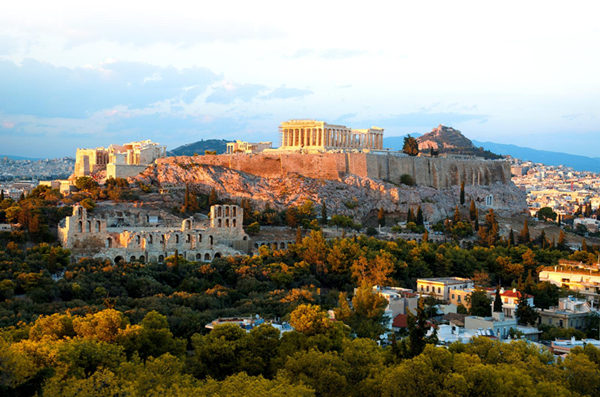
An aerial view of Athens, Greece Photo: VCG
In his address at the Pnyx in Athens on October 7, in front of the Acropolis, US Secretary of State Marco Rubio offered Greece what sounded like an extravagant compliment: a place at the beginning of the story of “the West.” Beneath the philhellenic courtesies, however, lay something more consequential, and considerably less flattering.
Inventing an eternal West
The word “West,” together with “Western,” recurred 19 times in Rubio’s Pnyx speech. This insistence was no accident: the West was its central political character, endowed with a birth, an inheritance, a mission and an apparently indispensable American guardian.
Yet, as the recent book The West: The History of an Idea (Princeton University Press, 2025) demonstrates, “the West” is not a single civilizational subject surviving intact from antiquity. Its modern construction took shape in the nineteenth century, in part supplanting an older conception of “Europe” that had included Russia. Auguste Comte played an important part in that intellectual reordering. Its boundaries have moved with political antagonisms, imperial rivalries and claims to cultural precedence. The familiar story “from Plato to NATO” is not an ancient self-description miraculously preserved through the ages, but a retrospective and rather shoddy a posteriori ideological-historiographical construction. In its eventual Euro-Atlantic form, the center of the alleged civilization migrated from its supposed birthplace to the United States—from cradle to periphery, and from periphery to command.
Who belongs to this imagined historical West, who is licensed to represent it, and who may speak in its name have therefore never been settled questions. Rubio resolves them by fiat. He draws a seamless line from Athenian antiquity to American republicanism and casts the American as the mature realization of a civilization born in Greece. If American power is the consummation of Western history, defending American primacy is no longer merely a matter of US strategy—it becomes the defense of civilization as such. Geopolitical subordination acquires the agreeable appearance of civilizational solidarity.
The timing of this historical incantation is revealing. As political unity between Europe and the US becomes less assured, their supposedly indissoluble civilizational unity is invoked with mounting fervor. Ideology labors to declare an eternal historical destiny precisely where actual power relations increasingly demand negotiation.
And Greece? Rubio called it a “model ally” and expressed the hope that Europe would follow its example. I should hesitate to wager my house on that prospect. What Greece exemplifies, in this account, is a Europe in which no inconvenient distinction arises between loyalty to the US and loyalty to oneself.
The Greeks who vanished from history
The speech’s most extraordinary omission passed almost unnoticed in Greece itself. The actual, continuous, historical Greece—the Greece of people rather than museum objects, vividly evoked in a different register by the Greek-American writer Sean Mathews in his recent book, The New Byzantines—has no place in Rubio’s chronicle except as an inert, cheerfully compliant revenant.
Follow his historical procession: It begins with Athens and Rome, then passes directly through Augustine and Thomas Aquinas, Latin Christendom, the cathedrals of Western Europe, Michelangelo and the scientists of the Western modern age. Magellan, Columbus and Cortés follow—then American territorial expansion, the Alamo and, at last, the American republic. A continuous genealogy has been contrived, and its omissions are as politically eloquent as its inclusions.
Where is the Eastern Roman Empire—what later historians called Byzantium? Where is Constantinople, a great center of European civilization at a time when much of the post-Roman West had not yet acquired its later cultural and political form? Where are the Greek-speaking patristic tradition, Eastern Christianity, Orthodoxy, and the Byzantine political, philosophical, theological and literary inheritance? This was a substantial part of the actual historical formation of the people before whom Rubio was speaking, not a marginal interlude between a glorious antiquity and a modern rediscovery.
Greeks were not sealed in a freezer in classical antiquity and thawed out in the nineteenth century. Nor were modern Greeks created by Western Europe’s rediscovery of their classical forebears; there was a people there (largely) speaking Greek. Their historical existence traverses precisely those centuries Rubio’s genealogy must pass over. The living Greek audience cannot be admitted into his civilizational scheme on its own terms. It can only enter by surrendering its history and its agency—whereupon, suitably docile, it may be fitted into almost any ideological contradiction.
There is a further irony. As the historical study of the very idea of the West shows, earlier articulations of Western identity were forged in opposition to the Greek-speaking Orthodox world of the Eastern Roman Empire. The category now presented as Greece’s immemorial home has also served as an instrument of Greece’s exclusion.
Rubio did, of course, invoke the Greek War of Independence of 1821 and Daniel Webster’s philhellenism. But that courtesy compounds the problem rather than resolving it. Modern Greece is allowed to appear as the beneficiary of American sympathy, not as the inheritor of the long historical experience supposedly connecting ancient Athens to the modern US. Antiquity becomes a chosen decorative ancestor of the US, and contemporary Greece becomes a model ally of the US. The historical Greece between them is simply expelled from the story.
That so many Greek commentators received this arrangement as the highest imaginable compliment is perhaps the most melancholy aspect of the affair. A country is invited to rejoice in being identified as another country’s ancestor, even as its own history is effaced. Whether Rubio’s exuberant version of neoconservative American exceptionalism as the essence of ancient Greek civilization could survive serious historical or philological scrutiny is another question—and not one he seems eager to entertain.
In the end, the address at the Pnyx reveals rather more than Rubio may have intended. Greece provided the postcard for a prospective Republican presidential narrative that seeks to restore a global hierarchy whose material foundations are steadily receding. In exchange, it received congratulations for its exemplary conformity—a new patriotism in which devotion to one’s country is measured by devotion to somebody else’s. More astonishing than Rubio’s ambitions is the poverty of the response in Greece, where even elementary resistance to this erasure proved scarce. Perhaps, after all, he was right to cast us as the model living dead.
Sotiris Mitralexis is an honorary senior research fellow from the Department of Anthropology at University College London in the United Kingdom.
Editor:Yu Hui
Copyright©2026 CSSN All Rights Reserved