


Temporal transformation and time governance in digital society
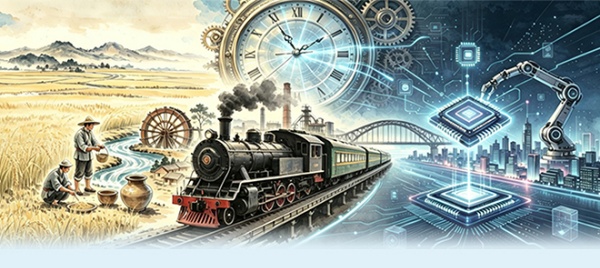
A particular type of society gives rise to its own temporal form, while the evolution of temporal forms is driven primarily by changes in the form of society. The long era of agricultural society gave rise to agricultural time. With the emergence of industrial society in the late 18th century, clock time took shape and gradually replaced agricultural time as the dominant temporal form of society. Since the 1940s, information technologies represented by computers and the internet have developed rapidly and penetrated deeply into society, gradually driving humanity from industrial society toward information society. Since the 1990s, the internet’s large-scale global spread has given rise to network society. As an advanced stage in the development of information society, network society has driven a new transformation in temporal forms.
New forms of social interaction construct network time
Some research suggests that, given the ways in which the internet has reshaped the forms and patterns of social interaction, the new temporal form of network society can be termed “network time.” Network time refers to a temporal form generated by the internet’s restructuring of social connections and interaction, characterized primarily by immediacy and interactivity. It is a product of the new social interactions shaped by the internet, rather than merely a technological outcome. On the surface, the internet has reshaped the temporal dimension of interaction, for example by shortening the time it takes. More fundamentally, however, these new forms of social interaction have endowed social time with new qualities and meanings, placing time more prominently within social interaction itself. By sustaining and creating extensive social connections, the internet has fundamentally transformed the scale, forms, structures, and logic of social interaction, thereby shaping new patterns of interaction.
The new forms of social interaction in network society construct network time and give it a pronounced interactive character, making it a form of interactive time distinct from individual time. The emergence of network time is a product of the “interactive transformation of time.” Unlike agricultural time, industrial time, and other pre-internet temporal forms, network time constitutes a new form of social time. Agricultural time is primarily “natural time,” measured by natural phenomena and agricultural activities. Industrial time is primarily “efficiency time,” measured by clock time and the rhythm of machines. Network time, by contrast, is shaped by new forms of social interaction mediated by the internet, with interaction itself serving as its measure. Different temporal measures give rise to different forms of social temporal discipline.
Network time generates new temporal discipline
As a new temporal form of network society, network time regulates network society through the temporal discipline it generates. Temporal discipline refers to the rules that emerge through the disciplining of time—that is, rules governing the timing of social activities. It constitutes a form of social control, and different forms of society tend to produce their own dominant temporal disciplines. Agricultural society, for example, emphasizes “following the seasons,” whereas industrial society emphasizes “keeping time” and “punctuality.”
The temporal discipline generated by network time is manifested primarily in immediate response and synchronous interaction. With the internet embedded across various spheres of society, and networked terminals, mobile phones, and other devices woven into everyday life, network time has produced embedded, visible, traceable, and monitorable forms of timekeeping. Because the trajectories of network time can be stored, retrieved, and reconstructed, they can readily be traced and monitored. This timekeeping discipline introduces a visible and monitorable regularity into everyday life, establishing new forms of order for social production and social interaction. The temporal discipline generated by network time reflects society’s demand for immediate responses and synchronous interaction, while the new forms of social interaction mediated by the internet respond to and amplify this demand.
In short, time serves as a measure of society, through which human beings organize action and establish order. Although time in network society must still be understood through existing tools and symbols such as hourglasses and clocks, network time constitutes a new temporal logic and mode of temporal organization. The temporal discipline of immediate response and synchronous interaction that it generates has become embedded in the definition and organization of networked social life, making network time as consequential for everyday life as earlier temporal forms. By becoming the temporal discipline of network society, network time evolves into structured time. Immediate response and synchronous interaction thus establish a social rhythm that, once internalized, shapes the frameworks governing individual and collective action—particularly social interaction—and is put into practice through individual time allocation and social temporal institutions.
Social problems triggered by network time
Network time restructures time in network society, reshaping behavioral norms and people’s ways of life. The temporal discipline it generates can regulate temporal order and social behavior, but it also gives rise to a range of temporal problems. Society as a whole has yet to fully adapt to the framework and norms of network time, further intensifying these pressures and contributing to a broader temporal crisis. This makes “time governance” necessary—that is, governance directed at network time itself to address the temporal problems and crises it produces.
Network time draws on the convenient, ever-present timekeeping tools and systems provided by information technologies, internet applications, and networked terminals to achieve a high degree of temporal quantification. Within this environment, people can perceive time with great precision and engage in increasingly fine-grained time management. Yet this can also lead to excessive timekeeping, allowing network time, reduced to a set of “digital” measurements, to dominate various spheres of society. This can encourage technicism and utilitarianism, ultimately hollowing out the meaning of social interaction. Because the passage of network time can be displayed, stored, and traced, individuals and organizations can constantly monitor time during social interaction and use notifications and reminders to press others to respond quickly. This inevitably generates time pressure. The same is true at the societal level, where temporal surveillance has become increasingly commonplace. Network time can thus readily become a controlling force.
The internet has created a way of life characterized by “permanent connectedness” and “permanent availability.” As long as actors remain part of an interactive network, information sent by one party can generally reach the other in real time, whether or not the recipient is actively online, except when communication is disrupted by power outages, network failures, incorrect addresses, network controls, or similar circumstances. This makes the process of responding to interaction traceable and monitorable, giving rise to compulsory interaction. As the internet penetrates more spheres of society, such compulsory interaction occurs not only in everyday life and the workplace but across society more broadly. Established norms of interaction can now be readily monitored in terms of response times, amplifying the pressure to comply. Compulsory interaction can cause social interaction to depart from its original purposes of producing meaning, facilitating communication, and achieving mutual understanding, while also weakening individuals’ autonomy over their own time. The “free time” emphasized by Karl Marx is therefore more difficult to realize in network society. The widespread, high degree of synchronicity demanded by network-time discipline compresses time, space, and procedures, creating pressure on individuals, organizations, and society to synchronize their activities while also risking procedural distortions and deviations in social governance.
With the internet now embedded in the basic infrastructure of society, the pace it imposes has increasingly driven society as a whole toward acceleration. The immediate interactions generated and sustained by internet applications and networked terminals have likewise accelerated new forms of social interaction. This is reflected primarily in faster information exchange, a quicker pace of interaction, and shorter waiting times. One party can use instant messaging tools to remind or urge another to respond quickly, perpetuating a self-reinforcing cycle of acceleration. Individuals within interaction networks may appear capable of completing more interactional tasks, but they become caught in a race to accelerate. Under such circumstances, individuals may experience a sense of “time famine,” marked by excessive time pressure and temporal anxiety. These temporal emotions are then transmitted along chains of interaction, eventually becoming structural emotional responses to time and a broader social temporal mentality.
Building on the social connections created by the internet, new forms of social interaction continue to expand. Individuals and organizations must respond to an ever-growing volume of messages, demands, and interactional tasks, steadily increasing the burden of interaction. Unlike modes of time use that require physical presence and are exclusive to a single activity, network time can accommodate multiple tasks simultaneously. As a result, periods once devoted exclusively to a single activity are broken into scattered fragments, with different uses of time increasingly overlapping. Some scholars have described this phenomenon as “fragmented existence.”
Under network time, busyness increasingly assumes a systemic character, shaped by the structures and systems of interaction networks. Individuals, organizations, and other actors embedded in interaction networks are shaped by network structures and systems, giving rise to forms of busyness that are involuntary and interconnected: The busyness of one individual or organization can, in turn, generate additional demands on others in the network. System-driven busyness is not a new phenomenon, but network time draws more social actors into it and intensifies this condition. “Systemic busyness” thus becomes a form of internal attrition, locking individuals, organizations, and society into ever-expanding chains of interaction. As the pervasive synchronicity of network society increases interdependence among social actors, systemic busyness may push society as a whole into a “temporal deadlock,” resulting in systemic dysfunction. In many cases, such busyness is rooted in institutionalized temporal arrangements that individuals and organizations find difficult to escape.
As network time gives rise to mounting social problems and temporal crises, “time governance” has become increasingly necessary. First, society needs mechanisms for escaping systemic busyness, including stronger trust in social interaction, greater tolerance for “asynchronous” interaction, and fewer unnecessary or ineffective interactions. Second, a new temporal culture should place greater emphasis on the “quality” of network time and move beyond a fixation on the “quantity” of time. This calls for appropriate mechanisms of social deceleration and a temporal culture more accepting of slower rhythms. Third, the temporal ethics of network society should be strengthened to advance temporal justice. This requires helping people adapt to the temporal discipline of network society while also reducing their passive subordination to it, ensuring greater access to “free time.”
Wu Shiwen is a professor from the School of Journalism and Communication at Wuhan University. This article has been edited and excerpted from Modern Communication, Issue 2, 2026.
Editor:Yu Hui
Copyright©2026 CSSN All Rights Reserved