


Third realm attribute of digital power
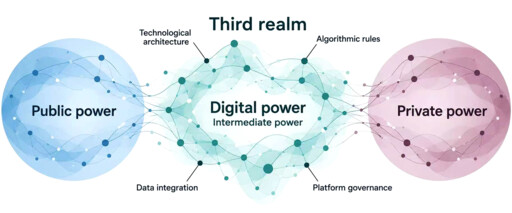
Digital power is generated and operates through technological architectures, algorithmic rules, data integration, and platform governance. It occupies a position between public and private power and can be understood as intermediate power. Image generated by AI
Digital power is a fundamental concept in digital law, referring to the pervasive domination that private actors or government agencies exercise through data control and algorithmic decision-making enabled by digital technologies such as big data and artificial intelligence (AI). Existing research on digital power has largely focused on the public–private dichotomy: The dominance and influence of large digital platforms constitute digital private power, while the new forms of public power generated by the state’s application of digital technologies to the exercise of public authority constitute digital public power. On this basis, scholars have examined the overlap between private power in the public sphere and public power in the private sphere.
The public–private dichotomy has long dominated the study of power and provided an effective framework for understanding how society functions and how power is allocated. Yet the underlying logic of digital power has moved beyond that of traditional theories of public power, creating a new type of power and a new mechanism for its exercise—transforming how power is produced and reshaping the relations through which it is produced.
This article argues that digital power is neither a simple projection of traditional forms of power onto digital media nor merely a product of overlapping or changing power attributes across the public and private spheres. Rather, it signals the rise of power in a “third realm” independent of the traditional public and private spheres, profoundly transforming the theoretical genealogy and practical logic of power.
Limited explanatory power of public–private dichotomy
The distinction between public and private commonly provides a basis for understanding concepts and their underlying social relations. Yet the public–private dichotomy does not readily accommodate digital power. The dichotomy takes actor identity and power boundaries as its starting points, relying on clearly identifiable power holders and traceable points of operation. Digital domination, however, is often generated through the continuous operation of technology, data, and algorithms and does not necessarily take the form of commands issued by an identifiable actor.
Moreover, the legal norms based on the public–private dichotomy rest on assumptions of comprehensibility and accountability, which are increasingly weakened by technological barriers and systemic opacity in digital spaces. The traditional public–private dichotomy and digital power operate according to different principles, so applying the former to the latter can produce a mismatch that limits the framework’s explanatory power, particularly when identifying who holds power, establishing the conditions for its regulation, and locating digital power within the broader genealogy of power.
Digital power is generated and operates through technological architectures, algorithmic rules, data integration, and platform governance, exhibiting forms of domination that are not centered on identifiable actors, formal institutions, or the state. It therefore differs both from public power monopolized by state institutions and from private power based primarily on contractual and market relations. Research that seeks to explain digital power, advance its study, and fully demonstrate its autonomy must first move beyond the constraints of the public–private dichotomy.
Autonomy of digital power in the third realm
The formation, evolution, and operation of power depend on stable social spaces, understood as relational fields continuously constructed, maintained, and reshaped through human practice. Traditional social space is structured by the public–private dichotomy, with the two opposing spheres each seen as relatively stable and internally uniform. Yet this simplified binary framework can constrain understanding of highly complex and dynamic social phenomena. The concept of the third realm seeks to move beyond the traditional public–private dichotomy and explain the autonomy of digital power in terms of its historical evolution and the principles governing its operation today.
First, the third realm has emerged in the digital age. A realm between the public and private spheres falls neither entirely under state administration nor exclusively within the scope of autonomy under private law. As the public and private increasingly converge across social life, the third realm has expanded and taken on new meaning. Here, the third realm refers to a new social space produced by this unprecedented convergence, organized through technology, supported by big data and platform rules, and no longer constrained by specific physical boundaries. This complex space takes shape through the interaction of data, algorithms, AI, the metaverse, and other elements, while remaining closely connected to the physical world as the virtual and physical interact and evolve together. The third realm has its own distinctive process of formation, clear structural characteristics, and essential functions.
Second, the autonomy of digital power is rooted in historical evolution. Across different historical periods, power has continuously reorganized relational networks in response to changes in social structure, modes of production, and technological systems, assuming different forms and attributes. The traditional authority of primitive social communities corresponded to a natural social structure in which the public and private were undifferentiated, while the public power of the modern state corresponded to an institutional social structure in which they were distinct. The digital age is the product of the combined effects of accumulated knowledge, technological progress, and institutional evolution. As products of this age, the third realm and digital power fulfill complementary functions: The former provides a new space in which public and private elements converge, while the latter generates the order needed for that space to function stably. Digital power is therefore neither an extension nor a variant of public or private power, but an autonomous form of power suited to the third realm of digital society.
The emergence of digital power marks the latest stage in the progression from traditional authority to institutional power and now to technological power. This shift indicates that contemporary society is transitioning from institutionalized order to technologically mediated order and reflects a broader historical evolution in the organization of human communities from natural communities to institutional communities and then to technological communities. Digital power in the third realm exhibits its autonomy as part of this historical evolution.
Third, digital power’s autonomy is also rooted in the logic of social reality. The rise of the third realm has substantially weakened the physical foundations of the public and private spheres and changed the meaning of social space in human activities. The temporal and spatial limitations of traditional public and private spheres are being dismantled and redefined. The rapid flow of information through digital technologies diminishes the significance of physical barriers, with access to spaces increasingly determined by digital identity credentials and authorization rather than physical procedures or channels. Meanwhile, “digital time” neither simply corresponds to natural day-and-night cycles nor fully follows administrative time. Instead, it is centered on event-driven processes and metric-based feedback, emphasizing real-time responsiveness, simultaneity, and continuity.
Within the third realm, digital power operates through the production of social relations governed by the rules of digital time and space. This process is particularly evident in everyday life. As temporal and spatial boundaries continue to dissolve, human social relations increasingly migrate into digital time and space. Individuals and groups are compelled to interact within the digital third realm, where they are subject to new forms of domination and intervention generated by algorithms, platforms, and big data. Digital power thus becomes detached from the traditional public and private spheres grounded in physical time and space and instead autonomously shapes the basic order of digital society through the third realm.
Digital power as ‘intermediate power’
The autonomy of digital power means that it neither depends on public or private power nor constitutes their simple extension or transformation through digital technologies. Rather, it is a distinct form of power that exists alongside public and private power in the digital age. Public and private power form the two ends of the modern power spectrum, and when social space undergoes structural change, forms of power likewise shift and differentiate along this spectrum. Just as the third realm occupies a position between the public and private spheres, digital power occupies a position between public and private power and can therefore be understood as intermediate power. The concept is not intended to create another category within the existing framework, but to bridge the gap between public and private power and more accurately describe new objects and relationships. It thus clarifies the concept of digital power while enabling research to move beyond the public–private dichotomy and develop a framework for governance suited to the third realm.
At the epistemological level, intermediate power changes the understanding of power, shifting analysis from a focus on state or market actors to the systematic study of technological structures and relationships. Within the genealogy of power, it situates digital power in the continuous evolution of power in human societies, using power as a thread connecting clan society to digital society. Research on digital power should therefore proceed through three stages: clarifying the object of study conceptually, analyzing power mechanisms structurally, and adopting appropriate methods to make the research workable in practice. It should also retain an open perspective while exercising appropriate self-restraint.
Concepts both represent and regulate reality, and their normative function has methodological significance. The concept of intermediate power shifts the focus of digital-power governance from external constraints on actors toward the systematic shaping of rules endogenous to the digital ecosystem, opening up possibilities for reconfiguring checks and balances and the allocation of responsibility. Future institutional design should therefore establish a multidimensional balance among public power, private rights, digital rights, and digital power, while addressing the tensions between technological efficiency gains and the digital inequality and digital rights violations they can generate, with due regard for the legitimacy of power.
Zhou Shangjun is a professor from the Institute of Science and Technology Law at Southwest University of Political Science and Law (SWUPL). Huang Dejun is from the Administrative Law School at SWUPL. This article has been edited and excerpted from Academic Monthly, Issue 4, 2026.
Editor:Yu Hui
Copyright©2026 CSSN All Rights Reserved