


Cultural self-consciousness and new aesthetic trends in children’s literature
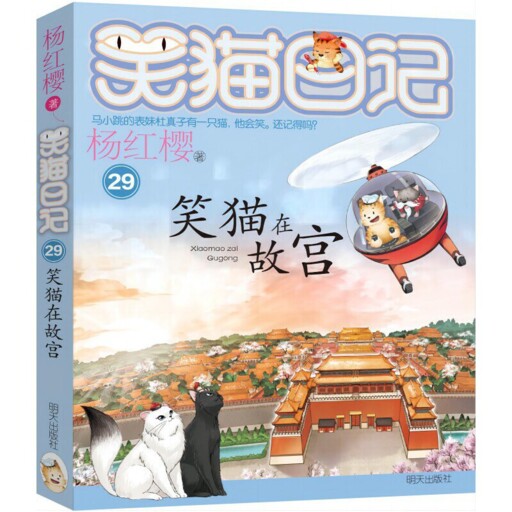
FILE PHOTO: A smiling cat in the Palace Museum by Yang Hongying
In the new era, children’s literature has drawn deeply on the rich resources of Chinese history and culture, carrying forward and revitalizing the aesthetic spirit of the Chinese tradition. In advancing the creative transformation and innovative development of China’s fine traditional culture, a wealth of distinguished works has emerged. Together, they reflect a trajectory grounded in cultural inheritance, animated by the vitality of the child’s imagination, and sustained within a vibrant artistic landscape.
Constructing children’s subjectivity through cultural genes
Children’s literature is devoted to meeting children’s intellectual needs and fostering their subjectivity. The unity of children’s subjectivity and cultural subjectivity constitutes its core value. Cultural subjectivity is both its root and its soul, and its mission lies in cultivating a future generation endowed with strong cultural confidence, profound cultural grounding, and a broad cultural vision. Children are not only future inheritors of culture, but also its creators. In recent years, an increasingly pronounced cultural self-consciousness within the field has become a new aesthetic pathway for constructing children’s subjectivity through cultural genes.
In his novel Nine Songs (2024), Lin Yan explores children’s growth against the backdrop of the poetic spirit and humanistic sentiment of the Chinese nation. The work establishes a creative intertextual dialogue between the Warring States Period (475–221 BCE) poet Qu Yuan’s “Nine Songs” and the “Nine Songs” composed by the child protagonist, A Li, presenting a tapestry in which the poetic spirit of Chinese culture intertwines seamlessly with the innocence of childhood. Lin unfolds the narrative in language—poetic, concise, and resonant—subtly cultivating in young readers a refined feel for their mother tongue while nurturing aesthetic awareness and creative capacity.
Liu Yaohui’s The Autumn Moon Shines High over the Great Wall (2024) is a coming-of-age novel written to commemorate the 80th anniversary of the victory of the Chinese People’s War of Resistance Against Japanese Aggression and the World Anti-Fascist War. Drawing upon the intellectual heritage of Chinese culture, the author traces young people’s maturation amid wartime, capturing with precision the aesthetic temperament rooted in that historical context. The image of “the autumn moon shining high over the Great Wall” evokes a chilly yet majestic artistic atmosphere, suffused throughout with the elegant and tragic beauty characteristic of classical poetry.
Notably, the novel foregrounds the cultural spirit and national sentiment of the Chinese people during wartime, nourishing children of the new era with moral integrity, history’s poetic nature, and youthful vigor.
Both tangible and intangible cultural heritage have become focal themes in contemporary children’s literature, opening new aesthetic pathways for innovation across genres. Folk arts such as paper-cutting, embroidery, and traditional wax-dyeing (batik) have enriched the visual symbols and cultural expressions of original picture books, while series centered on the Palace Museum, Dunhuang, and museum treasure hunts have inaugurated new paradigms of spatial narration. Yet, despite these creative advances, significant challenges remain, such as connecting the vast spatiotemporal dimensions of history and culture with children’s inner worlds and sensibilities, genuinely embodying their subjective initiative in cultural transmission, and enhancing their cultural understanding and artistic imagination. In response, writers have demonstrated considerable artistic skill and ingenuity in crafting museum-narrative IPs tailored specifically to young readers.
In A Smiling Cat in the Palace Museum (2023), author Yang Hongying orchestrates an encounter between the smiling cat and the palace cat of the Palace Museum. By adopting an animal perspective familiar to children, she transforms the grand cultural space of the palace into an adventure playground brimming with childlike delight. The smiling cat is no longer merely a fictional character, but an experienced guide and curious companion, leading young readers through red walls and golden roofs while listening to stories told by the palace cat about hidden anecdotes tucked within palace corners and ornately carved beams. As one young reader commented, Yang Hongying’s storytelling and characterization are masterful: “The Hall of Supreme Harmony’s palace cat, Xiao Fuzi (little blessing), emerges as a ‘living history,’ a ‘living map,’ and a ‘living dictionary’ of the Palace Museum.” Guided by Xiao Fuzi and immersed in the author’s vivid prose, readers gain a deep, intuitive understanding of the 600-year history of this grand palace complex. Such responses aptly illuminate the artistic mechanisms and aesthetic principles underlying culturally themed works in children’s literature.
Writer Xiao Mao, a prominent contemporary author of children’s literature known for reimagining traditional mythological materials, has actively pursued the creative transformation of such resources. Marked by rich imagination and witty, humorous language, his works are warmly received by young readers. Committed to integrating traditional cultural elements into modern children’s literature, he skillfully employs narrative techniques drawn from folk storytelling. In Princess Jieyou and the Winged Horse (2024), Xiao Mao weaves elements of Dunhuang culture into the narrative, boldly combining the historical figure Princess Jieyou (worry free) with the winged horse depicted in Dunhuang murals. Set against a rich and deeply layered historical-cultural backdrop, he portrays Princess Jieyou’s childhood and growth, interpreting her life philosophy—“never hurried, never worried”—through a reflective modern lens. Guided by a renewed fairy-tale vision, the work explores innovative pathways for a distinctly Chinese-style fairy tale, infusing the project of constructing children’s subjectivity through cultural genes with fresh contemporary resonance.
Local writing shapes splendid childhood imagination
In recent years, new trends have emerged in regional children’s literature centered on local culture. Cross-regional exploration has injected fresh vitality into local poetics, generating notable innovation in both literary form and aesthetic concepts.
Chen Shige has long devoted himself to the creation of fairy tales, though his philosophically oriented approach has recently taken a new turn. His Fairy-Tale Border Town (2024), inspired by the fairy-tale town of Burqin in Altay Prefecture, Xinjiang Uyghur Autonomous Region, draws upon the region’s human geography, history, and culture to construct a living fairy-tale world grounded in reality. It offers children around the world a Chinese fairy-tale homeland that can be touched, experienced, explored, and imaginatively followed. The book depicts more than 80 species of animals and over 50 kinds of plants from Xinjiang, along with associated historical legends, proverbs, lakes, deserts, dwellings, and music. By integrating region-specific natural history with fairy-tale poetics, Chen achieves truly “rooted writing” anchored in land and people. His cultural self-consciousness has led him to articulate a new fairy-tale aesthetic: “Life itself is a fairy tale, and fairy tales are beautiful everyday life.”
In Ballet on the Street Market (2024), Qin Wenjun composes a polyphonic narrative that becomes the defining theme of a rural ballet in its time. The novel interweaves the beauty of nature and art, portraying an ideal life in China’s newly revitalized countryside and pastoral landscapes. Qin’s unhurried prose resonates with the humanistic temperament of Yunnan, rendering a vivid portrait of a land where nature and art coexist in harmony. This sense of ease reflects both her long literary cultivation and the achievements of new rural revitalization in Yunnan, as well as the province’s distinctive lifestyle and aesthetic ethos. Such composure signals the growing maturity of contemporary Chinese children’s literature—a mode of writing shaped by calmness, leisure, serenity, and quiet happiness.
In the sci-fi novel Song of the Thunder Pool Fishermen (2025), Ma Chuansi follows four adolescents as they embark on intertwined journeys in search of their cultural roots in a water town in the south of the lower reaches of the Yangtze River. Through patterns of repetition and variation, the novel weaves a science fiction narrative through a culturally resonant landscape. The plot is tightly structured yet richly infused with historical memory and symbolic meaning. Elements such as extraterrestrial civilizations, species evolution, and genetic science blend organically with motifs drawn from Chinese culture, allowing a resplendent literary world to coexist with cutting-edge scientific imagination. By guiding children to decode culture along historical memory through storytelling—while incorporating bold and modern sci-fi elements—the novel pioneers an innovative aesthetic pathway for the creative transmission of culture and history.
Intergenerational transmission reshapes children’s aesthetic experience
Children’s literature primarily serves minors under the age of 18. Under the strong influence of cultural self-consciousness, China’s children’s literature community has adopted a more open understanding of interactions between children and adults, as well as of diverse expressions of age. In recent years, cultural narratives centered on intergenerational inheritance and the portrayal of elderly figures have emerged as a notable direction. Representative works in this vein are not only cherished by young readers but also widely appreciated by adults across age groups. Intergenerational relationships, together with their layered cultural meanings, are reshaping children’s everyday lives and generating new aesthetic landscapes.
In Grandmother of the Wolf Cave (2023), Wang Yongying opens the novel with an ordinary yet distinctive caregiving experience between grandmother and grandchild. Through vivid details of daily life, the novel reveals the characteristics and patterns of children’s psychological development. Drawing on insights akin to depth psychology, it addresses issues of mental health while underscoring the profound intellectual value of ethical kinship and familial love.
In sum, cultural self-consciousness has opened broader horizons of value and aesthetic space for original Chinese children’s literature. A steadfast commitment to cultural roots endows these works with a wellspring of enduring creative energy, while cultural confidence enables a century-old tradition to continue forging a developmental path that integrates national spirit with world values.
Li Lifang is a professor from the School of Chinese Languages and Literatures at Lanzhou University.
Editor:Yu Hui
Copyright©2026 CSSN All Rights Reserved