


‘Physical features’ and ‘literary mind’: New interpretations of the themes of Song poetry
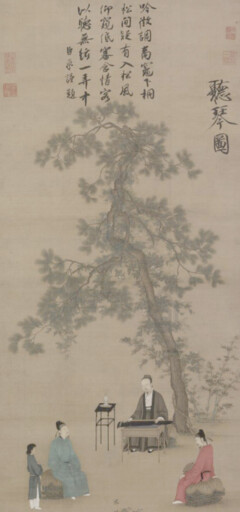
FILE PHOTO: The painting “Appreciating the Sound of Chinese Guqin,” collected in the Palace Museum
The Song Dynasty (960–1279) was a period in which traditional Chinese society reached maturity while undergoing transformation. It produced material civilization and cultural legacies of far-reaching influence and has been hailed as “the age of artists” (Will Durant, The Story of Civilization). Song poetry stands as a representative achievement of this era, distinguished by rich themes and distinctive artistic features, including a turn toward everyday life, the diversity of poetic schools, the intellectual inclination of benefiting the world, and an aesthetic that blends refinement with popular appeal. These characteristics reflect the notable cultural ideal of “reaching to the greatest extent and yet penetrating to the minutest things” (The Doctrine of the Mean).
Poetry centered on objects and utensils offers a revealing perspective on the evolution of Song poetic themes and the distinctive character of the period, carrying particular significance in literary history. Taking writing implements, the qin (also known as the guqin, a seven-stringed Chinese zither), and screens as examples, this article explores the thematic development and characteristics of object-centered poetry in the Song Dynasty.
Flourishing of poetry on writing implements
The Song Dynasty upheld governance through culture, giving rise to a typical scholar-official civil culture alongside a rich material civilization, in which writing implements formed an important component. For instance, Northern Song (960–1127) scholar Su Yijian’s Records of the Four Treasures of the Study consists of five volumes: two devoted to writing brushes and one each to inkstone, ink stick, and paper, tracing their origins and development and concluding with related poetry and prose. Li Xiaomei’s Chinese Ink Making Techniques comprises three volumes: The first illustrates ink-making processes such as pine harvesting, kiln construction, firing, and soot collection; the second records the procedures of 16 producers, including the Zu family, Li Chao, Li Tinggui, tribute ink from (then) Shunzhou, and others; and the third describes specific methods involving ox-hide gelatin, antler gelatin, reduced-glue techniques, and Jigong ink. Mi Fu’s A History of Inkstones discusses the qualities and textures of inkstones, their forms and styles across dynasties, and 26 categories such as jade and white inkstones, serving as a valuable reference for connoisseurship. These works collectively demonstrate the flourishing enthusiasm among Song literati for writing implements.
Influenced by this cultural penchant, Song poetry increasingly reflected material life, and writing implements emerged as a distinctive thematic category. For example, Wang Shipeng’s Collected and Annotated Poems of Su Dongpo (Su Dongpo, also known as Su Shi, a major Song-Dynasty poet) includes categories such as “brush and ink,” “inkstones,” and “utensils.” Likewise, Su Zhe’s Complete Works of Su Zhe (Yingbin), Classified and Compiled lists categories such as “brush and inkstones” and “utensils,” while Liu Kezhuang’s Classified Anthology of Tang and Song Poems includes a “utensils” section featuring subcategories such as “brush,” “ink,” “paper,” and “inkstone.”
In literary history, Selections of Refined Literature, compiled by Southern Dynasties (420–589) writer Xiao Tong, was the first to classify poetry by themes, yet it did not include a category for cultural objects or implements. By the Song Dynasty, however, some anthologies began to feature specialized categories such as brush, ink, paper, and inkstone, reflecting the flourishing of poetry centered on material objects. Representative works include Ouyang Xiu’s “A Poem in Response to Liu Yuanfu on Chengxin Hall Paper” (Chengxin Hall Paper is a famous high-quality paper of the Song Dynasty), in which he describes Chengxin paper, reminiscing about his friends Shi Yannian and Su Shunqin while reflecting on his life. Chen Shidao, having seen ancient ink bestowed by Emperor Shenzong at the residences of Chao Wuyi and Qin Guan, composed “On Ancient Ink,” praising its rarity while recalling stories of Emperor Shenzong’s governance, thereby imbuing the poem with rich cultural meaning and a distinctive “poetic historiographical” quality.
New interpretations in qin-themed poetry
China has, since ancient times, attached great importance to musical cultivation, with the qin emerging at an early stage in Chinese cultural history. The Eastern Han (25–220) scholar Cai Yong wrote in Guide to the Qin: “Fu Xi made the qin in order to cultivate one’s character and regulate one’s nature.” The Book of Rites records that Shun made a five-string qin to sing the “song of the south wind.” The Book of Master Lie recounts that Confucius studied the qin under Master Xiang, and also tells of Boya, famed for playing the instrument, and Zhong Ziqi, celebrated for his discerning listening. In the Warring States period (475 - 221 BCE), Chu State writer Song Yu wrote in “Ode of Admonition” of “taking up the qin and playing melodies such as ‘Orchid’ and ‘White Snow.’” During the Three Kingdoms period (220 - 280), Ji Kang declared in “Ode to the Qin” that “among all instruments, the virtue of the qin is supreme.”
By the Song Dynasty, the leishu (classified encyclopedia) Finest Blossoms in the Garden of Literature, compiled by Li Fang and others, included numerous qin-themed works. Volume 212 collects 29 qin poems from the Southern Dynasties to the late period of Tang Dynasty (618 - 907), while volume 334 includes seven qin songs. The Song Dynasty’s esteem for literary arts ensured that the qin occupied an important place in literati life. For example, Ouyang Xiu styled himself “Liuyi Jushi” (Scholar of Six Ones) in his later years, one of the “six” being the qin. He composed poems such as “Playing the Qin in the Manner of Jia Dao” and “Two Poems Composed While Playing the Qin at Night, Dedicated to Mei Yaochen (Shengyu),” depicting the experience of playing and listening.
From the perspective of poetic form, qin poetry before the Song Dynasty was predominantly composed in five-character lines, whereas in the Song Dynasty, it developed further, with greater use of seven-character lines. In terms of content, while earlier works often focused on connoisseurship and emotional reflection, Song qin poetry gradually reoriented its focus toward everyday life and became more discursive and richer in philosophical reasoning. For example, Northern Song poet Huang Shu’s “A Poem in Response, Accompanying the Prime Minister to Listen to a Sichuan Monk Play the Qin” was composed during routine banquets while he served under Wen Yanbo, concluding with the conventional complimentary sentiment, “You have labored deeply to help the ruler build his lasting reign.” Meanwhile, Su Shi’s “Poem Inscribed on Mr. Shen’s Qin” (also known as “Poem on the Qin”) contains these philosophical lines: If you say the music lives in the zither, how is it does not resound when shut in its case? If you say the music lives in your fingers, why do you not listen to your finger alone? (Burton Watson, Trans.)
Urban screens inspiring literati creativity
In ancient China, the screen functioned not only as a practical object for partitioning living space but also as a form of visual art. It became a medium that stimulated literati creativity and facilitated the dissemination of literary and artistic expression. During the Tang and Song periods, painted screens, handscrolls, and murals constituted the three principal forms of painting. In the Song Dynasty, screens were used across a wide range of social settings, from the imperial court to everyday urban life.
For instance, Chen Kui’s Records of Southern Song Imperial Library describes the arrangement of the Secret House—a place to collect precious literature—where the imperial screen occupied a particularly prominent position. Similarly, Li Xinchuan’s Miscellaneous Records of the Court and the Realm Since the Jianyan Reign records that Emperor Xiaozong commissioned a large, lacquered screen behind the throne of Xuande Hall. The screen listed officials in two columns, with yellow tags indicating their names and positions, while its reverse side featured “Huayi Tu: Map of China and Adjacent Regions.” Such imperial screens were closely tied to governance, bearing particular political significance.
In urban settings, screens often carried a lively aesthetic appeal. Zhou Mi’s Wulin Jiushi: Memoirs of Southern Song Hangzhou recounts that after abdication, Emperor Gaozong travelled frequently to indulge his appreciation of scenic landscapes. One day, as his boat passed the Broken Bridge on West Lake, he noticed a wine shop with a plain screen inscribed with “Wind Through the Pines.” The final line read, “Tomorrow I’ll bring my unfinished wine again, to seek the flower hair ornaments along the road.” Admiring it, the emperor learned it was the spontaneous drunken writing of Imperial Academy student Yu Guobao. Smiling, he remarked, “The lyric is excellent, though the last line is somewhat pedantic,” revised it to “Tomorrow, still half-drunk, I’ll come again,” and subsequently granted Yu an official appointment. In this way, urban screens became a medium for literary interaction between the Imperial Academy students and the emperor.
As Wu Hung notes in The Double Screen: Medium and Representation in Chinese Painting, by the Song Dynasty the imagery of painted screens had grown increasingly poetic. Screens created a poetic cultural space for Song literati, closely intertwined with their daily lives and creative practices. This is especially evident in poetic descriptions of screens and inscriptions upon them.
In sum, as Liu Xie states in The Literary Mind and the Carving of Dragons, a poet both follows external things in their transformations and lingers with the movements of the mind. The writing of object-centered poetic themes in the Song Dynasty, through the interplay of “physical features” and “literary mind,” vividly presents the material cultural life of the time while reflecting the intellectual world and aesthetic sensibilities of the literati. It is thus rich in both the distinctive characteristics of its age and enduring literary significance.
Tie Aihua is a professor from the Department of History at Soochow University; Zeng Weigang is a professor from the School of Chinese Language and Literature at Soochow University.
Editor:Yu Hui
Copyright©2026 CSSN All Rights Reserved