


Revival of Chinese literary classics in digital age
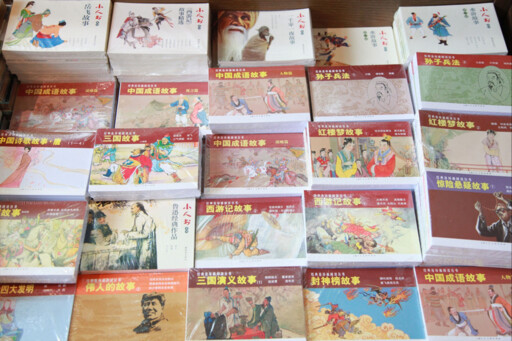
Comic book versions of Chinese literary classics on display at Librairie Avant-Garde-Yihe Bookstore in Nanjing, Jiangsu Province, Apr. 21, 2026 Photo: IC PHOTO
In today’s digital age, the sheer quantity and broad cultural impact of creative adaptations of Chinese literary classics have given rise to what may be described as a “revival of Chinese literary classics.” This phenomenon, along with the distinctive contemporary ways in which canonical literature is being preserved and reinvented, merits sustained attention and deeper reflection.
Surge of interest in dissemination and reception
Chinese literary classics have long exerted enduring cultural influence, and the “rewriting” of canonical works has consistently accompanied the development of modern and contemporary Chinese literary history. Yet the scale and influence of creative transformations in the digital era far exceed those of any previous period. The domestically produced AAA video game Black Myth: Wukong, released in August 2024, and the animated film Ne Zha 2, which premiered at the end of January 2025, both achieved phenomenal success. If one considers the vast number of Journey to the West fan fictions circulating online, the creative foundations of Black Myth: Wukong become readily traceable. In fact, reinterpretations of Journey to the West had already attracted public attention during the early rise of internet media. Jin Hezai’s The Legend of Wukong (2000), widely regarded as one of the landmark works of early online literature and often referred to as “the first great internet novel,” centers on Sun Wukong’s repeated yet futile struggle against the celestial order. Since then, fan fiction based on Journey to the West has proliferated across digital platforms. Nor is this phenomenon limited to a single classic. Canonical works such as The Investiture of the Gods, Romance of the Three Kingdoms, Dream of the Red Chamber, Water Margin, and Classic of Mountains and Seas have all undergone repeated creative reinterpretation, attracting widespread attention. On major online literature platforms, tags such as “Journey to the West” and “Three Kingdoms” have become stable and highly popular searchable categories.
At the same time, secondary creations based on literary classics now circulate through increasingly diverse channels. These reinterpretations are no longer confined to online fan fiction but have expanded into social media and independent content platforms, video-sharing sites, animation, gaming, and other digital cultural industries. Beyond classical literature, works by major modern Chinese writers have also become what internet culture calls “traffic magnets.” The online popularity of renowned Chinese writer Lu Xun, for example, has grown exponentially across various digital platforms. It is particularly important to emphasize that most of this dissemination and creative transformation are grounded in admiration for the original works and authors, rather than parody or deconstruction. In his analysis of fan fiction culture, American media scholar Henry Jenkins argues that such enthusiasm for creative transformation originates in affection for specific source texts and that, compared with passive reading or one-way reception, creative adaptation requires a far greater degree of “emotional and intellectual investment.”
The large-scale emergence of online fan fiction, the internet’s sustained attention to canonical writers and texts, and the expansion of creative adaptations across multiple media forms and multimodal modes of expression all testify to the renewed popularity and cultural vitality of Chinese literary classics in the digital era.
Classical inheritance and innovation through digital media
Literary classics inherently contain vast possibilities for interpretation, while internet-enabled digital dissemination has diversified both the subjects who interpret classics and the modes through which they are creatively transformed. The authority to produce meaning is no longer monopolized by academic scholars or professional critics. Ordinary readers, self-media creators, and enthusiasts from diverse fields have all become active participants in cultural production. Participatory culture and interactive media have transformed the interpretation and “secondary creation” of literary classics from authoritative acts of exegesis into spaces of shared viewpoints and emotional resonance, as well as platforms where creative transformations of canonical works intersect with everyday life.
First, digital media has democratized the production of cultural content, greatly expanding both the number and diversity of those engaged in interpreting and creatively transforming literary classics. In digital media environments, the agents of creative adaptation include vast communities of online fiction writers and audiovisual content creators. The number of online literature authors in China has already surpassed 30 million, while online audiovisual creator accounts now exceed 100 million. These creators come from highly diverse educational and professional backgrounds, with most of them working outside the field of literary studies.
Second, the internet’s interactive nature has generated new modes of public participation in the reproduction of literary classics, modes fundamentally different from traditional academic or aesthetic interpretation. On many digital platforms, interpretations and secondary creations of literary classics are not primarily intended to provide readers with authoritative guidance. Instead, they construct participatory and communicative communities in which ideas and emotions can be exchanged. Features such as “chapter comments” and “paragraph comments” on online fiction platforms turn fan fiction into spaces of discussion and emotional interaction even as works are still being written. In video-based media, “bullet comments” similarly serve as important mechanisms of interaction between audiences and creators.
Third, digital media have profoundly altered contemporary experiences of time and space, reshaping modes of cultural production while enabling cross-temporal and cross-spatial integration between lived experience and classical texts. The internet gives information exchange and acquisition unprecedented fluidity and reproducibility, allowing vast reservoirs of classical cultural resources to be mobilized and fused with contemporary life experiences. Literary classics are increasingly interpreted and received within the contexts of everyday life, where they are adapted to meet the emotional and experiential needs of ordinary audiences.
Finally, the embedding of literary classics into everyday life is also reflected in the popular tendency to recast canonical authors and characters as intimate, approachable, and emotionally relatable “friends,” turning literary classics into “cultural symbols” for daily emotional expression. On social media, for example, Lu Xun is frequently portrayed as “the eternal king of internet memes,” “Lu Xun with hundreds of alternate accounts,” “a master of love confessions,” or “the king of food lovers”—images that imbue the canonical writer with a vivid sense of ordinary human warmth.
Fusion of popular and digital experience
Digital media has transformed both the agents and the modes of literary dissemination, while also bringing contemporary social experience into the reconstruction of literary classics. This has generated distinctive new perspectives on the creative transformation of canonical literature in the new era.
First, many adaptations of literary classics that achieve “cross-boundary” popularity employ narrative strategies designed to evoke mass emotional resonance. These include transforming minor characters into protagonists, incorporating the logic of workplace survival, or adopting the internal perspective of socially marginalized figures. Supporting characters—or even narrative “tools” within the original structure—often become the focal points of reinterpretation. In Ne Zha 2, for example, the creators seek to “rehabilitate” supporting characters and antagonists alike, while many film critics interpret the character Shen Gongbao through the lens of the “small-town swot,” a contemporary social archetype. As workplace survival has become a major concern for modern audiences, numerous adaptations recast stories from classical literature as workplace narratives. Once secondary characters are elevated to central roles, their motivations are frequently reshaped according to workplace logic. Some authors reinterpret the rise and decline of the Jia family in Dream of the Red Chamber as a “guide to surviving office politics,” while the pilgrimage for Buddhist scriptures in Journey to the West becomes “the promotion story of a celestial intern,” thereby generating strong resonance among contemporary readers.
Second, the narrative forms used in creative adaptations of literary classics have distinctly digital-media characteristics, which work in tandem with the expression of popular everyday experience. A quantitative analysis of fan fiction derived from China’s “Four Great Classical Novels” across major online literature platforms, categorized according to platform-assigned genre tags, shows that narrative settings such as “system genre,” “rules horror,” “time travel,” and “rebirth” dominate these works. These are all narrative forms unique to, and characteristic of, digitally constructed environments. In “system genre,” for example, devices such as “life simulators” or “historical simulators” allow readers and authors to project their emotions and desires onto literary characters, achieving compensatory emotional fulfillment by altering those characters’ established destinies. Through narratives of “time travel” and “rebirth,” the perspectives of ordinary individuals and experiences of workplace life not only reshape the original plots of literary classics but also articulate aspirations for personal reversal of fortune and upward mobility from the social margins.
Any analysis of the contemporary revival of Chinese literary classics in the digital era must also acknowledge the potential problems associated with these developments. The integration of popular and digital experiences into literary classics, together with creative strategies such as meme-making, collage, and hybridization, not only alters original plots and character destinies but may also transform the fundamental worldview of the source text through shifts in perspective or the addition of “system” mechanics. Such developments inevitably raise concerns regarding the seriousness and purity of literary classics. These issues should therefore be approached dialectically and guided with rational discernment. The fact that classics continue to be received and creatively transformed in different ways across different historical periods itself testifies to their richness and originality. Moreover, the capacity of classics to engage with contemporary historical experience and shape the emotions and lives of present-day audiences is an important manifestation of their enduring vitality.
At the same time, it must also be emphasized that Chinese literary classics constitute the “source,” while creatively transformed works represent the “flow”; together, they contribute to the preservation and development of Chinese literary tradition. The digitally disseminated and creatively adapted works of Chinese literary classics vary greatly in quality, making timely critical intervention by scholars and critics essential. Creative works that both respect the original texts and successfully integrate the spirit of the new era deserve affirmation. Likewise, works capable of genuinely stimulating public interest in traditional literature and culture, and of inspiring younger generations to read, should be actively supported. Only by respecting the canonical status of the classics themselves while also recognizing that historically situated reinterpretations inject new vitality into them can we assess the current revival of Chinese literary classics in a balanced and dialectical manner. In this process of transformation, the dynamic unity between “classicality” and “contemporaneity” is vividly revealed, infusing the reception and transmission of Chinese literary classics with renewed cultural energy.
Li Wei is a professor from the School of Chinese Language and Literature at Nanjing Normal University. This article has been edited and excerpted from Literary Review, Issue 6, 2025.
Editor:Yu Hui
Copyright©2026 CSSN All Rights Reserved