


Compilation, publication of women’s writings in late Ming and early Qing
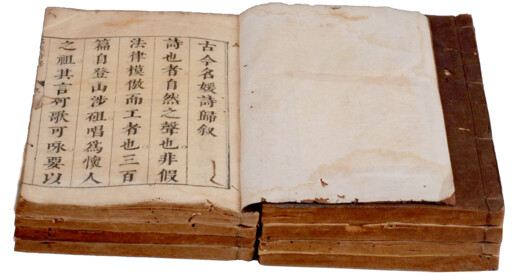
A Return to Poetry by Distinguished Women, an anthology of women’s poetry compiled in the late Ming, on display at Guilin Museum, Guangxi Zhuang Autonomous Region PHOTO: Guilin Museum
Since the Jiajing period (1522–1566), the Ming literary world saw a growing trend toward selecting, compiling, and publishing collections of women’s writings—a phenomenon largely absent from the Song (960–1279) and Yuan (1271–1368) periods. By the late Ming (1368–1644) and early Qing (1644–1911), this publishing boom reflected sustained efforts to bring women authors into public view, challenge prejudices against women’s literary activity, and foster a literary sphere shaped jointly and complementarily by men and women. In doing so, it helped create public support for women to move beyond the inner chambers and claim a place for their creative work in literary history. These collections not only recovered many previously overlooked authors, but also brought them from the margins to the foreground. Through prefaces and postscripts, brief biographies, literary works, and critical commentary, they reshaped perceptions of women writers and gave readers a fuller understanding of literary history.
From inner-chamber exchanges to wider circulation
Before the late Ming, relatively few works by women authors survived. By the late Ming, however, the situation had changed markedly: Individual collections and anthologies of women’s writings multiplied, women’s literary activity took on a more collective character, and numerous female literary groups with strong family affiliations emerged in the Jiangnan region during the late Ming and early Qing.
Compilations of women’s writings began to appear during the Jiajing period and became increasingly common after the beginning of the Wanli period (1573–1620). Ming poetry anthologies compiled by traditional literati began to include categories such as “women of the inner chambers” and “courtesans,” while specialized anthologies devoted exclusively to women’s poetry were also compiled and published. Notably, some collections were compiled by women poets themselves. By the Shunzhi (1644–1661) and Kangxi (1662–1722) periods, large numbers of such works were being published, alongside a growing number of individual collections by women authors. Over the course of the 17th century, some 300 to 400 collections of women’s writings—including both anthologies and individual collections—appeared in print.
The publication of these collections testified to the flourishing of women’s literature in the late Ming, but its deeper significance lay in moving women’s writings from circulation within the family into the public sphere. In the Song and Yuan periods, women authors were relatively few and their literary exchanges were generally confined to fathers and brothers before marriage and husbands afterward. By the late Ming, however, these networks of familial exchange had broadened to include mothers and daughters, sisters-in-law, mothers- and daughters-in-law, and other female relatives. The women authors of the Qi family in Shanyin, Zhejiang, during the late Ming and early Qing offer a representative example. Even then, however, such connections remained rooted mainly in kinship or marriage. During the Chongzhen (1628–1644) and Shunzhi periods, at the transition between the Ming and Qing dynasties, a new form of literary association based on geographical proximity also began to emerge.
The process of compiling women poets’ works naturally involved small gatherings in women’s chambers to discuss poetry and exchange compositions. These interactions eventually developed into women’s literary societies, and literary association and poetic exchange became important ways for women to move beyond the inner chambers into a wider social world. Representative examples included the Tongcheng Distinguished Women’s Poetry Society, centered largely on women from the same family, and the Qiantang Jiaoyuan Poetry Society, composed mainly of women from the same locality. Yet whether conducted within families or through regional literary societies, the circulation of women’s writing remained relatively limited. What truly carried their work across regions were the anthologies and selected collections compiled and printed by booksellers. Women poets who had once written largely in private became objects of broader public attention. Their talents attracted male literati, who commented on their works and expressed views on women’s literary activity through prefaces and postscripts.
Changes in public opinion, social transformation
Late Ming booksellers played a major role in bringing women’s writings into broader circulation. They collected works widely and recruited prominent literary figures to write prefaces and commentaries, thereby introducing women authors and their writings to a larger readership. Collections attributed to male literati were often produced through cooperation between booksellers and prominent figures—or, in some cases, published under prominent names without authorization. Considerable borrowing and repetition existed among these collections, but as a cultural phenomenon their proliferation still reflected the growing appreciation of women authors and their works in late Ming society.
Under the long influence of Neo-Confucian ideas inherited from the Song and Yuan periods, women’s writings had often been neglected. This not only resulted in the loss of a substantial body of women’s literature, but also reinforced the entrenched notion that “a woman’s virtue lies in having no talent.” Male literati therefore sought to challenge such rigid attitudes through the collection and publication of women’s writings. Although the format and content of commercial editions were often repetitive and derivative, they nonetheless expanded the influence of women’s literature, raised the status of women authors, and helped alter traditional perceptions.
The publishers themselves—the owners of commercial bookshops—were, of course, motivated largely by practical and economic considerations. More revealing of changing social attitudes were the opinions of prominent male literati, who became a central force in championing women’s literature and bringing women writers into the broader social sphere. The most influential example was A Return to Poetry by Distinguished Women by Zhong Xing, a Ming literary figure. Scholars generally believe it was compiled by a late Ming bookseller under Zhong Xing’s name, yet its critical commentary clearly reflects ideas associated with the Jingling School and puts into practice its poetic ideals of “true poetry,” the “profound, secluded, solitary, and austere,” and the “spiritual yet substantial.” Its compiler and commentators were evidently thoroughly familiar with Jingling poetics. The work’s distinctive importance, however, lay not simply in repeating Jingling ideas, but in bringing to light and articulating the literary value of women’s writing.
These collections not only reflected traditional literati views on women’s literature, but also the distinctive gender attitudes of late Ming society. The Jiangnan region was highly commercialized, with a particularly vibrant market-town culture. Officials, urban residents, artisans, industrialists, and merchants were influenced intellectually by Ming philosopher Wang Yangming’s learning of the mind and placed considerable value on leisure; opera, storytelling, and novel reading were important parts of daily life. Such intellectual currents and lifestyles encouraged new understandings of society and human life. The traditional hierarchy of scholars, farmers, artisans, and merchants was weakening, while merchants increasingly became a group capable of shaping social customs. Women continued to educate children and manage households but could also contribute significantly to family livelihoods by working as private-school teachers or selling calligraphy and paintings. Against this background, both the old social hierarchy and the division of labor summarized by the saying “men outside, women inside” were being reconfigured, while ideas of social equality gradually gained ground. Women’s talents and abilities consequently won greater acceptance across different social strata—a development also encouraged by scholar officials, who exercised considerable influence over public opinion.
Shaping women poets, constructing a history of women’s poetry
The movement of women’s writings from the inner chambers to the world beyond, and from private space into the public sphere, was driven by several factors, including changing gender concepts, the expansion of publishing, and the growth of social networks. Publishing was especially important because it shifted attention from literary creation toward the circulation of literary works. The compilers of women’s collections were not the creators of the texts they handled; rather, through editorial selection and arrangement, they participated in the reproduction of knowledge. Using prefaces and postscripts, editorial guidelines, tables of contents, brief biographies, literary works, and critical commentary, they reorganized women authors and their writings from past and present into new bodies of knowledge shaped by the compilers’ own intellectual priorities. What kind of new literary knowledge, then, did these collections produce?
First, they recovered women authors who had previously been obscured, creating a form of transmission through which history could be preserved in poetry and individuals remembered through their writings. In traditional sources, women were often mentioned only in connection with male family members. Seeking to present a fuller picture of women’s literary activity from ancient times to their own day, compilers searched extensively through literary materials to restore neglected women authors and works to public view.
Second, they reshaped representations of women, moving away from traditional models centered on chaste and exemplary womanhood toward the figure of the talented and distinguished woman. In earlier periods, women were generally represented through biography, with moral conduct serving as the principal standard by which they were judged. Biographies devoted to talented women were comparatively uncommon before the Qing Dynasty. By the late Ming, however, changing attitudes toward women and growing recognition of their talents and accomplishments made such biographies increasingly common.
Third, compilers reconstructed literary history through their selection and critical evaluation of works. Authors typically leave behind writings that vary in quantity, style, and genre, but decisions about which works to include—and how many pieces by each author to select—inevitably reflect the compiler’s preferences. Through selection and commentary, compilers articulated the kinds of women’s poetry and aesthetic qualities they themselves recognized and valued.
In sum, the compilation of women’s writings in the late Ming and early Qing acted as a multifaceted prism through which changing ideas about talent and virtue, gender, literature, and knowledge can be observed. The elevation of women’s literature reflected important shifts in late Ming literary thought; understanding history as jointly constituted by men and women marked a significant advance in social thinking; and reorganizing records of women and their writings represented a new exploration in the construction of knowledge. Thereafter, collections of women’s writings circulated widely throughout the Qing Dynasty, while women’s literary societies also became increasingly common.
Chen Shuiyun is a professor from the School of Chinese Language and Literature at Wuhan University. This article has been edited and excerpted from the Journal of Soochow University Philosophy and Social Science Edition, Issue 1, 2026.
Editor:Yu Hui
Copyright©2026 CSSN All Rights Reserved