


The national character and global significance of Shanshui aesthetics
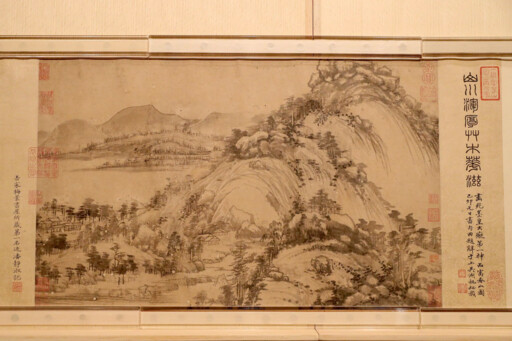
A detail from the painting “Dwelling in Fuchun Mountains,” in the collection of the Zhejiang Provincial Museum Photo: VCG
Shanshui [Chinese literati landscape] aesthetics has a long and distinguished history. Rooted in the aesthetic consciousness of nature that emerged from China’s agrarian civilization, it is one of the most distinctive expressions of China’s aesthetic spirit and has exerted significant influence worldwide. Shanshui aesthetics took shape within this agrarian setting. The vast alluvial plains of the Yellow River and Yangtze River basins provided fertile conditions for the development of early agricultural civilization and laid the foundation for an aesthetic appreciation of mountains and waters.
A way of life centered on working from sunrise to sunset enabled people to establish an intimate and interdependent relationship with the surrounding natural landscape. Through observing the world around them, they gradually came to appreciate mountains and waters in ways that extended beyond practical utility.
Flowers blooming and fading, clouds gathering and dispersing, waves rolling through fields of wheat, and yellow leaves drifting to the ground—such everyday scenes in an agrarian society stirred aesthetic pleasure and a wide range of emotions among the people of ancient China. Consequently, sorrow over the passing of spring and melancholy at the arrival of autumn became recurring themes in classical Chinese literature.
Evolution and influence
Scenery does not exist inherently as an object of aesthetic appreciation; rather, it takes shape through the interplay of particular historical periods, social structures, and cultural ideas. Shanshui art, as a distinct aesthetic category, emerged under particular historical conditions. The development of early art was closely associated with the decoration of the human body, and artistic expression in many parts of the world initially centered on human figures. Among the world’s artistic traditions, Chinese art was among the earliest to shift its focus from the human body to landscape.
Whereas landscape painting in the West did not emerge as an independent genre until the period between the 17th and 19th centuries, Shanshui poetry and painting had already gradually matured during the Wei, Jin, and Northern and Southern Dynasties, approximately from the 3rd to 6th centuries CE.
Works such as Zong Bing’s “On the Creation of Landscape Painting,” which systematically articulated ideas of landscape aesthetics, helped establish an independent conception of landscape appreciation more than 1,000 years before comparable developments in the West.
Shanshui aesthetics thus emerged as an independent aesthetic form relatively early in Chinese culture. This early development gave Shanshui aesthetics a pioneering place in the broader history of aesthetics.
The incorporation of Shanshui into art represented a decisive transformation in human aesthetic and artistic activity, expanding humanity’s aesthetic vision beyond the human figure toward the natural world. This broadened the realm of artistic creation and deepened aesthetic reflection, allowing people to consider the relationship between humanity and nature from a broader and more profound perspective.
China’s distinctive experience of appreciating nature
Every great civilization has developed a distinctive aesthetic tradition. Viewed in broad terms across Chinese and Western artistic traditions, art centered on the human body may be seen as emblematic of the West, while Shanshui art is particularly representative of China. In classical Western art, the human figure occupied a central place in aesthetic appreciation, while classical Western aesthetics often treated the human body as a supreme expression of beauty.
Unlike the traditional Western conception of nature, the Chinese view does not place nature and humanity in strict subject-object opposition. Instead, the two form an organic whole expressed in the idea of unity of Heaven and humanity.
In the Chinese understanding, Shanshui does not regard mountains and waters simply as objects to be conquered but part of a living natural world with which people can form an intellectual connection. This distinctive conception of nature underpins the Shanshui aesthetic ideal of places that are suitable for wandering and dwelling. The traditional principles of Shanshui painting—places through which one can walk, gaze, wander, and dwell—vividly reflect the Chinese understanding of nature as an intellectual home.
In artistic creation, the artist does not seek simply to reproduce natural scenery objectively. Rather, brush and ink convey the vitality, spirit, and living energy, creating an infinite artistic realm within a limited space. Viewers can thus undertake a form of “reclining travel,” imaginatively wandering through the painted landscape and entering into intellectual communion with Heaven and Earth. This Chinese experience, which closely integrates appreciation of nature with philosophies of life and moral cultivation, forms a distinctive core of Shanshui aesthetics.
The concept of “landscape” in the broad sense encompasses a very wide range of subjects. Western landscape aesthetics developed alongside commercial civilization and modern science and technology, placing greater emphasis on the aesthetic contemplation of natural scenery in its visible form. Western landscape painting therefore often incorporates maritime, urban, commercial, and technological dimensions. Alongside refined portrayals of rural scenery, it also includes numerous depictions of seascapes, beaches, streets, iron bridges, and distant trains.
Shanshui, by contrast, represents a more particular conception of landscape, primarily involving natural features such as mountains, rivers, forests, lakes, flowers, birds, insects, and fish. Chinese landscape appreciation is not confined to what can be encompassed within a single field of vision. The Chinese aesthetic experience of nature places greater emphasis on expressing feelings through nature and using natural objects to convey aspirations and ideals. Shanshui painting is generally not a direct rendering of an actual scene. Rather, through abstraction and transformation, it creates imagined landscapes that depart from observable reality. The concepts of “substance emotionalism” and “valuing spirit over form” encapsulate key principles of this artistic tradition.
A vital source for contemporary environmental aesthetics
Shanshui has long carried connotations of sublimity and sacredness in Chinese culture. Since the pre-Qin period (before 221 BCE), Chinese thought has endowed the appreciation of nature with ethical significance. The “Three Friends of Winter”—pine, bamboo, and plum blossom—symbolize the moral character of the Junzi [the Confucian ideal of the morally cultivated person].
Buddhism and Daoism have long regarded remote mountains as settings for intellectual cultivation, while Buddhist temples and Daoist monasteries have often been built deep among lofty mountains, seemingly hidden within the clouds.
Shanshui offers aesthetic pleasure, cultivates moral character, and allows people to set aside the distractions of the secular world. They therefore become spaces for a more poetic mode of life and for intellectual repose.
China’s agrarian civilization fostered a distinctive conception of nature, embodied in the cultural ideal of the unity of Heaven and humanity. Shanshui paintings often depict worlds of mist-shrouded mountains, unusual peaks and rocks, and places far removed from worldly noise and everyday concerns. They express a sincere longing for pristine nature largely untouched by human interference.
This ideal retains important practical significance today. The rapid development of modern industrial civilization has disrupted the balance between humanity and nature, contributing to severe ecological crises and environmental degradation and posing unprecedented challenges to human survival and development. It was partly in response to these disruptions that contemporary environmental aesthetics emerged, centered on a reconsideration of the relationship between humanity and nature and a call to restore a more harmonious relationship between the two.
The central concept of the unity of Heaven and humanity in traditional Shanshui aesthetics, the value expressed in the saying “the wise delight in water, while the benevolent delight in mountains,” and the idea of regarding nature as humanity’s intellectual home all speak directly to the central concerns of contemporary environmental aesthetics. They provide important intellectual resources for responding to today’s ecological challenges.
Shanshui aesthetics reminds us that nature has never merely been an object for humanity to conquer and exploit. Rather, nature and human life form an organic whole in which both coexist and flourish. Respecting nature, drawing close to it, and finding intellectual nourishment through communion with the natural world are essential to achieving harmonious coexistence between humanity and nature. In this sense, Shanshui aesthetics provides a vital indigenous source of inspiration for the development of contemporary environmental aesthetics.
American environmental ethicist Holmes Rolston III once posed the question of whether the natural world possesses a beauty worthy of human love. Shanshui aesthetics offers a clear and powerful affirmative response to this question. As a representative expression of the Chinese aesthetic spirit, Shanshui aesthetics has gradually entered broader Western academic discourse, becoming an important theoretical resource for contemporary environmental aesthetics.
Dai Xun is a professor from the Department of Chinese Language and Literature at Xiamen University.
Editor:Yu Hui
Copyright©2023 CSSN All Rights Reserved