


Revisiting the Afro-Asian-Latin American literary translation movement
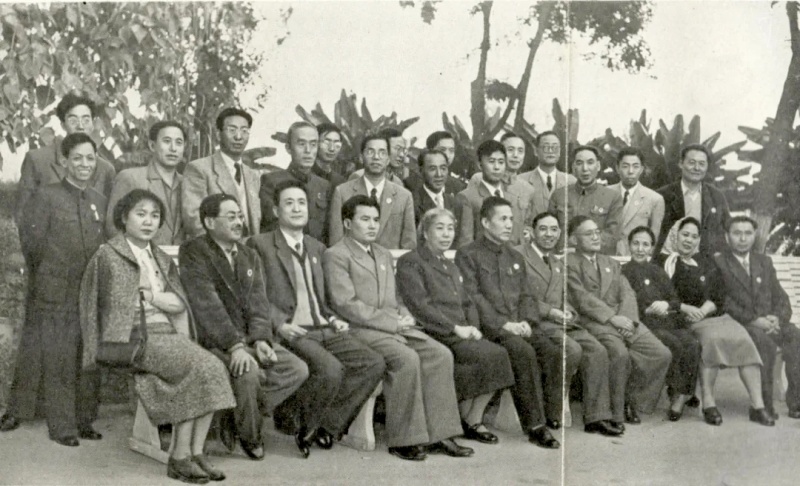
FILE PHOTO: Members of the Chinese delegation pose for a group portrait at the First Afro-Asian Writers’ Conference in Tashkent in 1958.
The Afro-Asian-Latin American literary translation movement was an international effort in the 1950s and 1960s to translate literature from Asia, Africa, and Latin America and bring it to a wider readership. Led by the Soviet Union and China, it swept across all three regions and rallied large numbers of progressive intellectuals in the West around a common struggle against imperialism and hegemony. The movement lent support to the international political struggles of socialist and Third World countries and gave shape to a new type of “world literature.”
Postwar rise of a literary translation movement
After World War II, newly established states in Asia, Africa, and Latin America set about developing their national economies and pursuing independent, self-reliant paths to modernization.
At the 1955 Bandung Conference, delegates adopted a communiqué addressing economic and cultural cooperation, as well as the promotion of world peace and international cooperation. In setting out this agenda, the delegates sought to deepen cultural exchange among the countries and peoples of Asia, Africa, and Latin America.
The First Afro-Asian Writers’ Conference, held in 1958 in Tashkent, then the capital of the Uzbek Soviet Socialist Republic, produced two significant points of consensus. The delegates recognized the advances made by Asian and African literatures and cultures and the role they played in advancing human progress, fighting for national independence, resisting colonialism, and defending freedom and world peace. They also pledged to strengthen cultural ties among the peoples of Asia and Africa and between them and the West. After the conference, Third World countries including China and India established the Afro-Asian Writers’ Bureau. The bureau organized a series of Afro-Asian writers’ conferences, each with a distinct theme, launched the literary journal Lotus to publish translations of literature from Asia, Africa, and Latin America, and established the Lotus Prize for Literature. These initiatives had a far-reaching impact across all three regions and in the West.
Between 1958 and 1966, delegations of Chinese writers attended successive Afro-Asian Writers’ Conferences and preparatory meetings in Moscow, Tashkent, Colombo, Cairo, and elsewhere. They also translated and introduced a substantial body of literature from Asia, Africa, and Latin America. In early 1959, the journal Yiwen (Translations) was renamed World Literature and became a major international outlet for the movement. From 1959 to 1962, World Literature published translations of 380 works of poetry and prose by Asian and African writers, while The Writers Publishing House issued individual poetry collections by writers from Guinea, Indonesia, Sudan, Vietnam, and elsewhere in Asia, Africa, and Latin America. Chinese writers and translators used literature to support African struggles for national liberation from colonial rule. By bringing works about those struggles to Chinese readers, they also helped deepen mutual understanding between the Chinese people and the peoples of Asia, Africa, and Latin America.
During this period, Chinese writers and translators also forged close ties with Latin American literary circles. Pablo Neruda visited Beijing in 1951. Between 1951 and 1952, Latin Americans made up one-third of the delegates to the Asia-Pacific Peace Conference hosted by the newly founded People’s Republic of China.
The movement and the making of a new ‘world literature’
The Afro-Asian-Latin American literary translation movement formed a significant strand of the broader campaign for world peace.
Writers, artists, and intellectuals around the world took part in large numbers. Writing, translating, and sharing literature deepened understanding and trust among the peoples of Asia, Africa, and Latin America and between them and the West, forging cultural ties across national and regional boundaries. Through their writing and exchanges, participants supported socialist and Third World countries in their international political struggles and took an active part in national liberation movements around the world. Amid U.S. threats of nuclear war against the Soviet Union and China and during the War to Resist U.S. Aggression and Aid Korea, Chinese writers and cultural figures led by Guo Moruo and Mao Dun used international forums such as the World Peace Council and the Afro-Asian Writers’ Conferences to rally people across Asia, Africa, Latin America, and beyond against those threats and what they described as “bacteriological warfare” on the Korean battlefield. The African American writer W. E. B. Du Bois and the British scientist Joseph Needham were among those who answered the appeal. On repeated visits to China, Du Bois and Neruda met many ordinary Chinese people, came to feel a deep sympathy for them, and formed lasting friendships with Guo Moruo, Ai Qing, and other Chinese writers.
The Afro-Asian Writers’ Bureau organized translation projects and cultural exchanges on a large scale, bringing together Asian and African writers and their counterparts from the newly independent Latin American states. Their work brought Third World literature to a much wider international audience. Many writers from these regions first came to prominence in the Chinese and foreign-language editions of In Defence of Peace, a journal founded by the World Peace Council and published under various titles, or in the English-language editions of Chinese Literature and Peking Review. These publications carried a wealth of poetry, fiction, drama, and prose that chronicled national independence movements across Asia, Africa, and Latin America and portrayed the newfound well-being of people who had shaken off colonial rule. Drawing on the distinctive histories, everyday experiences, customs, and sensibilities of these societies, writers and translators sought to fashion a “new person.” Their efforts spurred literary invention and production across the Third World, giving rise to literary concepts, forms of expression, and artistic styles distinct from Western literary traditions and opening up new possibilities for a new “world literature.”
Drawing on the movement’s legacy
Under the direction of Guo Moruo, Mao Dun, Zhou Yang, and others who held leading posts in the World Peace Council, the Afro-Asian Writers’ Bureau, and the Chinese Writers Association, Yiwen published special issues on Egyptian literature, Latin American poetry, the literatures of Asian countries, and the literatures of Afro-Asian countries. At the same time, translations of literature from all three regions appeared in numerous standalone volumes and book series, becoming a hallmark of literary translation in the early years of the PRC. These publications marked the beginnings of the translation and study of foreign literature in the new republic and gave its own literary writing a distinct political and aesthetic direction. They helped advance socialist culture and contemporary Chinese literature and represented an early attempt to chart a distinctive Chinese path to modernization and the development of a socialist culture.
Through the movement, Chinese theories of people’s literature and art, along with works of literary criticism, reached readers elsewhere in Asia, Africa, and Latin America through translation. These works helped shape how a generation of writers saw the world and understood literature. The widely respected Indonesian writer Pramoedya Ananta Toer visited China several times and developed a deep attachment to the country. Inspired by Mao Zedong’s conception of people’s literature and art, he abandoned his aristocratic literary outlook, immersed himself in everyday life in Indonesia, and began writing from the perspective of ordinary people. He arranged for the translation and publication of Mao’s “Talks at the Yan’an Forum on Literature and Art,” along with works by Lu Xun, Ding Ling, Mao Dun, and others that gave ordinary people a central place. These publications influenced many scholars and writers.
The movement was animated by the belief that literature could shape a “new person.” As the Indian writer Mulk Raj Anand put it, “Our literature and arts are thus the weapons of the new concepts of man—that the suppressed, disinherited and the insulted of Asia and Africa can rise to live, in brotherhood with other men.” Writers across the postwar Third World shared the hope that literature could help bring this new kind of person into being. They believed that translating and circulating literature from Asia, Africa, and Latin America would reshape the world they lived in. In their view, only the figure of the “new person”—someone who resisted oppression, hegemony, and discrimination and prized equality, freedom, and independence—could truly give voice to the interests, feelings, and aspirations of people across the Global South.
Throughout the movement, the Chinese government and figures in China’s intellectual and cultural circles maintained an independent position. They set the agendas of successive Afro-Asian Writers’ Conferences, promoted translations of literature from Asia, Africa, and Latin America, and funded literary projects and exchanges that helped people in those regions resist Western cultural hegemony. Through these efforts, China demonstrated its cultural leadership and international influence. Changes unseen in a century are now unfolding at an accelerating pace. As the international cultural landscape shifts, China should draw on the rich experience of the Afro?Asian?Latin American literary translation movement of the 1950s and 1960s to articulate its own perspectives and develop its own terms of debate in literary, historical, and international studies. That work would help China take the initiative in building an independent knowledge system for Chinese philosophy and the social sciences.
Liang Zhan is a research fellow from the Institute of World History at the Chinese Academy of Social Sciences.
Editor:Yu Hui
Copyright©2026 CSSN All Rights Reserved