


Open science in psychology: The Chinese experience
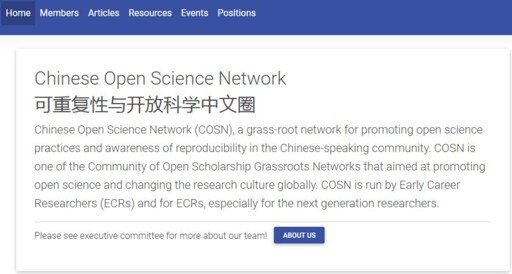
FILE PHOTO: Chinese Open Science Network (COSN), a grassroots network dedicated to promoting open science practices within the Chinese-speaking academic community
Open science is increasingly becoming a global movement driving transformations in research paradigms. The UNESCO Recommendation on Open Science, released in 2021, marked its recognition as a matter of global consensus. In psychology, prompted by the “replicability crisis,” an open science movement had already been initiated before international organizations formally began to advocate for it. This movement has generated a set of principles, practices, and standards spanning the entire research lifecycle, positioning psychology as a forerunner of the open science movement. However, in reality, open science ideas and related approaches in psychology have largely been developed and disseminated within academic systems in Western developed countries, where English is the dominant language.
To truly realize the vision of open science as a public good that benefits all humanity, broader participation by researchers in developing countries is essential. Building on their distinctive social, economic, and cultural contexts, these researchers must explore locally grounded pathways to open science. Chinese psychology researchers, in particular, need to actively develop a Chinese approach to open science, articulate Chinese perspectives, and, together with scholars from other developing countries, contribute Global South experiences to the international open science enterprise.
Rise of open science community in China
Over the past decade, young Chinese researchers have formed an online, Chinese-language open science community—the Chinese Open Science Network (COSN)—leveraging the internet to promote open, rigorous, and reproducible research through knowledge sharing, skills training, and scholarly collaboration. Since its inception, COSN has already exerted a broad influence within China’s psychological research community.
This localized practice has also gained strong recognition from the international academic community. That recognition is reflected in COSN’s inclusion in UNESCO’s 2023 Open Science Outlook report and in the commendation it received from the Society for the Improvement of Psychological Science (SIPS). COSN members have also been repeatedly invited to deliver oral presentations at international conferences, including the 4th United Nations Open Science and Open Scholarship Conference in 2025, and have published articles in several leading international journals.
The success of COSN reflects a multi-level, multi-actor response to open science that has emerged across Chinese society in recent years. These efforts range from principled policy support articulated in national documents—such as the Law of the People’s Republic of China on Progress of Science and Technology and the 2024–2035 master plan on building China into a leading country in education—to international initiatives such as the Initiative on International Cooperation in Open Science jointly launched by China with Brazil, South Africa, and the African Union, as well as the development of online scholarly platforms such as ChinaXiv and ScienceDB. They also encompass consensus-building efforts within academic communities—such as the Xiangshan Initiative on Implementing Open Science and the Suzhou Initiative for Open Science in Psychology—as well as annual academic events such as OA-Weekly. Together, these initiatives have facilitated the localization of open science in China.
Pathway for open science participation in developing countries
Drawing on their own experience and the shared challenges faced by scholars in developing countries, COSN members have recently proposed a four-level, step-by-step pathway for open science participation tailored to researchers in such contexts.
Level 1: “Survival.” When researchers are operating under conditions of relative resource scarcity, they can make full use of existing open scholarly resources to lay the groundwork for rigorous research. First, open-access repositories such as arXiv, PsyArXiv, and Zenodo provide access to articles, preprints, and postprints, enabling researchers to stay abreast of global academic developments. Second, open science platforms such as the Open Science Framework (OSF), Zenodo, Figshare, and OpenNeuro offer access to research data, code, and materials that can directly support researchers’ own work. Third, open-source software (e.g., JASP, Jamovi) and open-source hardware (e.g., OpenBCI) can further reduce research costs. Fourth, openly accessible teaching and training materials allow researchers to learn and apply rapidly evolving research methods at low cost. For example, the R programming language has become one of the most important data analysis tools in the social sciences, and open-source projects such as bookdown.org provide extensive learning resources.
Level 2: “Development.” Once researchers are able to secure basic scholarly output by leveraging open research resources, they can further integrate open science practices into their own research workflows in a context-sensitive manner, progressively enhancing transparency and rigor. First, for newer practices such as pre-registration and registered reports, researchers can address concerns and misconceptions through learning and hands-on experience—for example, by starting with relatively simple projects such as direct replication studies, or by joining large-scale collaborative projects that adopt registered reports. Second, researchers can gradually improve the reproducibility of their work by effectively organizing file systems, using codebooks to document variables, recording scripts, computational environments, and software versions, or even achieving full reproducibility through tools such as Docker. Third, making one’s papers and data openly accessible can enhance research visibility and impact. Publishing via open access expands readership and increases scholarly influence. When funding is limited, Diamond OA—which involves no article processing charges or access fees—and Green OA—which allows authors to share their work in open repositories such as PsyArXiv or Zenodo—are viable options.
Level 3: “Ecosystem building.” For researchers with substantial skill and experience in open science practices, contributing to the scholarly community can further amplify their academic impact. First, researchers can examine the reproducibility of data analyses in published studies by testing computational reproducibility; where feasible, they can also conduct direct replications or join large-scale replication projects. Second, they can engage in metascience research to evaluate and reflect on prevailing research practices and findings within their discipline, offering insights grounded in national or regional contexts. Third, researchers can contribute to open-source software development by improving documentation, adding new functionalities (e.g., dockerHDDM), or developing new packages or standalone tools (e.g., xSample, bruceR, PsyCalibrator). Fourth, small-scale open science repositories can be created to address the specific needs of particular countries or regions. Fifth, joining or organizing open science communities and activities helps strengthen the broader ecosystem and facilitates the diffusion of open science practices.
Level 4: “Changing the climate.” Early-career researchers can leverage the internet to form grassroots networks that help shift academic norms. They may begin by joining existing open science communities such as the Society for the Improvement of Psychological Science or the Framework for Open and Reproducible Research Training (FORRT). Where active open science communities are lacking, they can also initiate new, theme-focused communities. Senior researchers, meanwhile, can leverage their roles as decision-makers and rule-setters to reform academic incentive structures by embedding open science principles into education, supervision, peer review, funding, and hiring policies, thereby driving broader cultural change in research.
Recognizing hidden costs, risks
While embracing the opportunities offered by open science, researchers in developing countries must also recognize the hidden costs and risks embedded in current open science practices. First, open science often entails substantial hidden time and financial costs. For example, although the registered report model enhances rigor and transparency, its review process differs from traditional publication models and requires a significant upfront investment of time. Similarly, properly curating, annotating, and sharing data demands considerable time and labor. Researchers should therefore decide when and which open science practices to adopt based on their available resources and career goals, rather than pursuing “perfect” openness indiscriminately.
Second, while cross-national collaboration promoted by open science ideally fosters more equitable partnerships, in practice it can exacerbate existing power asymmetries within academia. Researchers from developed countries may dominate collaborations due to greater access to resources and technical expertise, relegating researchers from developing countries to the role of mere data collectors, with limited influence over research design, analytical strategies, or manuscript preparation. In such forms of “helicopter research,” scholars from the Global South often struggle to achieve meaningful academic development. In more extreme cases, “ethics dumping” may occur, whereby researchers from developed countries exploit weaker ethical review and regulatory frameworks in developing countries to conduct high-risk studies that would not be permitted in their home countries, potentially harming local communities and participants. Mitigating these risks requires the establishment of more equitable and transparent international collaboration mechanisms, ensuring that Global South researchers participate as equal partners throughout the research process, alongside strengthened cross-national oversight of research ethics.
Global implications of China’s open science practices
The open science practices of young Chinese psychology researchers—and their leadership within developing-country research contexts—offer three key lessons for the global open science movement, particularly in the Global South.
First, the self-organizing vitality of researcher-led open science communities is a critical driving force. In periods when institutional support remains underdeveloped, grassroots networks led by early-career researchers and closely aligned with frontline research needs can become the most dynamic agents of idea diffusion and practice change, owing to their flexibility, low cost, and intrinsic motivation.
Second, creative localization is essential. Successful open science practices are never simple replicas of Western models. The use of the WeChat ecosystem by young Chinese psychology researchers for knowledge dissemination illustrates the necessity and effectiveness of integrating global principles with local conditions and cultural infrastructures.
Third, South–South cooperation and knowledge sharing provide effective pathways for overcoming structural constraints. Open Science in the Developing World: A Collection of Practical Guides for Researchers in Developing Countries—a practice-oriented guide led by the author and co-developed by researchers from 20 developing countries—represents a successful example of South–South collaboration in open science. Its publication demonstrates that through collective action and shared knowledge, researchers in developing countries can jointly define standards, contribute solutions, and transform their role in global scientific governance—from passive recipients to active creators and leaders.
Hu Chuanpeng is a professor from the School of Psychology at Nanjing Normal University.
Editor:Yu Hui
Copyright©2023 CSSN All Rights Reserved