


Ferry landings as geographical memory anchors of Yangtze River culture
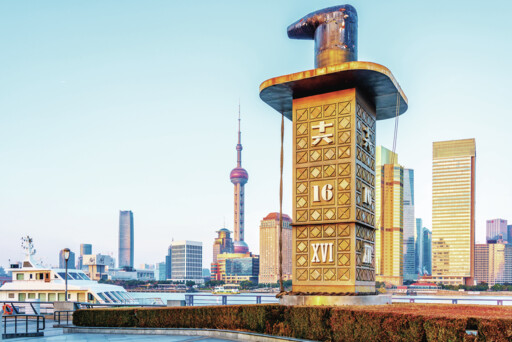
Shiliupu Wharf connects China with the world. Photo: TUCHONG
In the early stages of human history, communities took shape along waterways, with ferry landings and riverbanks serving as focal points where fishing, hunting, and agrarian cultures emerged. This “ferry space,” organized around ferries, landings, and crossings, evolved through processes of settlement, cultural encounter, and historical accumulation, gradually becoming a memory anchor of Yangtze River culture. Ferry landings offer spatial points of convergence for diverse cultural elements, while ferries themselves function as mobile narratives through which Yangtze River culture is disseminated, linking local memory with basin-wide cultural experience. As memory anchors, ferry landings crystallize core recollections of settlement origins and transportation hubs; as sites of memory, they enable the circulation of people and goods, through which local urban culture and folk traditions are transmitted. The stable material foundation provided by these anchoring sites allows them to serve as recognizable media of cultural transmission, while the mobility and convergence inherent in ferry activity promote cultural integration, in turn deepening and expanding the layers of memory associated with these places. In this sense, ferry landings “anchor” flowing time and dispersed cultural information within a concrete spatial setting, becoming key reference points through which individuals and communities construct identity and interpret the cultural trajectories of the Yangtze River.
Fixity of material space
The fixity of ferry space constitutes the primary precondition for its role as a memory anchor. Through their immobile material form, ferry landings provide a stable geographical foundation for the convergence of diverse strands of Yangtze River culture. This fixity—expressed in the stability of geographical coordinates, the continuity of infrastructural configurations, and the persistence of spatial functions—underpins the roles of ferry landings as sites of origin, aggregation, and cultural transmission.
From the perspective of geographical coordinates, ferry landings along the Yangtze River are often located at fixed natural sites, such as stable shorelines and bends in the river channel, forming spatial markers that have remained unchanged for centuries. A representative example is the ancient Xijin ferry landing in Zhenjiang, Jiangsu Province, which, situated along the lower reaches of the Yangtze, has long functioned as a fixed hub linking different regions of the river basin. The fixity of such geographical coordinates renders ferry landings locatable and traceable cultural nodes within the Yangtze water network, providing material foundations—such as access to resources and information—for the emergence and development of cities and towns.
In terms of infrastructural configuration, physical elements such as wharf stone steps, station buildings and clock towers provide the structural support that enables ferry landings to function as memory anchors. At the ferry landing in Anqing, Anhui Province, for example, the Zhenfeng Pagoda—known as the “first pagoda along the ten-thousand-li Yangtze River”—together with the Yingjiang Temple, has remained in continuous use since the Ming Dynasty (1368–1644), serving as a physical space in which diverse religious cultures converge. Integrating Huizhou architectural craftsmanship with Buddhist art, this complex also accommodates multiple functions, including navigation, river viewing, prayer, and literary gathering. Through such fixed spatial anchoring, ferry landings become beacons of memory amid the repeated reshaping of the surrounding landscape, allowing cultural interaction to precipitate into a stable sense of spatial attachment.
In terms of spatial function, the core role of ferry landings in enabling water–land transition and cross-regional connectivity has never been erased by historical change; rather, it has continually expanded and adapted across different periods. From serving in antiquity as hubs of grain transport and relay stations, to functioning in the modern era as centers of commerce and migration, and further evolving in the present day into tourism destinations and cultural landmarks, ferry landings have consistently fulfilled their essential functions of connection and transfer. This continuity—whether sustained or reconfigured—ensures the persistence of cultural transmission: In antiquity, official rites and mercantile ethics were disseminated through canal transport; in the modern period, industrial civilization and urban culture spread via shipping networks; and in contemporary times, local spirit and intangible cultural heritage are conveyed through tourism. As memory anchors, ferry landings are continuously renewed within specific spatial contexts, becoming physical conduits through which Yangtze River culture is transmitted across historical epochs.
Condensability of temporal memory
The condensability of collective memory constitutes the core meaning of the memory anchor. By inscribing historical events, cultural customs, and social emotions from different periods, ferry landings transform the flow of time into perceptible forms of collective memory. This process of condensation corresponds closely to their roles as sites of origin, aggregation, and transmission, thereby shaping the temporal genealogy of Yangtze River culture.
As sites of origin, ferry landings condense the foundational memories of settlement civilization. The emergence of many towns and cities in the Yangtze River basin is closely linked to ferry crossings. For instance, the Chaotianmen ferry landing in Chongqing bears witness to the transformation of Bayu culture from a dock-centered to a trading culture. Through the fixed spatial form of ferry landings, the origins of settlement are permanently condensed into memory. Material remains such as ancient wharves, historic urban streets, and time-honored shops, together with intangible legacies including orally transmitted legends and local chronicles, collectively constitute a nostalgia-infused memory of “ferry towns and homeland settlements.” These memories function as temporal reference points for identifying the cultural roots of the Yangtze River.
As sites of aggregation, ferry landings condense interactive memories formed through multicultural encounters. Populations from different periods and regions converge at ferry crossings, continually accumulating cultural memories generated through their interactions. During the Tang (618–907) and Song (960–1279) dynasties, for example, Sichuan brocade from the upper reaches of the Yangtze and silk from the lower reaches were traded via ferry crossings, giving rise to memories of transregional commerce. Beginning in the modern period, Western culture entered the hinterland through riverside ferry crossings, generating memories of Sino–Western collision. These memories do not exist in isolation but overlap within ferry space. Hankou in Wuhan, Hubei Province, for instance, preserves traces of the ancient Tea Road, records memories of treaty-port opening and foreign trade in the modern period, and bears witness to the developmental history of modern shipping. The accumulation of these layered memories renders ferry landings historical witnesses to the inclusiveness of Yangtze River culture.
As sites of transmission, ferry landings condense processual memories of cultural diffusion. Both the tangible and intangible elements of Yangtze River culture are disseminated across regions and historical periods through ferry crossings, with the processes of transmission crystallizing into concrete mnemonic symbols. Steering techniques and hydrological knowledge associated with navigational culture, for example, are consolidated into professional memory through generational transmission among boatmen, while dockside snacks and commercial ethics embedded in everyday life are preserved as lived memory through the inheritance of time-honored brands. These collective mnemonic symbols transcend temporal boundaries and are continually reactivated and reinforced within ferry space. From ancient rituals of prayer to contemporary cultural performances, they are transmitted across regions and generations through the fixed spatial form of ferry landings, becoming a temporal bond that sustains the unity of Yangtze River culture.
Directionality of cultural meaning
The directionality of cultural meaning represents the ultimate value of the memory anchor. By articulating clearly defined cultural meanings, ferry landings bring together diverse cultural memories into a shared identification with Yangtze River culture. This directional quality is realized through their practical roles as sites of origin, aggregation, and transmission, achieving a dialectical unity between plural coexistence and integrated cohesion.
In its meaning as a site of origin, ferry landings embody locally grounded cultural wisdom and a shared value orientation. Although regional cultures along the Yangtze River possess distinct characteristics, many form concentric cultural identities, with ferry landings as their central points. In the modern period, for example, Shanghai’s Haipai culture takes Shiliupu Wharf along the Bund as a key marker of origin. This ferry-grounded local wisdom and value orientation enable different regional cultures to achieve shared value recognition and cultural consensus when tracing their origins. Despite regional differences, they all partake in a common Yangtze logic of waterfront settlement—“thriving by following the water and gathering by means of the ferry.”
In its meaning as a site of aggregation, ferry landings embody the core value of cultural inclusiveness. Within their associated spaces, official and folk cultures, indigenous and external traditions, and elite and everyday forms of life converge and intermingle, giving rise to a cultural character of “inclusive coexistence.” Historic ferry landings across the region have witnessed the ritual norms associated with state-organized grain transport while simultaneously nurturing the spiritual beliefs of popular commerce; they have preserved the refined poetic sensibilities of literati while sustaining the everyday lives of dockworkers. This orientation toward plural coexistence renders ferry landings a concentrated expression of the inclusiveness inherent in Yangtze River culture.
In its meaning as a site of transmission, the ferry landings embody their value as integrative connective nexus points. The diverse cultural genes of the Yangtze River are disseminated across regions via ferry, ultimately forming a cultural configuration of basin-wide integration. When upper-reach Ba-Shu culture is transmitted downstream by ferry along the Jinsha and Min rivers, it encounters and merges with Jingchu culture in the middle reaches and Wu–Yue culture in the lower reaches. This orientation toward cross-regional linkage positions the ferry as a vehicle for the integrated transmission of Yangtze River culture; at the same time, the dissemination and realization of Yangtze cultural values remain deeply rooted in the memories and narratives embedded within ferry space.
In fact, the memory anchor and the narrative carrier together constitute the dual media through which ferry crossings decode Yangtze River culture. The memories fixed by the anchor provide substantive content for cultural narratives, while the circulation of narratives continuously absorbs new cultural elements, in turn feeding back into and enriching the mnemonic connotations of the anchor. In other words, the ferry functions as a core memory anchor of Yangtze River culture, offering a stable point of reference for its cultural narratives and thereby endowing fluid narratives with a reliable foundation.
As memory anchors in their role as sites of origin, ferry landings initiate narratives of urban development and cultural genesis; as memory anchors in their role as sites of aggregation, they foreground the central theme of cultural convergence and symbiosis within Yangtze River culture; and as memory anchors in their role as sites of transmission, they link the narrative of Yangtze River culture as an integrated whole. This narrative system directly echoes the cultural values of cross-regional transmission discussed above. The dialectical relationships between space and culture, and between memory and narrative, together constitute the complete logic underlying ferry space as an anchor of Yangtze River culture.
In sum, ferry landings are not merely transportation hubs or nodes of settlement, but cultural fields. Within these fields, diverse material civilizations, patterns of social practice, and intellectuall worlds from the upper and lower reaches of the Yangtze River, as well as from its northern and southern banks, come into contact, interact, and merge. Through this process, they ultimately coalesce into a shared and mutually recognized cultural temperament and emotional structure, vividly articulating and powerfully sustaining the broader vision of Yangtze River culture as one of plural coexistence and civilizational unity.
Lu Shaoming is a distinguished professor from the School of Design at Shanghai Jiao Tong University.
Editor:Yu Hui
Copyright©2023 CSSN All Rights Reserved