


On the mission of psychology: Where people’s hearts go, where the great way leads
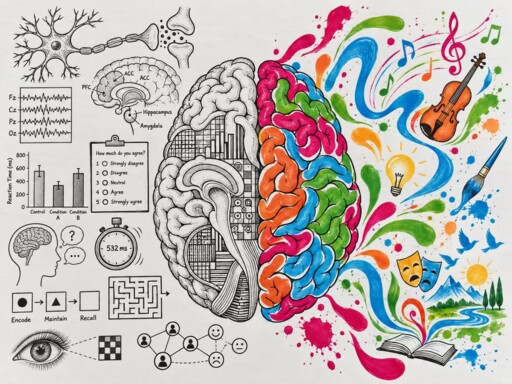
Grounding psychological research in people’s psychological lives and contemporary social realities can contribute to building an independent knowledge system for psychology. Image generated by AI
Textbooks generally define psychology as the science that studies the laws governing mind and behavior. This disciplinary definition was introduced from the West and has taken shape through psychology’s historical development. Although it broadly delineates the field of psychological research, it risks remaining superficial and is somewhat removed from Chinese tradition and contemporary realities. Psychology’s disciplinary mission therefore needs to be re-examined from a political standpoint, taking into account both the generality of psychological knowledge and its grounding in social reality.
Understanding mind, guiding action
Psychology should not only study the general laws governing the human mind and behavior, but also investigate the specific manifestations and mechanisms of the people’s psychological life, so as to better serve China’s efforts to promote psychological well-being. The people’s aspiration for a better life, as well as their thoughts, concerns, expectations, and hopes at every stage and in every aspect, should all be subjects of psychological research.
One of the core issues in studying the people’s psychology is “where their hearts go,” that is, the mechanisms and direction of mental activity. It requires exploring both the principles of the mind at the concrete level and the way of the mind at the metaphysical level. Psychology is not only a discipline of understanding, but also one of action.
The second core issue is “where the great way leads”—meaning that psychology cannot stop at explaining psychological phenomena, but must go further to seek solutions and explore where the great way lies and how to follow it. “Where people’s hearts go” concerns the mind, while “where the great way leads” concerns the principles that guide behavior and action. Just as pathways are made by people walking them, the essence of a path lies in putting it into practice. Building on an understanding of the laws governing mental activity, psychology should scientifically devise and implement courses of action to enhance the people’s psychological well-being. In summary, the disciplinary mission of psychology can be encapsulated as follows: “Where people’s hearts go, where the great way leads.” In other words, the mission of psychology is to ascertain “where people’s hearts go” and, on that basis, determine “where the great way leads,” clarifying the direction of individual and social action.
Seeking truth, pursuing highest good
The disciplinary mission of “where people’s hearts go, where the great way leads” also carries methodological implications for research. Research on “where people’s hearts go” aims to seek truth, following the principle of seeking truth from facts and employing scientific rationality to reveal and explain the necessary laws governing mental activity through logical, empirical, and mathematical methods, thereby answering factual questions such as what something is and why it occurs. Research on “where the great way leads” aims to attain the highest good, guided by moral values and practical rationality to address normative questions of what should be done and how it should be done through practical experience, value judgment, and normative guidance. Just as the natural world has objective laws independent of human will, the human mental world is likewise governed by objective laws. Both self-management and social governance must respect the objective laws governing mind and behavior, allowing people to follow their hearts without overstepping proper bounds and enabling governance that works with, rather than against, the human mind. Although psychological research begins with the scientific rationality of seeking truth, it must ultimately lead to the practical rationality of attaining the highest good, thereby integrating the two in a scholarly ideal in which “the human heart ultimately turns to the way and righteousness.”
Cultivating psychology professionals
The disciplinary mission of “where people’s hearts go, where the great way leads” also shapes the goals of education. We can illustrate this with the framework for training psychology professionals developed by the author for his institution. This framework, called the Make-I-Talent (MIT) model, comprises six core concepts.
The first is mission—cultivating pillars of national rejuvenation and pioneers of a strong nation. The second is ability—including research and practical competence. The third is knowledge—encompassing both theoretical and methodological knowledge. The fourth is ethics—cultivating inner virtue and expressing it through outward conduct. The fifth is insight—fostering students’ core professional capacity to understand human nature and discern the workings of the human mind. The sixth is talent—developing the preceding five core qualities to cultivate both academic and applied professionals.
The task of teaching is, on the one hand, to guide students to master the knowledge, abilities, and insights concerning “where people’s hearts go,” and on the other hand, to cultivate their moral courage and sense of mission regarding “where the great way leads.” With these core qualities, students can become the capable professionals needed in both academic and practical fields. When psychology graduates build their careers across the country, they must continue to discern the laws of “where people’s hearts go” with keen insight and embark on the journey of “where the great way leads” with courage.
The disciplinary mission of “where people’s hearts go, where the great way leads” also points to the possibility of establishing a unified science of mind encompassing human and artificial intelligence. As artificial intelligence advances at an accelerating pace, how can humanity achieve faster cognitive evolution? How can we avoid becoming less intelligent through cognitive outsourcing? How can we ensure continued control over another form of intelligence of our own creation? These are all core scientific questions for psychology or the science of mind to explain and address. We need to understand them by examining the relationship between the human mind and the external world, as well as the evolution of that relationship. In the beginning, heaven and earth had no mind; after the emergence of humanity, humans became the mind of heaven and earth. Now that human intelligence has evolved to such an extent, we may finally be able to truly “establish a mind for heaven and earth,” enabling the external world itself to possess forms of mind. When the Northern Song (960–1127) thinker Zhang Zai (1020-1077) proposed “ordaining conscience for heaven and earth,” he was still referring to the human mind, highlighting humanity’s subjective agency in the universe. It was, moreover, a purely metaphysical philosophical proposition. Today, “ordaining conscience for heaven and earth” means imparting to external things forms of advanced intelligence and subjectivity once exclusive to humans. This is a tangible scientific task, as well as a philosophical question concerning the essence of human nature and the boundary between the human mind and external things.
Whether the mind we create for silicon-based beings can remain aligned with the values of human society, and whether the silicon-based mind will develop its own subjectivity and value choices, have become challenges to human survival and threats to human dignity. Traditionally, psychology has mainly studied “where people’s hearts go, where the great way leads” in relation to carbon-based life. Today, it may also be necessary to explore whether silicon-based beings (intelligent agents) will have their own equivalents of “where people’s hearts go” and “where the great way leads.” In short, we need to establish a unified science of mind for human and artificial intelligence, thereby expanding the disciplinary boundaries of psychology. Both human populations and individuals undergo a process of cognitive development from embodied experience to reflexive abstraction, thereby advancing and expanding their intelligence. Hopefully, humanity’s reflective thinking today will prove deep enough to preserve some final advantage of the human mind, rather than allowing us to be undone by our own cleverness—or by what that cleverness has created.
In conclusion, by taking “where people’s hearts go, where the great way leads” as both a central research question and the disciplinary mission of psychology, we can better understand the internal logic of the discipline, its relationship with the practical needs of society, and the scientific questions shared by human and artificial intelligence. A scientific methodology that gives due weight to both seeking truth and attaining the highest good can guide basic and applied research while cultivating a new generation capable of discerning “where people’s hearts go” and having the courage to follow “where the great way leads.”
Xin Ziqiang is a professor from the Department of Psychology at Renmin University of China.
Editor:Yu Hui
Copyright©2026 CSSN All Rights Reserved