


Role of Chinese philosophy in digital age
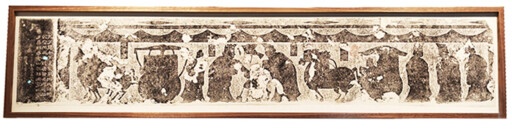
A Qing-dynasty rubbing of the stone relief Confucius Meeting Laozi, unearthed in Shandong Province, on display at the Henan Museum in Zhengzhou, Henan Province, Dec. 20, 2025. Photo: IC PHOTO
In the 21st century, digitalization has become an irreversible trend, as the emergence of digital technology has profoundly reshaped the ways human beings live and interact. On the one hand, the conveniences brought by new technologies are widely enjoyed, along with the freedom and vitality associated with virtual forms of existence. On the other hand, fragmentation of everyday life and a loss of wholeness have become increasingly evident, accompanied by disorientation amid pluralistic values and competing belief systems. In some cases, this condition even leads to forms of technological worship and technological domination.
From its earliest stages, Chinese philosophy has sought to establish meaning and value for human existence. As historical circumstances have evolved, it has taken on different forms while continually expanding its intellectual horizons through disciplinary development. In the contemporary context of rapid digital development and the pervasive application of technology, the question of what role Chinese philosophy should assume—and what kind of influence it could continue to exert—deserve careful reflection.
Drawing wisdom from cultural tradition
Traditional Chinese philosophy reflects two major orientations toward technology: “governing technique through the Dao” and “the Dao advancing into technique” (Dao, a fundamental concept in traditional Chinese philosophy, can mean “way,” “path,” “principle,” or the natural “order” governing the universe). Among ancient Chinese philosophers, some emphasized that the improper use of technique could undermine personal harmony and social stability. Mencius, for example, cautioned that “the choice of a profession, therefore, is a thing in which great caution is required.”
Other thinkers argued that the application of technique can be compatible with moral principles and even integrated with them. For instance, Zhuangzi wrote: “Therefore that which pervades (the action of) Heaven and Earth is (this one) attribute; that which operates in all things is (this one) course; that by which their superiors govern the people is the business (of the various departments); and that by which aptitude is given to ability is skill. The skill was manifested in all the (departments of) business; those departments were all administered in righteousness; the righteousness was (the outflow of) the natural virtue; the virtue was manifested according to the Dao; and the Dao was according to (the pattern of) Heaven.”
Whether emphasizing the governance of technique by the Dao or the integration of the Dao with technique, Chinese philosophical reflections on technology offer valuable insights for contemporary society in coordinating the relationships between human beings and things, body and mind, and humanity and nature. Yet the challenges facing the modern world extend beyond how digital technology should be understood and applied. They also involve responding to the deeper transformations brought about by the acceleration of modernity through digital technology and reconsidering how human existence and spiritual life might be reconstructed within a digital society.
Traditional Chinese philosophy places particular emphasis on deriving value from real life, practicing value in everyday activity, and guiding life through value-oriented reflection. The Confucian concern for everyday life is expressed socially and culturally through normative practices such as the “five cardinal relationships.” These practices establish order in daily life and allow individuals—often without conscious awareness—to cultivate meaning and wisdom. At the same time, they provide a form of assurance for the historical continuity and transmission of culture.
Daoist reflections on human nature and the ideal human condition differ from those of Confucianism, yet Daoist thought likewise opposes actions that damage or betray human nature and consistently upholds the pursuit of an ideal state of humanity. Moreover, both traditions avoid detachment from concrete reality, emphasizing instead the realization of ultimate concerns within the practices of everyday life.
Contemporary missions of Chinese philosophy
A digital society can be understood as an intensified form of technological society. The proliferation of instrumental rationality within a technological society has produced excessive individualism, materialism, utilitarianism, and opportunism. It has also contributed to alienated interpersonal relationships and heightened feelings of loneliness and anxiety—conditions that become even more pronounced in the digital age. Together, these tendencies manifest as value nihilism, the erosion of meaning, and the weakening of morality. The rational order of social existence is thereby disrupted, making the reconstruction of moral and value rationality an urgent task.
In confronting the universal problems of modernity that humanity faces in the digital age, a pressing challenge for contemporary scholars of Chinese philosophy is how to activate its practical significance under new historical conditions. How Chinese philosophy can remain rooted among ordinary people and, through reflection appropriate to the present era, interpret the old civilization in order to assist the new mandate, has become a central concern for the philosophical community.
First, Chinese philosophy should engage more deeply with the lifeworld of ordinary people, contributing experiential wisdom and practical insight. One defining feature of the digital age is virtual reality, which partially frees human activity from the material constraints of the physical world by imitating, reconstructing, extending, and supplementing it. Yet excessive dependence on virtual environments can obscure deeper human relationships and generate increasingly complex social problems.
In response to the “colonization” of the lifeworld by digital systems and the devaluation of the traditional substance of lived experience, Chinese philosophy can draw upon its character as a form of learning imbued with life experience and cultivated within the domain of lived experience. By encouraging active engagement with the lifeworld and emphasizing the realization of the Dao in daily conduct, it can offer intellectual resources for overcoming the estrangement between human beings and the world in the digital age, preventing individuals from becoming mere appendages of networks, and helping reconstruct a meaningful spiritual life.
Individuals may also draw from Chinese philosophy a source of independent and self-aware spiritual strength. While benefiting from the abundant information and expanded freedom made possible by digital technologies, individuals can avoid excessive dependence on networks and the attendant loss of the self, thereby reclaiming agency in everyday life.
Through the cultivation of relational ethics rooted in the Confucian idea of “benevolence that regards all as one,” along with the accumulation of emotional bonds formed through everyday interpersonal relations, individuals can partially overcome the estrangement and unfamiliarity associated with virtual existence. In this process they may gradually emerge from narrow, self-enclosed spaces, reintegrate into the real world, recover the capacity for genuine interaction and care, and develop a more vivid sense of individuality.
The ideal of “harmony through ritual and music” likewise offers support for reconstructing the order of life and value through families, communities, localities, and the nation. Such ideals help foster shared spiritual and cultural identities, alleviating the loss of meaning and deeper loneliness that can accompany a world increasingly mediated by digital symbols. The pursuit of ideal character and spiritual elevation may help modern individuals counter the tendencies toward simplification and superficiality, once again sensing the nobility and sacredness of ideals.
Second, the principle of “harmony without uniformity,” together with the Confucian ethic of reciprocity, should be emphasized in order to address conflicts of ethical values. Cyberspace should remain a pluralistic, open, and inclusive arena that embraces cultural differences and diverse ways of life. Individuals from different cultures and regions should seek moral consensus and aesthetic commonality that allow them to live together despite differing ethical perspectives.
A new digital-age morality centered on coexistence and inclusiveness can draw upon Confucian ideals of harmony without uniformity and the ethic of reciprocity, emphasizing respect for differences, tolerance of contradictions, and rational dialogue. Under such conditions, diverse tastes, voices, and emotions may be expressed freely, enabling human beings to develop more fully, richly, and authentically.
Confucian ethical thought further encourages moral self-reflection and responsibility through ideas such as “all people are my brothers and sisters and all things my companions,” “seeking common ground while preserving differences,” and “the unity of knowledge and action.” These concepts offer valuable resources for constructing modern interpersonal relationships and new ethical frameworks in contemporary society.
Third, it is necessary to integrate instrumental rationality with value rationality in order to overcome the logic of reification. One defining feature of the digital age is the alliance between digital technology and capital, which threatens human subjectivity while simultaneously drawing individuals into systems of competition driven by fame and profit.
The construction of a Digital China represents an inevitable trend of social development, allowing people to benefit from the convenience and intelligence made possible by digital technologies. Yet under the logic of capital, digital labor can increasingly alienate individuals and their cognitive activities, obscuring individuality and reducing human beings to abstract data. Society must therefore remain vigilant against collusion between digital technology and capital, transforming unequal relations of production so that digital technology becomes a constructive foundation for building a community with a shared future for humanity. Individuals, meanwhile, must cultivate creativity and innovation in order to resist marginalization and reification amid the expansion of capital. Through creative vitality, they can expand their life-world and meaning-world while shaping independent and integrated personalities.
Chinese philosophy—especially the Confucian tradition—places strong emphasis on value rationality and on the realization of life’s meaning and worth. In this respect, it offers intellectual resources for resisting the fragmentation of everyday life and the erosion of inner unity produced by specialization and technological domination in modern society.
By overcoming the logic of reification and allowing value rationality to guide instrumental rationality, the development of digital technology can become more humane. While affirming the importance of rational knowledge, Chinese philosophy also affirms the foundational place of moral virtue. In this way, it offers individuals a more comprehensive vision of the world and a stable basis for value, enabling them to illuminate virtue, cultivate righteousness, and pursue harmony in the Dao. Such a vision ultimately points toward the ultimate ideal of human liberation and the free and comprehensive development of all.
Wang Wenjuan is an associate professor from the School of Marxism at Beijing Institute of Technology. This article has been edited and excerpted from History of Chinese Philosophy, Issue 5, 2025.
Editor:Yu Hui
Copyright©2026 CSSN All Rights Reserved